
Claw machines are one of the most popular attractions in arcades, shopping malls, and family entertainment centers (FECs). While players often focus on choosing the right position and timing their grab, operators know that the real performance of a claw machine depends heavily on its internal settings.
Understanding claw machine settings helps arcade owners create a better balance between player experience, machine performance, and business operation.
Key settings such as claw strength, prize rate, and game difficulty determine how often players win, how challenging the game feels, and how attractive the machine remains over time.
For operators planning to purchase commercial claw machines, knowing these settings is also important when evaluating equipment suppliers and choosing the right configuration.
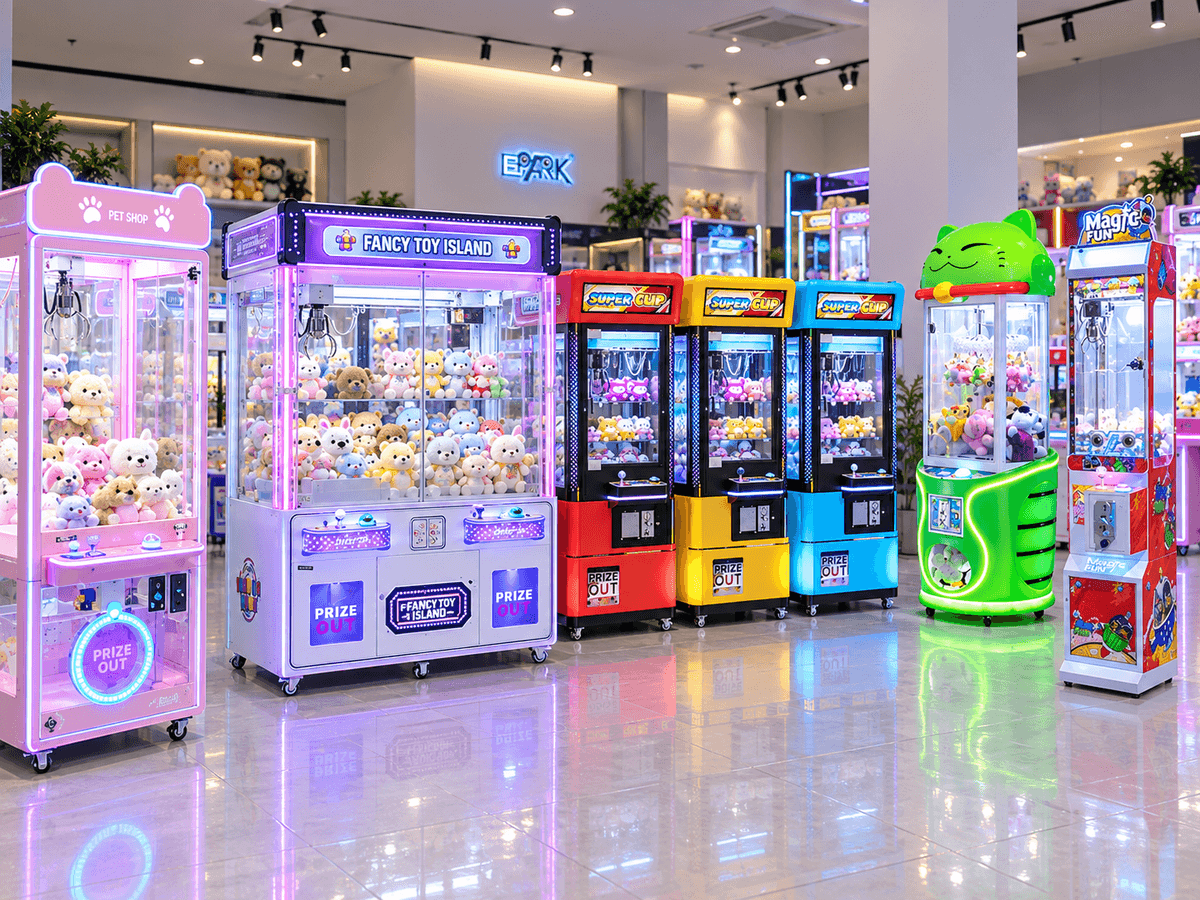
What Are Claw Machine Settings?
Claw machine settings refer to the adjustable parameters that control how the machine operates during gameplay.
Although different manufacturers may use different control systems, most commercial claw machines include several important settings:
| Setting | Function | Impact on Gameplay |
|---|---|---|
| Claw Strength | Controls grabbing power | Determines how firmly prizes can be held |
| Prize Rate | Controls winning frequency | Influences business revenue and player satisfaction |
| Game Time | Controls operation duration | Changes gameplay pressure |
| Drop Position | Controls claw movement accuracy | Affects difficulty |
| Motor Speed | Controls claw movement | Changes player experience |
These settings allow operators to adjust machines according to different locations, prize types, and customer groups.
For example, a family entertainment center may prefer a more balanced experience that encourages repeat visits, while a promotional event may use different settings to increase player engagement.
How Claw Strength Affects Gameplay
Claw strength is one of the most discussed claw machine settings.
Many players notice that the claw sometimes grips a prize strongly and sometimes appears weaker. This is usually related to how the machine controller manages power output.
What Is Claw Strength?
Claw strength refers to the amount of force generated when the claw closes around a prize.
A stronger claw can:
- Hold heavier prizes more securely;
- Improve the feeling of control;
- Increase the chance of successful grabs.
A weaker claw can:
- Make difficult prizes harder to win;
- Increase challenge;
- Reduce player satisfaction if incorrectly adjusted.
Commercial machines are generally designed with adjustable settings rather than a fixed grabbing force. This allows operators to match performance with prize size, weight, and business goals.
Why Correct Claw Strength Matters
From an operator perspective, the goal is not simply making the machine easier or harder.
A well-adjusted machine should:
- Provide achievable wins;
- Encourage continued play;
- Protect prize inventory;
- Maintain long-term customer interest.
Poor settings can create problems. If the claw is too weak, players may feel the machine is unfair. If it is too strong, prize costs may become difficult to manage.
Understanding Prize Rate and Payout Settings
Prize rate is another important concept in claw machine operation.
What Is Prize Rate?
Prize rate refers to the frequency at which prizes are successfully won during gameplay.
Operators often adjust prize rates based on:
- Prize value;
- Customer traffic;
- Location type;
- Marketing strategy.
For example:
- A high-traffic shopping mall may require a different setting approach compared with a small arcade.
- Premium prizes may require different operational planning compared with low-cost toys.
The objective is usually to create a sustainable experience where customers feel motivated while operators can maintain reasonable operating costs.
How Game Difficulty Is Adjusted
Game difficulty is not controlled by only one setting.
Several factors work together:
1. Prize Placement
The position and arrangement of prizes influence difficulty.
Professional operators often consider:
- Prize size;
- Shape;
- Weight distribution;
- Claw accessibility.
2. Claw Movement Accuracy
Movement sensitivity affects how easy it is for players to position the claw correctly.
3. Time Limits
A shorter play time creates more pressure, while longer play time allows beginners to learn the controls.
4. Prize Selection
Even with identical settings, different prizes create different gameplay experiences.
A lightweight plush toy and a heavier boxed product require different machine configurations.
Key Parameters Operators Should Know
When purchasing or operating a commercial claw machine, operators should understand several technical factors.
| Parameter | Why It Matters |
|---|---|
| Adjustable claw strength | Allows different prize configurations |
| Control system quality | Influences stability and reliability |
| Prize compartment design | Affects customer interaction |
| Cabinet durability | Important for commercial environments |
| Payment system compatibility | Supports different markets |
| Maintenance accessibility | Reduces downtime |
For international arcade projects, additional factors such as voltage compatibility, payment methods, and local operating requirements should also be considered.
Common Mistakes When Setting Up Claw Machines
Mistake 1: Setting Difficulty Too High
Some operators focus only on reducing prize costs.
However, if customers repeatedly fail without meaningful chances, the machine may lose attraction.
Mistake 2: Ignoring Prize Differences
A single setting may not work for every prize type.
Operators should adjust settings based on:
- Weight;
- Material;
- Shape;
- Customer expectations.
Mistake 3: Choosing Equipment Without Considering Support
A claw machine is not only a cabinet and claw mechanism.
Reliable operation also depends on:
- Manufacturing quality;
- Spare parts availability;
- Technical support;
- Software and hardware stability.
How to Choose a Commercial Claw Machine Supplier
Selecting the right supplier is an important step for arcade operators and entertainment investors.
A reliable supplier should provide:
1. Product Customization Capability
Different markets may require:
- Cabinet design changes;
- Brand customization;
- Payment system adjustments;
- Voltage adaptation.
2. Production and Quality Control
A professional manufacturer should have structured production processes and testing procedures.
3. Project Experience
For larger entertainment projects, suppliers with experience in arcade centers and FEC layouts can provide additional value.
EPARK Supplier Perspective: Supporting Arcade Projects
From a supplier perspective, customers often focus on machine appearance first, but successful operation depends on much more.
When supporting entertainment equipment projects, operators usually need help with:
- Selecting suitable machine combinations;
- Matching equipment with venue size;
- Planning customer flow;
- Understanding maintenance requirements.
EPARK specializes in commercial amusement equipment manufacturing and provides claw machines, arcade equipment, and complete entertainment solutions for different venue types.
With more than 13 years of industry experience, EPARK supports arcade operators, FEC owners, distributors, and entertainment projects with equipment production, customization, layout planning, installation support, and technical service.
For businesses planning a new arcade project, professional equipment planning can help reduce operational risks.
Learn more about related amusement equipment options:
commercial arcade equipment solutions
Maintenance Tips for Stable Claw Machine Performance
Regular maintenance helps keep claw machines attractive and reliable.
Operators should check:
Claw movement system;
Prize sensors;
Payment system;
Display functions;
Internal wiring;
Mechanical components.
Cleaning the cabinet and checking moving parts regularly also improves customer experience.
FAQ About Claw Machine Settings
1. Can claw strength be adjusted on every claw machine?
Most commercial claw machines provide adjustable settings, but the available options depend on the machine model and control system.
2. Does stronger claw strength always mean more winners?
Not necessarily. Prize weight, shape, placement, and machine configuration also affect winning results.
3. How often should operators adjust claw machine settings?
Settings should be reviewed when changing prizes, moving locations, or observing changes in customer behavior.
4. What is a good prize rate for a claw machine?
There is no universal prize rate because it depends on prize cost, location, customer group, and business model.
5. What should I check before buying a commercial claw machine?
Important factors include build quality, customization options, payment compatibility, supplier support, and maintenance requirements.
6. Can claw machines be customized for different countries?
Many commercial manufacturers support customization such as voltage, payment systems, cabinet design, and branding requirements.
Conclusion: Creating a Better Claw Machine Experience
Claw machine success depends on finding the right balance between challenge, entertainment value, and operational management.
Understanding claw machine settings allows operators to make better decisions about claw strength, prize rate, difficulty levels, and equipment selection.
For businesses investing in arcade centers, FEC projects, or entertainment venues, choosing a manufacturer with production experience and technical support can make long-term operation easier.
EPARK provides commercial claw machines and amusement equipment solutions for global entertainment businesses, including customization, project planning, and technical support.
Explore suitable equipment options or discuss your arcade project requirements with a professional amusement equipment supplier.
