
Claw machines have become one of the most recognizable attractions in arcades, shopping malls, family entertainment centers (FECs), and amusement venues worldwide.
While the claw mechanism, prize design, and game settings influence player engagement, the payment system directly affects how customers start the game.
A convenient and reliable payment method can reduce barriers for players, improve machine utilization, and help operators manage their business more efficiently.
Today, commercial claw machines commonly support three major payment options:
- Coin payment systems;
- Card-based payment systems;
- QR code and mobile payment systems.
Each option has different advantages depending on location, customer habits, and operational goals.
This guide explains the differences between these claw machine payment systems and helps arcade operators choose the right solution.
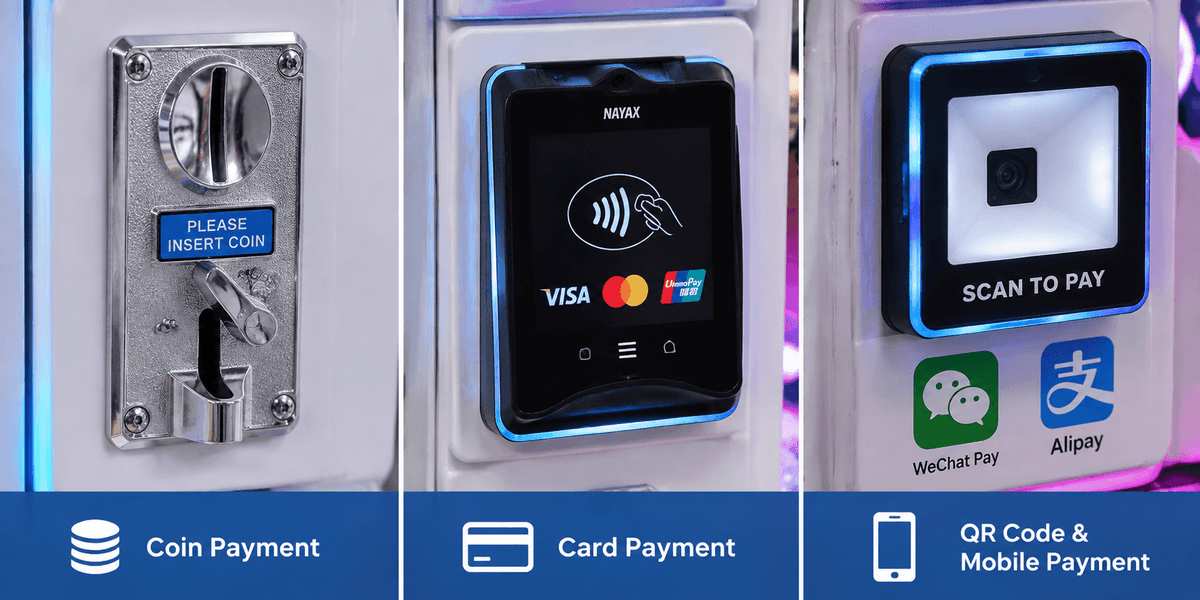
What Are Claw Machine Payment Systems?
A claw machine payment system is the hardware and software solution that allows customers to activate gameplay.
The payment system usually connects with:
- Coin acceptor;
- Card reader;
- QR payment module;
- Control board;
- Game management system.
When a customer completes payment, the system sends a signal to start the game.
For commercial operators, the payment system is more than a payment tool. It also affects:
- Customer convenience;
- Revenue tracking;
- Maintenance requirements;
- Machine compatibility;
- Operating efficiency.
Why Payment Systems Matter for Arcade Operators
Choosing the right payment method can influence the overall performance of a claw machine business.
1. Customer Convenience
Different markets have different payment habits.
For example:
- Traditional arcades may still prefer coins;
- Modern FECs often use membership cards;
- Shopping mall locations may benefit from QR payments.
The easier it is for customers to start playing, the lower the entry barrier.
2. Revenue Management
Modern payment systems can provide additional management possibilities.
Operators may track:
- Machine usage;
- Payment records;
- Customer activity;
- Promotional campaigns.
This information helps businesses optimize machine placement and operation.
3. Location Adaptability
A claw machine installed in Japan, Europe, North America, or Southeast Asia may require different payment solutions.
A professional supplier should consider local payment habits during equipment planning.
Coin Payment Systems: Traditional and Reliable
Coin-operated claw machines remain widely used in many entertainment venues.
How Coin Payment Works
The customer inserts coins or tokens into the machine.
The coin acceptor checks:
- Coin size;
- Weight;
- Magnetic characteristics;
- Payment value.
After successful validation, the machine allows gameplay.
Advantages of Coin Payment
Simple Operation
Coins are easy for customers to understand.
Low Initial Complexity
Traditional coin systems usually require fewer electronic components.
Suitable for Many Arcade Locations
Coin systems remain practical in:
- Classic arcades;
- Small entertainment centers;
- Independent game shops.
Limitations of Coin Systems
However, coin systems also have some challenges:
- Requires cash collection;
- Needs physical coin management;
- Limited customer data tracking;
- Requires local currency compatibility.
For international projects, operators should consider whether local customers still commonly use cash payments.
Card Payment Systems: Creating a Modern Arcade Experience
Card-based payment systems are increasingly common in larger entertainment venues.
These systems may include:
- Membership cards;
- RFID cards;
- Magnetic cards;
- Stored-value cards.
Advantages of Card Systems
Better Customer Experience
Customers can recharge a card and play multiple machines without carrying coins.
Supports FEC Management
Card systems can connect multiple attractions under one payment platform.
For example:
- Claw machines;
- Racing games;
- Redemption games;
- VR attractions.
Limitations of Card Systems
Operators should consider:
- Higher installation cost;
- Need for card management equipment;
- System integration requirements.
For larger entertainment projects, however, card systems can provide stronger management capabilities.
QR Code Payment Systems: The Cashless Trend
QR code payment has become increasingly popular because smartphones are widely available.
Customers can scan a QR code using:
- Mobile payment apps;
- Digital wallets;
- Online payment platforms.
Advantages of QR Code Payment
Cashless Convenience
Customers do not need coins or physical cards.
Suitable for International Locations
QR payment solutions can adapt to different local payment ecosystems.
Easy Promotion Integration
Some systems can support:
- Digital coupons;
- Promotional campaigns;
- Online transactions.
Possible Challenges
QR payment systems require:
- Stable network connection;
- Payment platform compatibility;
- Software integration.
Operators should confirm system support before purchasing equipment.
Coin vs Card vs QR Code: Comparison Guide
| Feature | Coin Payment | Card Payment | QR Code Payment |
|---|---|---|---|
| Initial Cost | Lower | Medium | Medium |
| Customer Convenience | Medium | High | High |
| Cash Management | Required | Reduced | Minimal |
| Data Tracking | Limited | Strong | Strong |
| Best For | Traditional arcades | FECs and large venues | Modern cashless locations |
| International Adaptability | Depends on currency | Good | Depends on payment platform |
There is no single payment system that fits every claw machine project.
The best choice depends on:
- Venue type;
- Customer demographics;
- Country;
- Budget;
- Management requirements.
How to Choose the Right Payment System for Your Claw Machine
Before selecting a payment system, operators should evaluate several factors.
1. Understand Your Customer Group
Ask:
- Are customers mainly children and families?
- Are visitors local or international?
- Do they prefer cashless payment?
2. Consider Venue Size
Small locations may prefer simple solutions.
Large FEC projects may require:
- Central payment management;
- Membership systems;
- Digital reporting.
3. Check Equipment Compatibility
The payment system should match:
- Machine control board;
- Software;
- Voltage requirements;
- Local payment standards.
Supplier Perspective: Payment Customization for Global Markets
From a supplier perspective, payment selection is often overlooked during early project planning.
Many customers focus on cabinet design and game features first, but payment compatibility can directly affect daily operation.
When supporting arcade equipment projects, professional suppliers usually need to consider:
- Target country payment habits;
- Local currency requirements;
- Customer management systems;
- Venue operation model.
EPARK provides commercial amusement equipment solutions including claw machines, arcade machines, customization services, and complete entertainment project support.
With more than 13 years of manufacturing experience, EPARK works with arcade operators, distributors, and FEC investors to provide equipment configuration, customization, production, installation support, and technical assistance.
For different markets, machines can be adapted according to project requirements, including payment methods, cabinet design, and operating environments.
Learn more about related equipment:
commercial claw machine solutions
Common Claw Machine Payment System Problems
Payment Device Does Not Recognize Coins
Possible causes:
- Incorrect coin settings;
- Dirty coin acceptor;
- Mechanical blockage.
Card System Cannot Connect
Possible issues:
- Software compatibility;
- Network problems;
- Hardware connection errors.
QR Payment Fails
Common reasons:
- Network instability;
- Payment platform limitations;
- Configuration errors.
Regular maintenance and supplier technical support can reduce downtime.
FAQ About Claw Machine Payment Systems
1. Can claw machines use both coin and QR payments?
Yes. Many commercial machines can support multiple payment options depending on the control system configuration.
2. Which payment system is best for a new arcade business?
The suitable option depends on location, customer habits, and business model.
3. Are QR code payment systems suitable for international markets?
They can be suitable, but operators should confirm compatibility with local payment platforms.
4. Do card payment systems require special software?
Many card systems require management software or compatible control systems.
5. Can old claw machines be upgraded with new payment systems?
Some machines can be upgraded, but compatibility depends on the hardware design.
6. What should I ask a supplier about payment systems?
Important questions include:
- Supported payment methods;
- Compatibility;
- Software support;
- Maintenance service;
- Customization options.
Conclusion: Choosing a Future-Ready Payment Solution
The payment system is an important part of a commercial claw machine investment.
Coin systems provide simplicity and reliability. Card systems offer better management for larger venues. QR code systems provide convenient cashless payment experiences.
For arcade operators and FEC investors, the best solution depends on customer behavior, venue size, and long-term business plans.
Working with an experienced amusement equipment manufacturer can help ensure that payment systems, machine design, and operational requirements work together effectively.
EPARK provides commercial claw machines and entertainment equipment solutions for global markets, supporting customization, project planning, and technical service.
FAQ
1. Can claw machines support multiple payment methods?
A:
Yes. Many commercial claw machines can support multiple payment options, including coins, cards, tokens, and QR code payments. The available options depend on the machine control system and market requirements.
2. Which payment system is best for a commercial claw machine?
A:
There is no single best payment system. Coin systems are simple and reliable, card systems are suitable for large FECs, and QR payment systems provide convenient cashless experiences. The right choice depends on your location, customers, and business model.
3. Can I upgrade my existing claw machine with a new payment system?
A:
Some claw machines can be upgraded with new payment systems. However, compatibility depends on the control board, wiring structure, and machine model.
4. Are QR code payment systems suitable for international claw machine businesses?
A:
Yes, QR payment systems can be suitable for international markets, but operators should confirm compatibility with local payment platforms and network conditions before installation.
5. Do claw machine payment systems require internet connection?
A:
Some cashless payment systems require an internet connection for payment verification and data management, while traditional coin-operated systems can work independently.
6. What payment system should I choose for a claw machine arcade store?
A:
The choice depends on your store size and operation model. Small venues may prefer coin systems, while larger arcades and FEC projects may benefit from card or cashless payment solutions with management features.
7. Can EPARK customize claw machine payment systems for different countries?
A:
Yes. EPARK provides customized claw machine solutions based on different market requirements, including payment methods, machine design, and operating environments.
8. What should I consider when choosing a claw machine supplier?
A:
Buyers should consider product quality, payment compatibility, customization ability, technical support, spare parts supply, and the supplier’s experience in international markets.
