
Opening a claw machine arcade does not always require a large shopping mall unit or a spacious entertainment center. With the right claw machine layout, even a 50 m² commercial space can become an attractive, functional gaming venue.
For arcade operators, shopping mall investors, and entertainment business owners, the main challenge is not simply fitting more machines into a limited area. It is creating a space where customers can move comfortably, discover different prizes, enjoy the games, and return for another visit.
A successful layout balances machine quantity, customer circulation, visual appeal, equipment accessibility, and daily operating needs.
This guide explores practical claw machine layout ideas for commercial spaces ranging from 50 to 200 m². It covers equipment configurations, recommended zoning strategies, machine selection, common design mistakes, and important considerations when working with an arcade equipment manufacturer.
Whether you are planning a small claw machine shop, a shopping mall entertainment corner, or a compact family entertainment center, these ideas can help you make better use of your available floor space.
1. Why Claw Machines Work Well in Small Commercial Spaces
Claw machines are a flexible option for entertainment businesses because they can operate individually or as part of a larger arcade.
Unlike attractions that require large movement areas, standard claw machines usually have relatively compact cabinets. Multiple machines can be arranged along walls, in rows, or around themed gaming zones.
They are suitable for several types of commercial locations:
- Shopping malls and retail entertainment areas
- Cinema lobbies and entertainment complexes
- Small independent arcade stores
- Family entertainment centers
- Tourist attractions and leisure facilities
- Commercial entertainment corners within larger venues
Another advantage is their flexibility. Operators can offer different prize categories, including plush toys, novelty gifts, accessories, and other suitable merchandise, without changing the entire store layout.
However, machine count alone does not determine business performance. Prize appeal, fair game operation, customer traffic, rental costs, maintenance, and machine availability all influence the results.
For small commercial venues, the goal should be to create a balanced entertainment experience rather than simply maximize the number of cabinets.
2. Key Principles of Effective Claw Machine Layout Planning
Before selecting machines, operators should understand how floor area will be used.
A commercial claw machine arcade needs more than space for equipment. Customers require room to stand, play, watch others, and move between machines. Staff also need access for cleaning, refilling prizes, and performing maintenance.
Allocate Space Based on Function
As an initial planning exercise, an operator might allocate approximately 55–65% of the venue to machine positions and their immediate playing areas, leaving the balance for wider circulation, payment facilities, storage, entrance space, and other functions.
The exact allocation depends on the room's shape, occupancy requirements, exits, and business model.
| Functional Area | Illustrative Allocation | Main Purpose |
|---|---|---|
| Machine positions and immediate play areas | 55–65% | Game cabinets and active players |
| Main circulation and entry space | 20–25% | Comfortable customer movement |
| Payment, prize and service areas | 5–10% | Customer support and transactions |
| Storage, maintenance and other uses | 5–10% | Daily operating needs |
Maintain Comfortable Walking Routes
A common mistake is calculating capacity from cabinet dimensions alone.
For example, a cabinet may occupy less than one square meter, but players need standing space in front of its controls. Accompanying family members, bags, and customers waiting nearby require additional room.
For early-stage planning, a main circulation aisle of approximately 1.2–1.5 meters can be a useful design target where the room allows. Busy locations may need more clearance.
Accessibility and fire-safety rules must be checked separately. As a U.S. example, the 2010 ADA Standards for Accessible Design generally specify a minimum 915 mm (36-inch) clear width for accessible walking surfaces, with additional requirements for turns and passing spaces. This is not a universal aisle-width rule or a substitute for local approval.
Create a Clear Customer Journey
An effective arcade layout should make it easy for customers to understand where to go.
A simple customer journey could follow this sequence:
- Enter the store and see attractive prize displays.
- Discover popular machines near the entrance.
- Move through the main gaming area.
- Explore different prize categories and machine types.
- Access payment or staff assistance when needed.
- Exit without crossing crowded playing positions.
A loop or U-shaped path can work well in many compact spaces because it reduces dead ends and gives customers multiple opportunities to discover machines.
Consider Lighting, Visibility, and Equipment Access
Claw machines are highly visual products. Cabinet lighting, prize arrangement, and themed decorations should make the space inviting without overwhelming customers.
Position important displays where they can be seen from the entrance. Avoid placing tall cabinet backs in front of other attractions.
Service access also matters. Depending on the machine model, staff may need access to front doors, side panels, rear panels, electrical connections, or internal components.
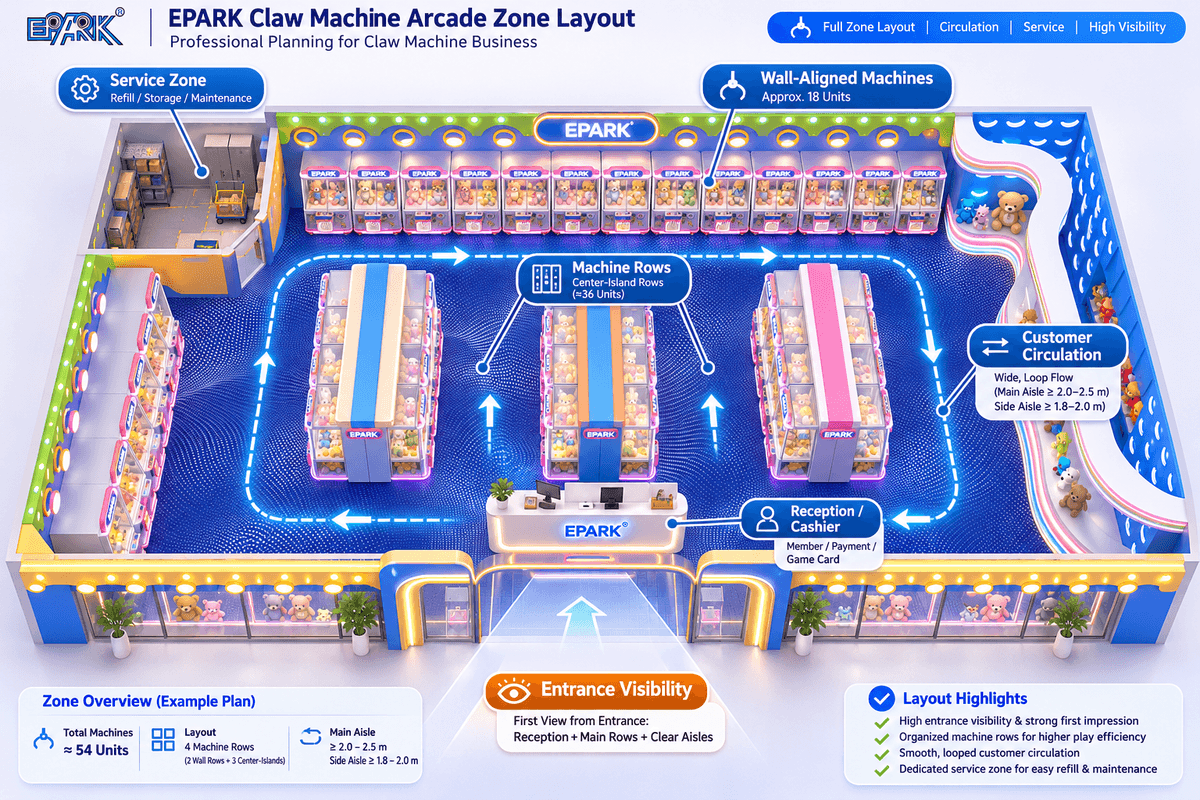
3. 50 m² Claw Machine Layout Ideas: Compact and Efficient
A 50 m² space is suitable for a compact claw machine shop, especially in shopping malls, pedestrian retail areas, or commercial buildings with regular visitor traffic.
At this size, the layout should prioritize visibility, simple movement, and efficient equipment placement.
Recommended Layout: Wall-Line or U-Shaped Arrangement
Place most cabinets against the left, right, and rear walls. Keep the center relatively open to create a comfortable viewing and circulation area.
A practical concept may include:
- Standard claw machines along the side walls.
- Smaller machines in selected corners.
- One visually distinctive cabinet near the entrance, without blocking access.
- A compact payment or token exchange station.
- Prize storage integrated into a small service area.
For preliminary budgeting, approximately 8–14 compact or standard machine positions may be worth testing in a 50 m² dedicated venue. The final number could be lower, especially if the room has irregular walls, columns, or significant storage requirements.
Equipment Strategy
Focus on a few distinct prize categories instead of filling every cabinet with similar products.
For example, one wall could feature plush toys, while the opposite wall offers collectible items and smaller gifts.
Keep signs clear, use consistent lighting, and avoid bulky decoration that takes up valuable floor space.
Best suited for: First-time arcade operators, small retail entertainment units, and compact standalone claw machine stores.
4. 80 m² Claw Machine Layout Ideas: Adding Variety Without Congestion
An 80 m² location gives operators more flexibility to separate equipment types while retaining a relatively compact floor plan.
This size can work well for a mall-based claw machine shop or a small arcade serving families, teenagers, and young adults.
Recommended Layout: U-Shaped Layout With a Small Central Island
Install the main cabinet rows along the perimeter and introduce a small island of machines in the center, provided that adequate circulation can be maintained on all sides.
The central island may contain double-sided equipment or compact cabinets, depending on their control-panel positions and service requirements.
A possible configuration includes:
- Standard plush claw machines along two walls.
- Mini prize machines in a central cluster.
- A small premium prize section at the back.
- A visible payment point near the entrance.
- A limited storage area for prizes and supplies.
An initial design may explore 14–22 machine positions, but this should be treated as a flexible equipment scenario rather than a guaranteed capacity.
Planning Tip: Avoid Blocking the Entrance
It may be tempting to fill the entrance with large, colorful machines. However, customers should have a clear view into the shop and enough room to enter without disturbing active players.
Place an attractive machine beside the entrance instead of directly in front of the door.
This approach creates a welcoming first impression while allowing visitors to see the wider arcade.
Best suited for: Shopping mall arcade shops, family entertainment corners, and small branded prize-game venues.
5. 100 m² Claw Machine Layout Ideas: Creating a Balanced Arcade
A 100 m² commercial space provides enough room to develop a more complete claw machine entertainment concept.
At this size, operators can begin separating machines by prize categories, customer preferences, and gaming experiences.
Recommended Layout: Parallel Rows With a Central Walkway
One practical arrangement uses two perimeter rows and a central machine island. The layout should allow customers to move around the island without blocking active players.
A typical arrangement could include:
- Entrance zone with eye-catching machines.
- Standard plush toy machines along the walls.
- Compact claw machines in the central area.
- A small premium prize section toward the back.
- A payment and customer service point near the entrance.
- A dedicated area for prize storage and replenishment.
Depending on cabinet dimensions and the available circulation space, an initial design could investigate approximately 18–28 machine positions.
Use Prize Categories to Improve Navigation
Grouping machines by prize type makes it easier for customers to find games that interest them.
For example, family-oriented plush machines could occupy one side, while collectible and novelty prize machines occupy another.
Clear overhead signs or subtle differences in cabinet lighting can make these categories easy to recognize.
Operators should also consider player height and accessibility. Some machines may be more suitable for younger customers, while others require taller users to reach the controls comfortably.
Best suited for: Dedicated claw machine arcades, shopping mall entertainment stores, and compact family entertainment businesses.
6. 150 m² Claw Machine Layout Ideas: Introducing Themed Gaming Zones
At 150 m², a claw machine arcade can provide a wider range of attractions and a more developed customer experience.
Rather than arranging every machine in identical rows, operators can divide the venue into several visually distinct sections.
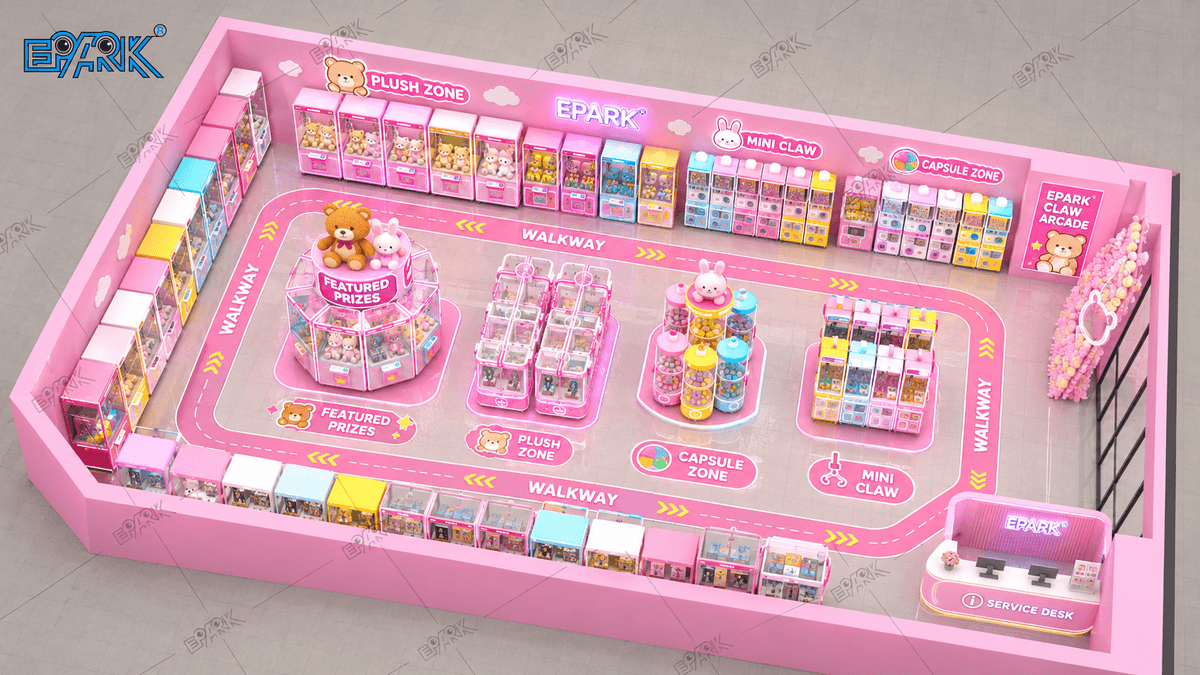
Recommended Layout: Perimeter Machines With Themed Islands
Use wall-mounted rows as the main equipment area, then introduce one or two central groups of machines where circulation space permits.
Possible zones include:
- Plush toy zone: Standard machines with soft toys and character merchandise.
- Collectible prize zone: Smaller cabinets with accessories, figures, and novelty items.
- Premium prize zone: Specialized machines for suitable higher-value prizes, subject to local rules.
- Family-friendly zone: Machines with accessible controls and age-appropriate prizes.
- Service zone: Payment facilities, staff support, and prize replenishment.
An early layout study might explore around 26–40 machine positions, depending on the size and type of cabinets.
For a practical reference, EPARK's website displays a 150 m² doll machine store concept with 30 game machines. This illustrates one possible configuration, although other sites may require different machine counts and layouts.
Use a Consistent Visual Theme
At this scale, thematic design becomes more useful.
A pastel-colored arcade might use matching machine cabinets, soft lighting, and playful wall graphics. A more modern store could feature contrasting colors and minimal decorative elements.
The theme should support the equipment rather than compete with it.
Allow for Flexible Equipment Changes
Prize demand may change throughout the year. Seasonal merchandise, new collectibles, and promotional activities can require updates to the machine mix.
Choose cabinet configurations and electrical positions that allow selected machines to be relocated without major renovation.
Best suited for: Branded claw machine stores, mall-based amusement projects, and operators seeking a more varied prize-game experience.
7. 200 m² Claw Machine Layout Ideas: Building a Complete Entertainment Experience
A 200 m² venue provides more opportunities to combine different machine types, customer zones, and entertainment features.
Operators can choose between a dedicated claw machine concept and a mixed arcade that includes other amusement equipment.
Option A: Dedicated Claw Machine Arcade
For a claw-focused venue, arrange machines around the perimeter and along carefully planned central rows.
Introduce a continuous circulation route connecting the main prize zones.
A preliminary concept may accommodate approximately 34–52 machine positions, depending on cabinet mix, usable space, and local requirements.
Special attractions can be positioned toward the back to encourage customers to explore the full store.
Option B: Mixed Arcade With Claw Machines
A mixed arcade can combine claw machines with selected complementary attractions, such as:
- Ticket redemption games
- Key Master-style prize machines
- Cut Prize machines
- Compact sports arcade equipment
- Other suitable coin-operated amusement games
This model offers greater entertainment variety but generally reduces the number of claw machines that can be installed.
Larger games also require their own operating and safety clearances.
Layout Comparison for 50–200 m² Commercial Spaces
| Total Space | Illustrative Claw Machine Positions | Suggested Layout | Recommended Concept |
|---|---|---|---|
| 50 m² | 8–14 | Wall-line or U-shape | Compact claw machine shop |
| 80 m² | 14–22 | U-shape with small central island | Small prize-game arcade |
| 100 m² | 18–28 | Perimeter rows and central island | Dedicated claw machine store |
| 150 m² | 26–40 | Themed zones and grouped machines | Branded prize-game arcade |
| 200 m² | 34–52 | Multiple zones and circulation loop | Larger claw-focused arcade |
Design for the Entire Customer Experience
At 200 m², operators should think beyond equipment placement.
Consider adding a photo-friendly feature wall, a clear information point, or a small seating area if the business model and available space justify it.
The goal is to create a welcoming destination where visitors can explore different attractions without feeling crowded.
Best suited for: Larger claw machine stores, shopping mall entertainment venues, and small family entertainment centers.
8. How to Choose the Right Claw Machines for Different Spaces
The best floor plan depends on the equipment selected.
Before ordering, compare machine dimensions, prize capacity, payment options, maintenance access, and electrical requirements.
Compare Machine Types
| Machine Type | Common Application | Layout Consideration |
|---|---|---|
| Mini claw machine | Small prizes, compact stores | Saves cabinet space; confirm player access |
| Standard toy claw machine | Plush toys and general gifts | Suitable for wall rows and themed zones |
| Large claw machine | Oversized toys or focal displays | Requires more floor area and visual clearance |
| Cut Prize machine | Specialized prize challenges | Allow access for resetting and maintenance |
| Key Master-style machine | Featured prize games | Consider visibility and control-panel access |
| Customized claw machine | Branded entertainment venues | Confirm final dimensions before layout approval |
Machine sizes can vary substantially between models. Avoid relying on a single standard footprint when preparing a purchasing plan.
Choose Machines According to Customer Profiles
For family-oriented venues, prioritize intuitive controls, suitable prizes, and clear visual displays.
For teenagers and young adults, collectible merchandise, themed designs, and varied game mechanics may be useful additions.
For mixed-age shopping mall locations, a balanced combination is often preferable to relying on one prize category.
Consider Payment System Compatibility
Commercial claw machines may support coins, tokens, cards, or digital payment systems, depending on their configuration.
Before purchasing, confirm whether the equipment supports the payment methods commonly used in your target market.
Also check:
- Local currency and token compatibility
- Cashless payment integration requirements
- Network or connectivity needs
- Transaction reporting features
- Service and maintenance arrangements
EPARK supplies commercial claw machines and supports customization of cabinet appearance, lighting, branding, and payment configurations. Buyers can explore its commercial prize machine options when comparing equipment for different venue sizes.
For international projects, confirm voltage, plug standards, and model-specific compliance documents before finalizing an order.
9. Common Claw Machine Layout Mistakes to Avoid
Even a visually attractive arcade can become difficult to operate if the layout overlooks basic functional requirements.
Mistake 1: Installing Too Many Machines
A crowded store may make it difficult for customers to reach controls, watch games, or move comfortably.
Machine quantity should be determined after allocating space for circulation and operating functions.
Mistake 2: Ignoring Customer Sightlines
Tall cabinets and poorly positioned displays can hide machines from visitors.
Keep attractive prizes visible from the main walking routes, and avoid creating dark or isolated corners.
Mistake 3: Using Identical Prize Categories Everywhere
Offering too many similar machines may limit customer interest.
Introduce an appropriate variety of prize types and cabinet formats based on the audience and operating strategy.
Mistake 4: Forgetting Maintenance Access
Claw machines require regular cleaning, prize replenishment, adjustments, and occasional repairs.
Equipment placed too close together may make servicing difficult.
Before installation, review the manufacturer's maintenance access requirements for every cabinet.
Mistake 5: Overlooking Electrical Planning
Avoid positioning cabinets solely according to appearance without checking power requirements.
Use an electrical plan that identifies outlets, cable routes, machine loads, protective devices, and other applicable requirements. Have qualified professionals verify the installation.
Mistake 6: Treating Accessibility as an Afterthought
A layout should account for customers with different mobility needs.
Where applicable, provide accessible routes, suitable maneuvering space, and controls that can be reached and operated.
For U.S. projects, the U.S. Access Board's accessibility guidance is a useful starting reference. Requirements elsewhere may differ.
access-board.gov
10. How to Plan a Commercial Claw Machine Project With a Manufacturer
For operators purchasing multiple machines, layout planning should begin before equipment production or shipping.
Working with a manufacturer that offers equipment selection and venue design support can help coordinate these decisions.
Step 1: Measure the Commercial Space
Prepare a floor plan showing:
- Total dimensions and usable floor area
- Entrance and exit positions
- Columns and fixed walls
- Ceiling height
- Existing electrical infrastructure
- Structural or service restrictions
- Emergency routes and other required clearances
Photographs and a dimensioned drawing make it easier to evaluate possible machine arrangements.
Step 2: Define the Business Concept
Decide whether the venue will focus entirely on claw machines or combine them with other arcade games.
Identify the target age groups, expected traffic patterns, preferred prize categories, and intended visual theme.
Step 3: Prepare an Initial Equipment List
Choose suitable machine types based on the available area and business concept.
Start with a conservative quantity, then test alternative arrangements.
From a supplier's perspective, one commonly overlooked issue is the difference between cabinet dimensions and installed operating space. A machine that fits on a drawing may still interfere with the player zone, door swing, or maintenance access.
For this reason, machine selection and floor planning should be completed together.
Step 4: Develop a 2D Layout and 3D Design
A 2D layout helps determine cabinet positions, circulation routes, service areas, and equipment quantities.
A 3D design can help evaluate cabinet appearance, lighting, wall graphics, and the overall visitor experience before installation.
EPARK, a Guangzhou-based arcade equipment manufacturer, supports venue planning, equipment configuration, customization, and 3D design for amusement projects. Its services can help buyers evaluate different layouts before proceeding with equipment selection.
Step 5: Evaluate the Budget and Operating Costs
The project budget should cover more than the purchase price of the machines.
Important cost categories include:
| Cost Category | Key Considerations |
|---|---|
| Equipment | Model, quantity, features, customization |
| Shipping and import | Freight, duties, taxes, handling |
| Store fit-out | Flooring, lighting, branding, electrical work |
| Prize inventory | Initial stock, replenishment, damaged goods |
| Payment systems | Hardware, software, transaction fees |
| Operations | Rent, staffing, electricity, cleaning |
| Maintenance | Spare parts, repairs, technical support |
To evaluate financial feasibility, operators can estimate monthly revenue and contribution margins using local assumptions rather than relying on generic earnings claims.
A simple starting calculation is:
Monthly Play Revenue = Paid Plays per Day × Average Revenue per Play × Operating Days
Subtract prize costs, payment fees, and other variable costs to estimate contribution, then account for fixed operating expenses and the initial investment.
Test conservative, expected, and optimistic scenarios before committing.
Step 6: Verify Compliance, Delivery, and Installation
Before production, confirm the required machine specifications, payment arrangements, and documentation for the destination market.
For example, EPARK supports 110V and 220V configurations and different plug standards, subject to model availability.
Buyers should also request applicable certification information for the selected models. Certification documents should be checked against the importing country's requirements rather than assuming that one document covers every machine or market.
After installation, perform functional testing, payment checks, electrical inspections, and staff training before opening.
Step 7: Review Performance After Opening
The first layout does not need to remain permanent.
Monitor which cabinets attract attention, where queues develop, and which areas receive little traffic.
Useful operating measures include plays per machine, revenue per machine, prize cost per play, downtime, and customer feedback.
These observations can help operators adjust prize categories, move selected cabinets, and refine the customer experience.
11. Frequently Asked Questions About Claw Machine Layouts
How many claw machines can fit in a 50 m² store?
A 50 m² dedicated claw machine shop might begin with a preliminary layout of approximately 8–14 compact or standard cabinets. The actual capacity depends on the room shape, machine dimensions, customer circulation, storage, and local requirements.
A final equipment count should be based on a scaled floor plan.
What is the best layout for a small claw machine arcade?
Wall-line and U-shaped layouts are often practical for narrow or compact stores because they preserve central circulation space.
Larger venues may benefit from parallel rows, themed islands, or a continuous customer circulation loop.
The best option depends on the entrance position, equipment mix, and available floor area.
How much space should be left between claw machines?
There is no single spacing measurement suitable for every installation.
Machines positioned side by side may require sufficient clearance for their panels, ventilation, and maintenance access. The open area in front must also accommodate players and customer movement.
Aisle widths should be established separately using local building, fire-safety, and accessibility requirements.
Are mini claw machines better for small commercial spaces?
Mini machines can be useful when floor space is limited, especially for small prizes.
However, a store filled entirely with mini machines may offer less variety than a balanced combination of compact and standard cabinets.
The appropriate choice depends on the target audience, prize strategy, and desired visual effect.
Can I combine claw machines with other arcade equipment?
Yes. A small entertainment venue can combine claw machines with ticket redemption games, sports arcade machines, or other suitable attractions.
The layout must account for the footprint and operating clearances of each equipment type.
Mixed arcades generally accommodate fewer claw machines than dedicated claw-machine stores of the same size.
What is the ideal space for a profitable claw machine business?
There is no universally profitable floor area.
A small store with favorable rent and strong customer traffic may perform better than a larger store with high operating costs.
Profitability depends on location, rental expenses, customer demand, machine performance, prize costs, staffing, and overall management.
Operators should prepare a site-specific financial forecast before investing.
Do I need a professional 3D layout before buying machines?
A 3D layout is not mandatory for every project, but it can be valuable when planning themed interiors or ordering many machines.
A dimensioned 2D plan is the essential starting point for checking equipment fit and circulation. A 3D design adds visual understanding of lighting, branding, and customer experience.
Can claw machine cabinets be customized for my arcade brand?
Many commercial manufacturers offer customization options, including colors, logos, lighting, and payment systems.
EPARK offers OEM and ODM services and can coordinate suitable equipment selections with the overall design concept.
Customization availability, technical limitations, minimum order quantities, and delivery conditions should be confirmed for each project.
12. Conclusion: Building an Efficient Small Claw Machine Arcade
A successful claw machine layout is not defined by how many cabinets can fit into a room.
It is defined by how well the space supports customers, equipment, and daily operations.
For a 50 m² venue, compact wall-line arrangements can create a simple and accessible gaming environment. At 80–100 m², operators can introduce more machine variety and clearer prize categories. Larger spaces of 150–200 m² provide opportunities for themed zones, specialized attractions, and a more complete entertainment experience.
Regardless of size, the most important principles remain consistent: maintain comfortable customer circulation, choose appropriate machines, preserve maintenance access, and align the layout with the commercial location.
For operators planning a new arcade, working with an experienced equipment manufacturer can simplify the coordination of machines, customization, and venue design.
EPARK provides commercial arcade machines, claw machine customization, project planning, 3D design support, and related installation and after-sales technical services.
Businesses preparing a 50–200 m² claw machine project can contact EPARK's project team to discuss their floor plan, target customers, equipment configuration, and preliminary design requirements.
A carefully planned layout creates a stronger foundation for an attractive, manageable, and commercially sustainable claw machine business.
