
Opening a claw machine arcade can be an attractive business opportunity, especially in shopping malls, entertainment centers, family entertainment centers (FECs), and commercial retail spaces. However, one of the first questions investors face is how many claw machines they actually need to build a profitable business.
Should you start with 10 machines, 20 machines, or invest in 50 or more? The answer depends on several factors, including venue size, customer traffic, investment budget, target audience, and operating strategy.
Buying more machines does not automatically mean earning more money. Too few machines may limit customer choices, while too many can increase equipment costs and operating expenses without generating sufficient additional revenue.
The key is to find the right balance between machine quantity, product variety, available space, and customer demand.
This guide explains how to calculate the ideal number of claw machines, plan your arcade layout, estimate potential revenue, control operating costs, and choose the right equipment for long-term business growth.
1. How Many Claw Machines Do You Really Need?
There is no universal number of claw machines that guarantees profitability. A small retail location may operate with 8–12 machines, while a dedicated claw machine arcade may require 30–50 machines or more.
The right quantity depends on your business model and available space.
For a small shopping mall location, a compact collection of well-positioned machines can attract customers without requiring a large investment. For a dedicated claw machine arcade, a larger selection provides more prize categories, different cabinet styles, and more playing opportunities.
However, adding more machines does not necessarily increase revenue proportionally. If customer traffic remains unchanged, additional machines may simply divide existing customer spending across more cabinets.
For example, an arcade with 20 machines and consistent customer activity may perform better than a venue with 40 machines but insufficient visitors.
Instead of focusing only on how many machines you can install, consider how many machines your expected customers can actively use.
2. What Determines the Right Number of Machines?
Before purchasing equipment, evaluate four important factors.
Venue Size and Available Floor Space
Your total floor area determines how many machines you can physically install. However, the entire venue should not be occupied by equipment.
You also need space for entrances, customer movement, payment counters, prize storage, waiting areas, and maintenance access.
Machine dimensions are equally important. Mini claw machines, standard cabinets, and large prize machines have different space requirements.
Daily Customer Traffic
Customer traffic directly influences the number of machines your business can support.
A shopping mall location may attract more spontaneous visitors than a small standalone store. However, passing traffic does not necessarily translate into paying customers.
Estimate how many people will enter your venue, how many will play, and how frequently they may return.
Investment Budget
Your budget determines how many machines you can purchase, but equipment should not consume your entire startup capital.
You also need funds for rent, renovation, prize inventory, transportation, installation, marketing, and daily operations.
Maintaining sufficient working capital is particularly important during the first few months.
Target Customer Groups
Different customer groups may prefer different machine types and prize categories.
An arcade targeting children and families may benefit from colorful cabinets, smaller machines, and plush toy prizes. A venue targeting teenagers and young adults may require larger cabinets, gift machines, and more varied prize options.
Understanding your target customers helps you choose both the right machine quantity and equipment combination.
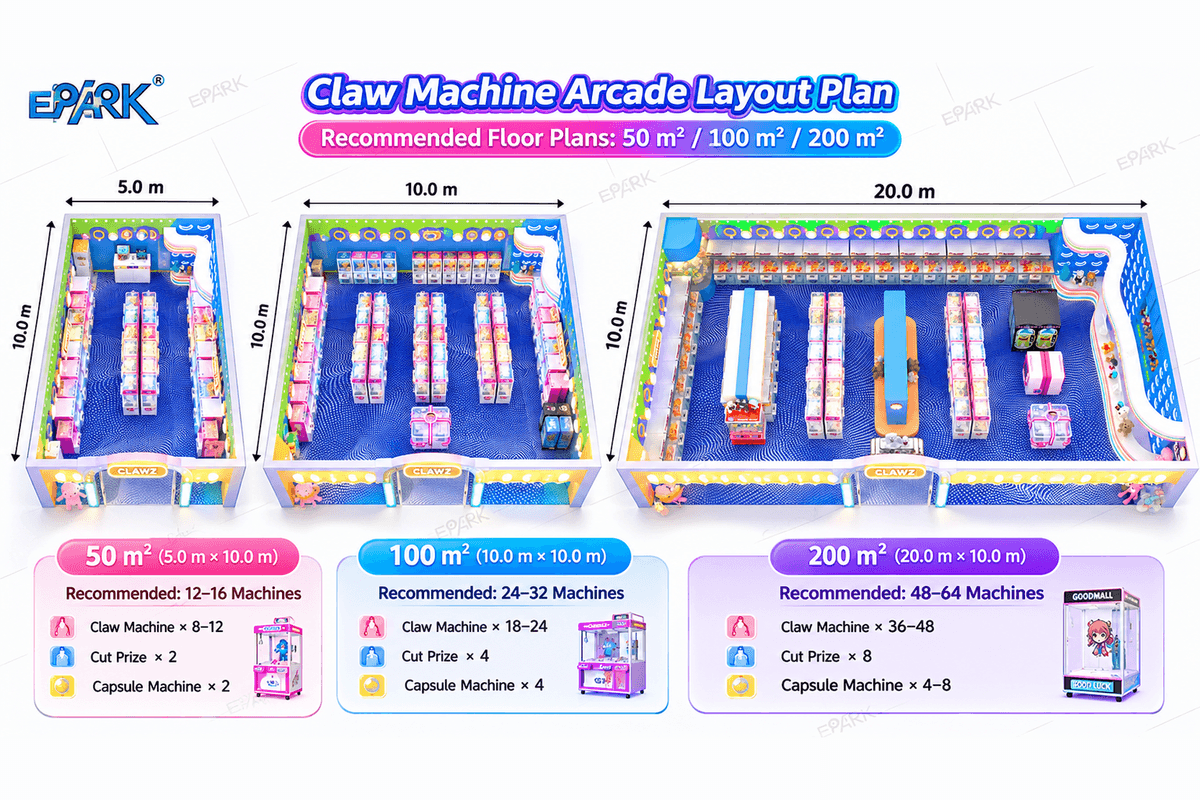
3. Recommended Claw Machine Quantities by Venue Size
The following recommendations provide general starting points for commercial planning. Actual capacity depends on cabinet dimensions, venue shape, aisle requirements, and local safety regulations.
50–80 m²: Small Claw Machine Arcade
Approximately 8–12 machines can work well for a compact arcade, shopping mall corner, or small retail entertainment area.
A combination of standard and mini claw machines can provide sufficient variety without overcrowding the venue.
80–120 m²: Compact Commercial Arcade
Approximately 12–18 machines may be suitable for this space.
You can introduce different cabinet sizes and prize categories while maintaining comfortable customer movement.
120–200 m²: Medium-Sized Claw Machine Arcade
Approximately 18–30 machines can provide a good foundation for a dedicated claw machine store.
This area allows operators to create different prize zones, including plush toys, small gifts, and larger prizes.
200–300 m²: Large Claw Machine Arcade
Approximately 30–45 machines may be suitable for a larger commercial venue.
You can organize machines into different sections and introduce more cabinet styles to attract customers with different preferences.
300–500 m²: Dedicated Claw Machine Entertainment Center
Approximately 45–70 machines or more may be considered, depending on the layout.
At this scale, operators should also plan for prize storage, customer service, staff access, and regular equipment maintenance.
More Than 500 m²: Large Commercial Entertainment Venue
For larger venues, machine quantity should be determined through a complete floor plan.
You may combine claw machines with other arcade attractions and redemption games to create a more comprehensive entertainment destination.
4. How to Calculate Your Ideal Machine Quantity
A practical calculation should combine available space, cabinet dimensions, customer demand, and future expansion plans.
Calculate the Usable Installation Area
Measure the total venue area and identify spaces that must remain available for entrances, emergency exits, customer movement, storage, and service counters.
For example, a 150 m² venue might allocate approximately 90–105 m² for machine installation, with the remaining area reserved for circulation and supporting functions.
Calculate the Space Required Per Machine
A standard claw machine may occupy approximately 0.8–1.0 m² of direct floor footprint. However, additional space is needed for customers to play and technicians to access the equipment.
Calculate the total space allocation per cabinet rather than using its physical dimensions alone.
Use a Machine Quantity Formula
Ideal Machine Quantity = Usable Installation Area ÷ Average Space Allocation Per Machine
For example:
100 m² ÷ 3.5 m² = Approximately 28 machines.
This provides a preliminary estimate, not a final installation quantity.
Consider Customer Demand and Future Expansion
Even if your venue can physically accommodate 30 machines, you should determine whether expected customer traffic can support them.
Monitor customer activity after opening and identify which machines attract the most attention.
Leaving flexible space also allows you to introduce new models, replace underperforming equipment, or expand popular prize categories as the business develops.
5. Choosing the Right Mix of Claw Machines
The number of machines matters, but machine variety also influences customer engagement and revenue potential.
Standard Claw Machines for Plush Toys
Standard claw machines are suitable for displaying stuffed animals, plush toys, and other popular gifts. They can form the foundation of your arcade because customers easily understand the gameplay and prize categories.
Mini Claw Machines for Smaller Spaces
Mini claw machines are useful for compact locations and smaller prizes. They can be placed near entrances, alongside standard cabinets, or in areas where larger equipment would be difficult to install.
Large Claw Machines for Premium Prizes
Large cabinets can accommodate bigger plush toys, oversized gifts, and visually attractive prize collections. They can also become focal points that attract attention when customers enter the venue.
Specialty Gift Machines
Some arcades can benefit from machines designed for accessories, boxed gifts, collectible toys, and other prize formats.
These machines introduce different playing experiences and help operators serve a wider customer audience.
Create a Balanced Machine Combination
For a 20-machine arcade, an example configuration could include 10 standard claw machines, 4 mini claw machines, 3 large prize machines, and 3 specialty gift machines.
Your final configuration should reflect local customer preferences, prize availability, and cabinet dimensions.
6. How Much Revenue Can Each Claw Machine Generate?
Revenue estimation is essential when deciding how many machines to purchase.
The earning potential of each cabinet depends on its price per play, daily paid plays, prize costs, customer traffic, and operating conditions.
Calculate Revenue Per Machine
The basic formulas are:
Daily Revenue = Paid Plays Per Day × Price Per Play
Monthly Revenue = Daily Revenue × Operating Days
For example, assume one machine charges $1 per play and receives 25 paid plays per day.
Daily revenue: 25 × $1 = $25.
Monthly revenue: $25 × 30 = $750.
This represents gross revenue before operating expenses.
Estimate Revenue by Machine Quantity
Assuming every machine receives 25 paid plays per day, charges $1 per play, and operates 30 days per month:
| Machine Quantity | Monthly Gross Revenue |
|---|---|
| 10 | $7,500 |
| 20 | $15,000 |
| 30 | $22,500 |
| 40 | $30,000 |
| 50 | $37,500 |
These figures are illustrative projections, not guaranteed results.
Compare Different Playing Volumes
A 20-machine arcade charging $1 per play could generate:
| Plays Per Machine Per Day | Monthly Gross Revenue |
|---|---|
| 15 | $9,000 |
| 25 | $15,000 |
| 40 | $24,000 |
| 50 | $30,000 |
This demonstrates why customer activity is just as important as equipment quantity.
Calculate Prize Expenses
Assume one machine receives 25 paid plays per day, charges $1 per play, has an illustrative 10% prize win rate, and each prize costs $3.
Daily prize expense:
25 × 10% × $3 = $7.50.
Monthly prize expense:
$7.50 × 30 = $225.
The estimated revenue remaining after prize expenses is:
$750 − $225 = $525.
This amount is before rent, employee salaries, electricity, maintenance, payment fees, and other operating expenses.
Actual prize costs and win rates vary. Operators should monitor real performance and use fair, transparent settings that comply with local regulations.
Monitor Individual Machine Performance
Not every cabinet generates the same revenue. Monitor daily paid plays, revenue, prize expenses, restocking frequency, machine downtime, and customer preferences.
After collecting several weeks of data, identify which machines perform well and which require changes to their prize selection, location, or configuration.
7. Understanding Operating Costs and Profitability
Gross revenue does not represent actual profit. A profitable arcade requires effective control of both startup investment and ongoing operating expenses.
Initial Investment Costs
Before opening, prepare a budget covering machine purchasing, international shipping, import duties, store renovation, electrical installation, payment systems, initial prize inventory, transportation, and installation.
Keep additional working capital for unexpected expenses and the first few months of operation.
Monthly Operating Expenses
Rent is often one of the largest fixed expenses. Employee salaries cover customer service, prize restocking, cleaning, and daily operations.
Prize inventory requires regular replenishment to maintain attractive displays. Electricity and internet expenses depend on machine quantity, power consumption, and operating hours.
Maintenance and spare parts should also be included. Motors, claw mechanisms, buttons, wiring, control boards, and lighting require periodic inspection.
Marketing, insurance, accounting, and other administrative expenses should be included in your operating budget.
Calculate Monthly Operating Profit
Consider an illustrative 20-machine arcade generating $15,000 in monthly gross revenue.
| Financial Item | Monthly Amount |
|---|---|
| Gross Revenue | $15,000 |
| Prize Expenses | $4,500 |
| Payment Fees | $450 |
| Rent | $3,000 |
| Employee Salaries | $2,500 |
| Electricity and Internet | $350 |
| Maintenance | $250 |
| Marketing | $300 |
| Insurance and Administration | $300 |
| Estimated Operating Profit | $3,350 |
The estimated operating profit is before taxes, depreciation, financing costs, and other excluded expenses. It is an example, not a guaranteed return.
Calculate the Break-Even Point
The break-even formula is:
Break-Even Revenue = Fixed Monthly Costs ÷ Contribution Margin Ratio
If fixed monthly costs are $6,700 and variable costs account for 33% of revenue, the contribution margin ratio is 67%.
$6,700 ÷ 0.67 = Approximately $10,000.
This means the arcade needs approximately $10,000 in monthly gross revenue to cover the expenses included in this example.
8. How to Choose Between a Small and Large Arcade Setup
Choosing between a small and large arcade depends on your available investment, business experience, location, and long-term objectives.
Small Arcade Setup
A small arcade with approximately 8–20 machines is suitable for first-time investors, compact retail locations, and shopping mall spaces.
Its advantages include lower initial equipment investment, reduced rental requirements, easier daily management, lower prize inventory requirements, and greater flexibility when testing customer preferences.
The main limitation is that fewer machines may provide less product variety and lower total revenue capacity.
Large Arcade Setup
A larger arcade with 30–50 machines or more can provide a wider range of prizes and a stronger dedicated entertainment environment.
It offers more opportunities to create different playing zones, attract different customer groups, and increase total revenue capacity.
However, larger venues require higher initial investment, more staff, additional prize inventory, and more complex management.
Which Setup Should You Choose?
If you are entering the industry for the first time, a smaller setup may be a practical starting point.
If you already have a suitable commercial location, sufficient working capital, and a clear understanding of customer demand, a larger installation may be worth considering.
The best decision is the one that matches your financial resources and realistic operating capacity.
9. Common Mistakes When Buying Too Many Claw Machines
Purchasing too many machines before understanding the market can create unnecessary financial pressure.
Focusing Only on Machine Quantity
More cabinets do not automatically mean more customers or higher revenue. Prioritize machine performance and customer experience instead of purchasing equipment simply to fill the venue.
Ignoring Floor Layout
Overcrowded machine arrangements make it difficult for customers to move comfortably and may affect maintenance access.
Always prepare a floor plan before confirming the equipment order.
Buying Too Many Identical Machines
A repetitive equipment combination may limit customer interest. Introduce different cabinet sizes, prize categories, and machine styles to provide more variety.
Underestimating Prize Costs
Prize inventory is a recurring expense, not a one-time purchase. Calculate the landed cost of prizes and establish a restocking plan before opening.
Spending the Entire Budget on Equipment
Leaving insufficient working capital can make it difficult to cover rent, salaries, maintenance, and marketing during the early operating period.
Ignoring After-Sales Support
Equipment downtime can affect revenue and customer satisfaction. Choose a supplier that can provide technical assistance, spare parts, and clear warranty arrangements.
10. How to Build a Profitable Claw Machine Arcade
Building a profitable arcade requires careful planning before purchasing equipment and continuous management after opening.
Step 1: Research Your Target Market
Study local competitors, customer demographics, shopping habits, and popular prize categories. Understand whether your location mainly attracts children, families, teenagers, or young adults.
Step 2: Confirm Your Venue and Budget
Measure the available floor space and calculate the total investment, including equipment, renovation, rent, prizes, transportation, and working capital.
Step 3: Prepare a Professional Floor Plan
Arrange machines according to cabinet dimensions and customer movement. Divide the venue into suitable prize and equipment zones while maintaining access for maintenance and restocking.
Step 4: Choose the Right Equipment
Select machines based on prize dimensions, target customers, available space, payment requirements, and expected operating conditions.
Step 5: Prepare Prizes and Payment Systems
Purchase suitable prize inventory and confirm that the machines support your preferred payment methods, such as coins, banknotes, cards, or cashless payments where available.
Step 6: Test Equipment Before Opening
Check machine functions, claw movement, payment systems, lighting, electrical connections, and prize compatibility. Arrange installation and staff training before welcoming customers.
Step 7: Monitor and Improve Performance
Record daily revenue, paid plays, prize expenses, machine downtime, and customer preferences.
Use actual operating data to adjust prize selections, relocate machines, and replace underperforming equipment.
A successful arcade is not simply about installing more machines. It is about continuously improving the customer experience and making informed operating decisions.
11. Why Work with an Experienced Claw Machine Manufacturer?
Choosing the right manufacturer is an important part of building a profitable claw machine arcade. A reliable supplier should provide more than individual machines. It should understand commercial operating requirements and help buyers select suitable equipment for their venues and budgets.
Working directly with an experienced manufacturer can also make equipment customization, quality control, transportation, and after-sales support easier to manage.
Factory Manufacturing and Product Quality
A professional manufacturer should have established production facilities, experienced technical staff, and quality inspection procedures.
Before placing an order, buyers should evaluate the manufacturer's production capabilities, product range, assembly process, and testing procedures.
EPARK operates a 25,000 m² manufacturing base and a 3,000 m² showroom, supported by a team of more than 100 employees. The company provides arcade machines and amusement equipment for international distributors, importers, arcade operators, and entertainment center investors.
Factory-direct purchasing allows buyers to communicate directly with the production team, discuss machine specifications, and obtain equipment configurations according to their project requirements.
OEM and ODM Customization
Different arcade businesses have different branding and operating requirements.
An experienced manufacturer should offer customization options such as:
- Cabinet colors and exterior designs.
- Company logos and branded graphics.
- LED lighting and visual effects.
- Machine dimensions and configurations.
- Coin, banknote, card, and cashless payment options, subject to compatibility.
- Language and control system configurations.
- Gameplay settings and prize display arrangements.
For example, a distributor may need branded claw machines for multiple retail locations, while an arcade investor may require a specific combination of cabinet sizes and payment systems.
OEM and ODM services help buyers develop equipment that matches their business positioning.
Certifications and Quality Inspection
Equipment quality and compliance should be considered before purchasing.
Ask suppliers about available certifications, electrical specifications, safety requirements, and documentation for the models you intend to purchase.
EPARK provides products with certifications and quality documentation including CE, RoHS, SGS, and ISO9001-related manufacturing quality credentials, depending on the product and applicable certification scope. Certain models may also have additional certifications.
Before shipment, buyers should confirm machine functions, electrical components, payment systems, cabinet appearance, and packaging arrangements.
Pre-shipment testing and inspection videos can also help overseas buyers understand the equipment condition before delivery.
Warranty and After-Sales Support
After-sales service is particularly important when operating multiple claw machines.
A reliable supplier should provide clear warranty terms, technical assistance, spare parts, and troubleshooting guidance.
EPARK provides a two-year warranty for applicable equipment, together with remote technical support, installation guidance, operator training, and spare parts assistance.
Having access to technical support can help operators reduce equipment downtime and maintain daily business operations.
One-Stop Arcade Project Solutions
Purchasing machines is only one part of establishing an arcade. Buyers may also need assistance with machine selection, floor planning, equipment combinations, production, shipping, and installation.
EPARK provides one-stop project support, including:
- Project requirements and budget evaluation.
- Machine recommendations.
- 2D and 3D floor plan design.
- Equipment quotations and configurations.
- OEM and ODM customization.
- Production and quality inspection.
- Export packaging and shipping arrangements.
- Installation guidance and after-sales support.
This approach helps buyers coordinate different stages of their projects through one manufacturing partner instead of managing multiple equipment suppliers independently.
International Export and Logistics Experience
For overseas buyers, international shipping and documentation are important parts of equipment purchasing.
An experienced manufacturer should understand export packaging, loading arrangements, shipping documentation, and different transportation requirements.
EPARK supplies amusement equipment to customers in more than 100 countries and regions. Machines can be prepared with protective packaging, including wooden frames or wooden cases and waterproof protection where appropriate.
Depending on the destination and purchasing requirements, shipping arrangements can include FOB and CIF options.
When choosing a supplier, buyers should compare not only the machine price but also product quality, customization capabilities, warranty terms, spare parts availability, and long-term support.
12. Frequently Asked Questions
1.How Many Claw Machines Do I Need to Start an Arcade?
A small arcade may start with 8–12 machines, while larger venues may need 20–50, depending on space and customer traffic.
2.How Much Does It Cost to Open a Claw Machine Arcade?
Startup costs depend on machine quantity, rent, shipping, renovation, and prize inventory.
3.Are Claw Machine Arcades Profitable?
Yes, they can be profitable with sufficient customer traffic, suitable pricing, and controlled operating costs.
4.How Much Space Does One Claw Machine Need?
A standard machine occupies approximately 0.8–1.0 m², excluding customer access and maintenance space.
5.What Types of Claw Machines Should I Buy?
Combine standard, mini, and large prize machines to attract different customers.
6.Can Claw Machines Accept Cashless Payments?
Yes. Many models support coins, banknotes, cards, and compatible cashless payment systems.
7.How Often Should Claw Machines Be Maintained?
Inspect claw mechanisms, payment systems, and electrical components regularly to prevent downtime.
8.How Do I Choose a Reliable Manufacturer?
Choose a manufacturer offering quality equipment, customization, warranty coverage, and reliable after-sales support.
Final Thoughts
The number of claw machines you need for a profitable arcade depends on much more than available floor space. Customer traffic, machine variety, investment budget, prize expenses, and operating costs all influence business performance.
A small arcade can achieve a practical starting configuration with a limited number of well-planned machines, while a larger entertainment center may benefit from a wider equipment selection and multiple prize zones.
Before investing, calculate your available space, understand your target customers, prepare a realistic budget, and choose machines that match your business model.
Working with an experienced claw machine manufacturer can also simplify equipment selection, customization, project planning, and after-sales support.
With the right equipment combination and effective business management, you can build a claw machine arcade designed for sustainable operation and long-term growth.
