
Choosing the right claw machines is an important decision when opening or upgrading an arcade. While some operators prefer installing multiple individual machines, others choose double-player or four-player claw machines to accommodate more customers at the same time.
But which setup is better for your business?
The answer depends on several factors, including available floor space, customer traffic, investment budget, target audience, prize selection, and daily operating requirements.
Single-player claw machines offer flexibility and independent operation, while multi-player claw machines can create a more interactive gaming experience and accommodate several players simultaneously.
For arcade operators, the goal is not simply to choose the machine with the highest player capacity. It is to select equipment that matches the venue's operating model and makes efficient use of the available space.
In this guide, we compare single-player and multi-player claw machines from a commercial perspective, helping arcade owners, shopping mall investors, and family entertainment center (FEC) operators make a more informed purchasing decision.
1. Understanding Single-Player and
Multi-Player Claw Machines
Before comparing the two configurations, it is important to understand how they differ in terms of cabinet design, player capacity, and operation.
What Is a
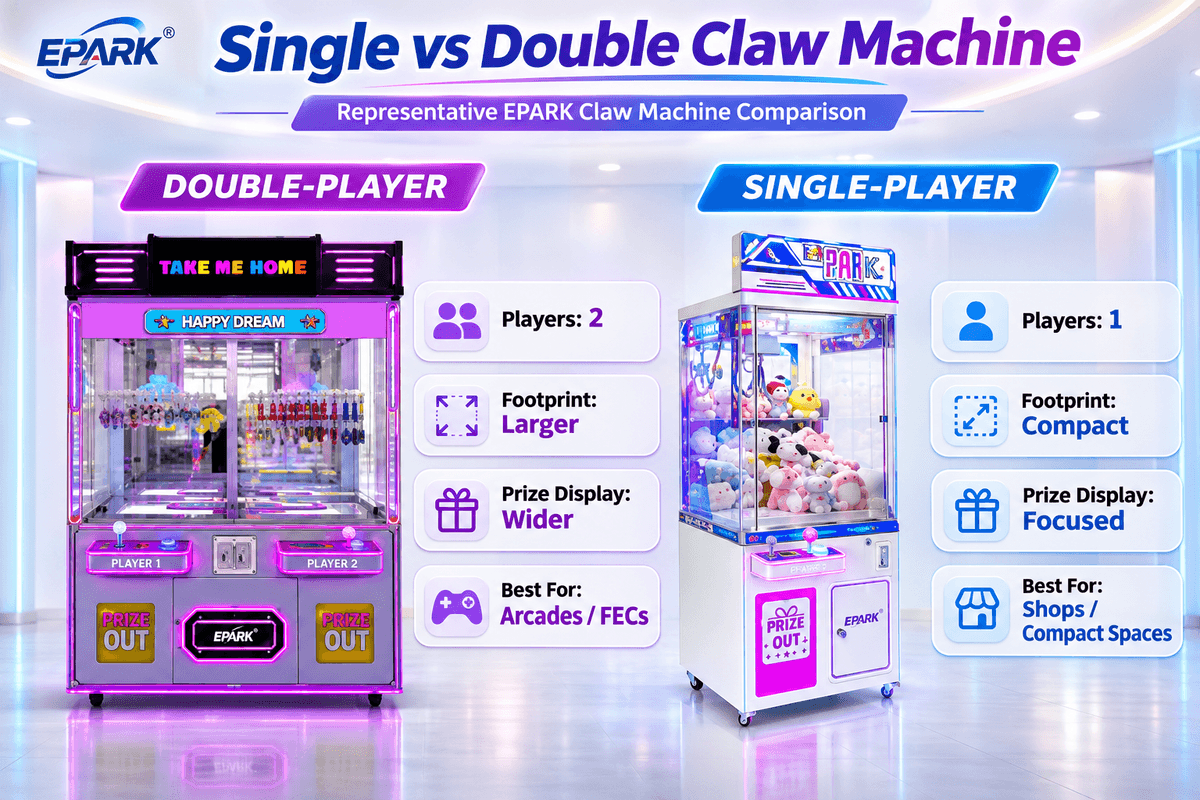
A single-player claw machine is a traditional arcade crane game designed for one player at a time.
Players use a joystick, buttons, or another control system to move the claw and attempt to pick up prizes inside the cabinet.
These machines commonly feature:
- One independent player control station.
- A dedicated prize display and collection area.
- Adjustable claw strength on supported models.
- LED lighting and transparent cabinet panels.
- Coin, bill, card, or digital payment options, depending on configuration.
Single-player machines are widely used in shopping malls, independent arcades, game centers, and family entertainment venues.
Their main advantage is flexibility. Operators can install multiple cabinets in different locations and assign each machine a different prize category or visual theme.
What Is a
A multi-player claw machine allows two or more customers to play simultaneously through multiple player stations integrated into one machine or cabinet configuration.
Common commercial configurations include:
- Double-player claw machines.
- Four-player claw machines.
- Other customized multi-station configurations.
Depending on the model, each player may have an independent claw mechanism, control system, and prize collection arrangement.
Some specialized machines may also support connected or shared gameplay.
Before purchasing, operators should confirm whether each station operates independently or shares certain mechanical and electronic components.
Multi-player machines are particularly attractive for busy entertainment venues where customers often visit in groups.
2.
Single-Player Claw Machines: Advantages and Limitations
Single-player machines remain a practical choice for many commercial arcades because they are relatively straightforward to arrange and operate.
However, their suitability depends on the venue's available space and customer demand.
Advantages of Single-Player Machines
1. Flexible Floor Layout
Individual cabinets can be positioned along walls, in rows, near entrances, or in smaller entertainment corners.
Operators can rearrange machines more easily when changing the store layout or introducing new prize categories.
2. Independent Game Operation
Each cabinet functions as an individual gaming station.
If one machine requires maintenance, the remaining cabinets can generally continue operating, assuming they have independent systems and power connections.
3. Easier Prize Category Management
Different machines can feature different types of merchandise.
For example:
- Plush toys.
- Character merchandise.
- Collectible figures.
- Small gift boxes.
- Seasonal prizes.
This allows operators to test different prize categories without changing the entire machine lineup.
4. Suitable for Smaller Locations
A single-player machine can be installed in a retail entertainment corner, cinema lobby, shopping mall, or compact arcade.
This makes it a useful option for businesses that want to introduce claw machines without creating a dedicated multi-player gaming area.
5. More Flexible Purchasing Strategy
Operators can purchase machines in stages, test their performance, and gradually expand the equipment lineup.
This can be helpful for first-time investors who want to manage their initial investment carefully.
Limitations of Single-Player Machines
The main limitation is that each cabinet serves only one active player at a time.
During busy periods, customers may need to wait for an available machine.
Installing several independent cabinets also means managing multiple payment systems, prize compartments, electrical connections, and maintenance points.
For venues with concentrated group traffic, a large number of individual machines may not always be the most efficient configuration.
3.
Multi-Player Claw Machines: Advantages and Limitations
Multi-player claw machines are designed to accommodate several customers simultaneously, making them an interesting option for busy entertainment environments.
Advantages of Multi-Player Machines
1. Higher Simultaneous Player Capacity
A double-player machine can serve two customers at once, while a four-player configuration can accommodate four players simultaneously.
This can help reduce waiting during peak periods when several customers want to play together.
2. Stronger Social Interaction
Multi-player machines create opportunities for friends, couples, and families to enjoy the game together.
Watching other players attempt to grab prizes can also attract attention from nearby visitors.
3. Efficient Use of Available Floor Space
Depending on cabinet dimensions, multi-player machines may provide more gaming positions within a limited floor area.
This is especially useful for entertainment venues where available space is expensive or restricted.
4. Attractive Central Displays
A larger multi-player cabinet can become a visual focal point in an arcade.
Colorful lighting, multiple control stations, and visible prizes can help create a more dynamic gaming environment.
5. Suitable for Group-Oriented Entertainment
Families visiting shopping malls and groups of friends visiting FECs may prefer playing side by side rather than waiting for separate machines.
Multi-player configurations can help support this type of experience.
Limitations of Multi-Player Machines
Multi-player machines also involve several considerations.
Higher Initial Equipment Investment
A multi-player cabinet may require a larger initial investment than a standard single-player model.
However, buyers should compare the cost per player station rather than looking only at the total machine price.
Less Flexible Placement
Some multi-player cabinets have wider dimensions or require more carefully planned customer access.
They may be difficult to install in narrow corridors or irregularly shaped spaces.
More Complex Maintenance Considerations
Depending on the machine design, multiple player stations may share internal electrical components, control systems, or prize mechanisms.
A fault in a shared component could affect more than one player position.
Buyers should ask manufacturers about the machine's internal configuration, service access, and spare-parts availability.
Prize Management Requirements
Machines with multiple stations may require larger or more frequent prize replenishment, depending on their capacity and operating volume.
Operators should establish a suitable stock management process before installation.
4. Single-Player vs. Multi-Player Claw Machines: Key Differences
The following comparison summarizes the main differences from a commercial purchasing perspective.
| Comparison Factor | Single-Player | Multi-Player |
|---|---|---|
| Player Capacity | One player per machine | Two or more players |
| Cabinet Configuration | Individual cabinet | Multiple stations in one configuration |
| Floor Layout | Highly flexible | Requires more deliberate positioning |
| Initial Investment | Generally lower per unit | Generally higher per unit |
| Cost Per Player Position | Depends on cabinet price | Depends on cabinet price and station count |
| Customer Experience | Individual gameplay | Group-oriented interaction |
| Prize Management | Separate prize selection per machine | Depends on whether stations share or separate prize systems |
| Maintenance | More individual units to maintain | Potentially more complex shared systems |
| Expansion | Easy to add individual cabinets | Depends on available space and configuration |
| Suitable Venues | Small arcades, retail corners, mall locations | Busy arcades, FECs, group entertainment areas |
Neither configuration is universally better.
A single-player machine may be more suitable when an operator needs flexibility and independent prize management.
A multi-player machine may be more attractive when the business needs to accommodate groups and maximize simultaneous gaming positions.
The final decision should be based on the venue's actual operating conditions.
5. Which Claw Machine Setup Fits Different Arcade Venues?
Different commercial locations have different customer behaviors and space limitations.
The ideal machine configuration should reflect how visitors use the venue.
Shopping Malls
Shopping mall entertainment areas often receive a mixture of families, teenagers, and casual visitors.
Single-player claw machines are useful for placing along storefronts, near walkways, and in compact entertainment corners.
Double-player machines can also be effective near areas where families naturally gather.
For larger mall entertainment zones, combining individual cabinets with selected multi-player machines can create a more varied experience.
Independent Arcade Game Centers
Dedicated arcade centers generally have more flexibility in equipment arrangement.
A combination of single-player and multi-player machines can work well.
Single-player cabinets can provide different prize categories, while multi-player units can serve customers who want to play together.
Operators should consider peak-hour traffic, queue formation, and the availability of staff for machine maintenance.
Family Entertainment Centers (FECs)
FECs often attract families and groups of friends who spend more time exploring different attractions.
Multi-player claw machines can provide an additional group activity, especially when positioned in a visible prize-game area.
Single-player machines can complement them by offering a wider selection of prizes and different difficulty settings.
A mixed configuration is often worth considering for FEC operators.
Small Retail Stores and Entertainment Corners
For smaller commercial spaces, single-player machines are usually easier to integrate into existing layouts.
They can be installed near checkout counters, entrances, or other areas where customers have spare time.
Multi-player machines may also work if the cabinet dimensions and player access requirements fit the available space.
Cinema Lobbies and Waiting Areas
Cinema visitors often arrive in pairs or groups and may have time before a screening begins.
A multi-player claw machine can provide an interactive activity for customers waiting together.
Smaller single-player machines can complement the installation without occupying too much floor area.
6. How to Compare Space Efficiency and Player Capacity
Floor space is one of the most important considerations when purchasing commercial arcade equipment.
However, operators should not compare machines using cabinet footprint alone.
A machine may have a compact base but require considerable space in front for players, prize collection, and customer movement.
Calculate the Space Required Per Player Position
A useful preliminary formula is:
Cabinet Area Per Player Position = Cabinet Footprint ÷ Number of Simultaneous Player Positions
For example, if a hypothetical multi-player cabinet occupies 1.6 m² and provides four independent player stations:
1.6 ÷ 4 = 0.4 m² per player position.
This calculation helps compare basic equipment density.
However, it does not represent the total operating area required.
A complete layout must also account for:
- Player standing positions.
- Customer circulation routes.
- Space for waiting visitors.
- Prize collection access.
- Maintenance clearance.
- Emergency access requirements.
Choose a Layout That Matches Customer Movement
Single-player machines can be arranged in straight rows or along perimeter walls.
This works particularly well when operators want to display multiple prize categories.
Multi-player machines are often more suitable for designated gaming zones where several people can gather without blocking the main walkway.
For mixed arcades, consider placing single-player machines around the perimeter and using one or more multi-player cabinets as central attractions.
The final aisle and accessible-route dimensions should comply with the building regulations applicable to the project location.
For U.S. projects, the ADA Standards for Accessible Design provide guidance on accessible routes and circulation requirements.
Consider Player Capacity During Peak Hours
Theoretical player capacity can be estimated using:
Theoretical Plays Per Hour = Number of Player Stations × 60 ÷ Average Game Duration in Minutes
For example, a four-player machine with an average game duration of two minutes has a theoretical capacity of:
4 × 60 ÷ 2 = 120 player sessions per hour.
This is a mathematical maximum under the assumed conditions, not a revenue forecast.
Actual performance will depend on machine availability, payment time, player behavior, repeat plays, and operating conditions.
7. Budget, Operating Costs, and Revenue Considerations
The purchasing decision should consider both initial investment and ongoing operating expenses.
A machine that costs less initially may not necessarily provide better long-term value.
Compare the Initial Investment
When evaluating single-player and multi-player machines, consider:
- Equipment purchase price.
- Shipping and transportation.
- Import duties and taxes.
- Installation expenses.
- Payment system configuration.
- Branding and customization.
- Initial prize inventory.
For multi-player machines, compare the total price with the number of independent player positions.
For single-player machines, consider whether buying multiple units will increase shipping, installation, and maintenance costs.
Evaluate Operating Expenses
Daily operating costs may include:
| Cost Category | What to Consider |
|---|---|
| Electricity | Power consumption and operating hours |
| Prize Inventory | Prize purchase and replenishment |
| Maintenance | Repairs, cleaning, and spare parts |
| Payment Processing | Transaction fees and payment hardware |
| Staffing | Prize replenishment and customer support |
| Floor Space | Rental cost and equipment clearance |
The power consumption of a machine should be confirmed from its actual model specification.
Do not estimate the electricity cost of a multi-player machine by simply multiplying a single-player machine's rated power by the number of stations.
Different configurations may use shared components and different electrical systems.
Estimate Potential Revenue
A basic revenue calculation is:
Monthly Gross Revenue = Paid Plays Per Day × Average Price Per Play × Operating Days
To compare configurations, operators should estimate the number of paid plays each setup can realistically generate.
Then deduct prize costs, payment fees, maintenance expenses, and other operating costs.
A useful additional metric is revenue contribution per square meter.
This helps operators evaluate whether a machine configuration is making effective use of expensive commercial floor space.
Actual performance must be established through location-specific testing. No machine configuration guarantees higher revenue or faster investment recovery.
8. Prize Selection, Payment Systems, and Maintenance
The player configuration is only one part of a successful claw machine operation.
Prize selection, payment convenience, and equipment reliability also influence the overall customer experience.
Prize Selection for Single-Player Machines
Individual machines provide flexibility when managing different prize categories.
Operators can dedicate separate cabinets to:
- Plush toys.
- Character merchandise.
- Small collectible gifts.
- Seasonal products.
- Novelty prizes.
This makes it easier to test different merchandise and adjust individual machine settings.
Prize Selection for Multi-Player Machines
For multi-player machines, operators should confirm how prizes are stored and distributed.
Some configurations may use separate prize compartments for different stations, while others may share certain internal systems.
The prize dimensions, weight, and dispensing mechanism should be compatible with the machine's design.
Before placing a bulk order, request confirmation of the supported prize specifications.
Payment System Compatibility
Modern commercial claw machines may support several payment methods, depending on the model and market.
Common options include:
- Coins and tokens.
- Banknotes.
- Membership cards.
- Contactless cards.
- QR code payments.
For international projects, confirm local payment compatibility, currency settings, voltage, and plug standards before purchasing.
Maintenance and Technical Support
Single-player machines generally allow operators to isolate maintenance tasks to individual cabinets.
Multi-player configurations may require more detailed troubleshooting when multiple stations share components.
Before purchasing either format, ask the manufacturer about:
- Spare parts availability.
- Control system configuration.
- Claw mechanism maintenance.
- Payment system troubleshooting.
- Technical documentation.
- Warranty coverage.
- Remote technical support.
For operators managing multiple locations, equipment consistency and spare-parts availability can be particularly important.
9. Why a Mixed Claw Machine Setup May Be Better
Many commercial arcades do not need to choose exclusively between single-player and multi-player machines.
A mixed configuration can combine the advantages of both.
Use Single-Player Machines for Variety
Individual cabinets can be arranged according to different prize themes.
This creates more choices for customers and gives operators flexibility when updating merchandise.
Use Multi-Player Machines as Attraction Points
A double-player or four-player machine can become a central feature of the claw machine area.
Its multi-station design may attract groups and encourage visitors to play together.
Create a Balanced Equipment Combination
For example, a medium-sized arcade could use:
- Standard single-player machines along the perimeter.
- Double-player machines in high-visibility locations.
- A four-player machine in a central gaming zone.
- Specialty prize machines to diversify the experience.
This is an illustrative concept, not a recommended fixed equipment ratio.
The actual configuration should depend on available floor area, customer demand, equipment prices, and the target audience.
Start With a Pilot Installation
For new arcade operators, it may be useful to begin with a smaller equipment combination.
Monitor:
- Plays per machine.
- Peak-hour demand.
- Average waiting time.
- Revenue per machine.
- Prize replenishment frequency.
- Maintenance frequency.
- Customer preferences.
After collecting operating data, the operator can decide whether additional single-player or multi-player machines are more appropriate.
This approach reduces the risk of purchasing an unsuitable equipment mix at the beginning of the project.
10. How to Choose the Right Claw Machine Supplier
Selecting the right equipment supplier is just as important as choosing the player configuration.
A reliable manufacturer should be able to provide clear technical information, suitable product options, and support throughout the purchasing process.
Check the Manufacturer's Product Range
A supplier offering only one configuration may not be able to provide the most suitable solution for every venue.
Look for manufacturers with different machine sizes and player capacities.
This allows operators to compare standard single-player cabinets, double-player machines, and four-player configurations.
Confirm Technical Specifications
Before ordering, request:
- Machine dimensions.
- Number of independent player stations.
- Power consumption.
- Voltage requirements.
- Prize capacity.
- Payment system options.
- Claw mechanism specifications.
- Maintenance access requirements.
Do not rely on product photographs alone.
Evaluate Customization Capabilities
For branded arcades or shopping mall entertainment projects, customization can help create a consistent visual identity.
Depending on the model, customization may include cabinet colors, logos, exterior graphics, lighting, and payment configurations.
Consider Long-Term Service Support
A commercial claw machine is intended for repeated operation.
Buyers should evaluate spare-parts supply, technical assistance, warranty terms, and the manufacturer's ability to support international projects.
From a manufacturer's perspective, one common purchasing mistake is choosing equipment based only on player capacity.
A four-player machine may look attractive on paper, but if the venue has limited customer traffic or insufficient space, the additional stations may not be fully utilized.
A better approach is to match machine configuration, cabinet dimensions, target customers, and operating costs before finalizing the order.
EPARK is a commercial amusement equipment manufacturer based in Guangzhou, China, with more than 13 years of industry experience and a factory and showroom area exceeding 25,000 m².
Its claw machine product range supports different commercial applications, with equipment customization, OEM/ODM services, and arcade project planning available for international buyers.
11. Frequently Asked Questions About Single-Player and Multi-Player Claw Machines
Are single-player claw machines better than multi-player machines?
Neither option is universally better.
Single-player machines offer flexible placement and independent operation, while multi-player machines accommodate more customers simultaneously.
The best option depends on the arcade's floor area, customer traffic, budget, and operating model.
How many players can use a multi-player claw machine?
Common commercial configurations include double-player and four-player claw machines.
Some manufacturers may offer additional customized configurations.
Always confirm the number of independent player stations and how each station operates.
Are multi-player claw machines more profitable?
They may provide higher simultaneous player capacity, but that does not automatically mean higher profitability.
Revenue depends on customer traffic, paid plays, pricing, prize costs, operating expenses, and equipment utilization.
Operators should compare revenue contribution per square meter and per player station rather than relying on player capacity alone.
Are single-player claw machines suitable for small arcades?
Yes. Single-player machines are often suitable for smaller venues because they can be arranged individually and installed in different areas.
They also allow operators to introduce different prize categories without purchasing large multi-station cabinets.
Can I combine single-player and multi-player claw machines in one arcade?
Yes. A mixed configuration is a practical option for many commercial venues.
Single-player machines can provide variety, while multi-player machines can serve families and groups.
The final equipment ratio should reflect the venue's space and customer demand.
Do multi-player claw machines consume more electricity?
Total power consumption depends on the machine's actual electrical design and number of components.
A multi-player cabinet may use shared systems, so its power consumption should not be estimated by simply multiplying the power rating of a single-player model.
Request the manufacturer's rated power specification for the exact model.
Which configuration is easier to maintain?
Single-player machines generally have simpler individual maintenance arrangements because each cabinet operates separately.
Multi-player machines may have more complex internal systems, depending on their design.
However, maintaining many individual machines can also increase the number of service points.
Spare-parts availability and manufacturer support should be considered for both types.
What should I ask a manufacturer before purchasing multi-player claw machines?
Ask about cabinet dimensions, independent player stations, prize compartments, power requirements, payment options, maintenance access, spare parts, and warranty coverage.
If the machine will be installed in a commercial arcade, also request a layout drawing to verify the required operating space.
12. Conclusion: Choosing the Right Claw Machine Setup for Your Arcade
Choosing between single-player and multi-player claw machines is ultimately a business decision.
Single-player machines are suitable for operators who value flexible placement, independent operation, and a wider variety of prize categories.
Multi-player machines are attractive for venues that want to accommodate groups, increase simultaneous player capacity, and create a more interactive entertainment environment.
For many commercial arcades and family entertainment centers, combining both configurations may provide a more balanced solution.
Before making a purchasing decision, evaluate your venue dimensions, expected customer traffic, target audience, budget, prize strategy, and long-term maintenance requirements.
Working with an experienced amusement equipment manufacturer can also help ensure that the selected machines fit the overall arcade layout.
EPARK provides commercial claw machines, customized equipment configurations, OEM/ODM services, and arcade project planning support for international buyers.
Whether you are opening a small claw machine shop or developing a larger family entertainment center, selecting the right equipment combination is an important step toward building an efficient and attractive arcade business.
