
Starting a claw machine business looks simple: buy several machines, fill them with attractive prizes, place them somewhere busy, and charge customers to play.
The machines may be simple to understand, but the business model is not automatically profitable.
A successful operation depends on five variables working together:
- Location
- Machine selection
- Prize strategy
- Cost control
- Player experience
A poorly located machine with expensive prizes can struggle even if the cabinet itself is excellent. A well-planned group of machines in a visible entertainment location can perform very differently.
This guide explains how to choose a business model, calculate startup costs, evaluate locations, select machines, estimate profit, and avoid common mistakes before investing.
Is a Claw Machine Business a Good Idea?
A claw machine operation can take several forms.
You might place one machine inside an existing restaurant. You might operate ten machines in a shopping mall. Or you might open a dedicated claw machine arcade with dozens of cabinets and a complete cashless payment system.
That flexibility is one reason the concept attracts both first-time amusement investors and established arcade operators.
IAAPA notes that arcade equipment can help attractions convert underused areas such as corners or empty rooms into revenue-producing space while extending guest visits and spending. Modern arcade mixes often include redemption equipment and self-merchandisers such as claw machines.
However, a claw business is not completely passive.
You still need to manage:
- Prize replenishment
- Machine cleaning
- Payment collection or settlement
- Maintenance
- Location relationships
- Performance tracking
- Prize rotation
- Customer issues
The business works best when you treat each machine as a small retail-and-entertainment unit rather than a box that automatically generates cash.
Choose Your Claw Machine Business Model
Before buying equipment, decide what business you are actually building.
Model 1: One or Several Machines Inside Another Business
You place machines inside:
- Restaurants
- Cinemas
- Bowling centers
- Supermarkets
- Indoor playgrounds
- Hotels
- Existing arcades
The venue may charge fixed rent or receive a percentage of revenue.
This model reduces your need to lease an entire store, making it useful for testing demand.
Its biggest challenge is dependence on someone else's traffic.
Model 2: A
Claw Machine Zone
Here, several machines are grouped together inside a mall, FEC, amusement center, or existing entertainment venue.
This format allows you to combine:
- Small-prize machines
- Plush machines
- Collectible machines
- Premium prize machines
- Multi-player cabinets
It also creates more visual impact than a single standalone cabinet.
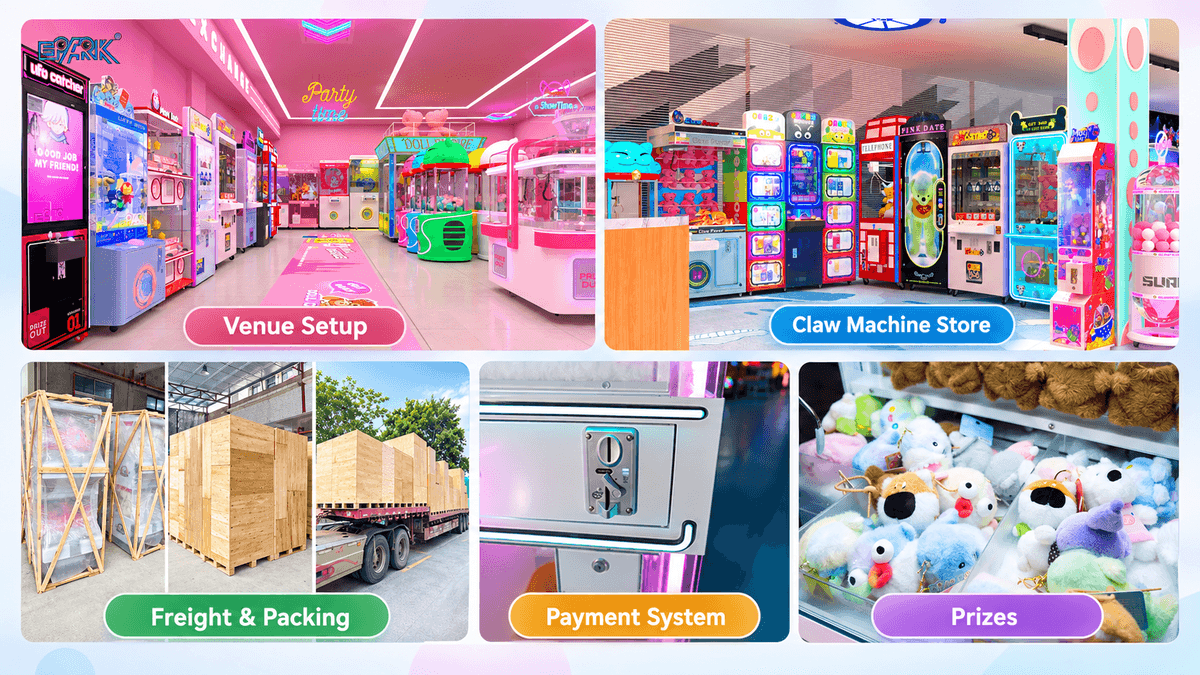
Model 3: A Dedicated
Claw Machine Store
A dedicated store offers the greatest control over branding, prize selection, pricing and customer experience.
It also creates the highest operational commitment.
In addition to equipment, you may need to pay for:
- Rent and deposit
- Interior decoration
- Electrical work
- Signage
- POS or card systems
- Staffing
- Insurance
- Business permits
- Marketing
For a new operator, a smaller pilot can provide valuable operating data before committing to a full store.
How Much Does It Cost to Start a Claw Machine Business?
There is no universal startup figure.
Public 2026 guides commonly place new commercial claw machines around the $800–$3,000+ range for many compact and standard configurations, while larger or more specialized machines can cost considerably more. These are public market references rather than standardized industry averages or EPARK quotations.
Your startup budget should include much more than the machines.
| Cost Category | What It May Include |
|---|---|
| Machines | Mini, standard, large or multi-player cabinets |
| Initial prize inventory | Plush, capsules, blind boxes, collectibles |
| Payment system | Coins, tokens, card readers, RFID or QR |
| Shipping | Domestic or international freight |
| Import costs | Duties, taxes and customs fees where applicable |
| Location | Deposit, rent or revenue-share commitment |
| Store preparation | Electrical work, signage and decoration |
| Spare parts | Motors, joysticks, buttons, power supplies and boards |
| Licenses / insurance | Depends on jurisdiction |
| Marketing | Opening promotion, social media and signage |
| Working capital | Replenishment and operating reserve |
The U.S. Small Business Administration recommends separating startup expenses into one-time and ongoing costs before launch. Typical startup categories include equipment, inventory, permits, insurance, utilities, salaries and marketing.
Do Not Forget Landed Cost
If you import machines, the factory quotation is not your final cost.
A basic calculation is:
Landed Cost = Machine Price + Freight + Insurance + Import Duty + Taxes + Customs / Local Delivery Costs
The U.S. International Trade Administration describes landed cost in essentially the same way and recommends treating it as an estimate because tariffs and other charges can change.
This distinction becomes particularly important when comparing factory-direct equipment with locally stocked machines.
How to Choose a Profitable Location
Location can make two identical machines produce completely different results.
Do not evaluate a site only by asking, “Is there a lot of foot traffic?”
Instead, examine the quality of that traffic.
1. Foot Traffic
Count how many people actually pass the proposed machine area.
Do this at:
- Weekday lunch
- Weekday evening
- Friday evening
- Weekend afternoon
- Weekend evening
Traffic that exists only during one narrow time period creates more risk.
2. Dwell Time
People need a reason to stop.
Good environments often include:
- Cinema waiting areas
- Bowling centers
- FECs
- Food courts
- Family restaurants
- Indoor playgrounds
- Mall entertainment zones
A busy walkway where everyone is rushing past may perform worse than a slightly quieter area where families spend 30 minutes waiting.
3. Visibility
A machine should ideally be visible before the customer walks directly past it.
Evaluate:
- Sight lines
- Entrance visibility
- Lighting
- Signage restrictions
- Nearby obstructions
- Queue space
A visually attractive machine hidden behind a pillar still has a visibility problem.
4. Audience Fit
Ask who visits the location.
Children and families may respond to plush toys and colorful themes.
Teenagers and young adults may prefer:
- Collectibles
- Character merchandise
- Blind boxes
- Trend-based prizes
- Premium gifts
The prize plan should follow the audience—not the other way around.
5. Occupancy Cost
A busy mall is not automatically a profitable location if rent consumes the contribution generated by the machines.
Compare:
Fixed Rent vs. Revenue Share vs. Minimum Rent + Revenue Share
Model the numbers before signing.
Simple Location Scorecard
| Factor | Score 1–5 |
|---|---|
| Foot traffic | |
| Visibility | |
| Dwell time | |
| Target audience fit | |
| Rent / commission attractiveness | |
| Operating hours | |
| Security | |
| Power and service access | |
| Nearby entertainment demand | |
| Competition |
A location scoring 42/50 deserves more investigation than one scoring 24/50, but the score is only a decision tool. Always test your assumptions against real operating data.
The SBA likewise advises businesses to consider target customers, rental rates, utilities, government restrictions, taxes and other location-dependent expenses when selecting a site.
Choose the Right Machines and Prize Mix
Do not buy twenty identical cabinets simply because you received a good bulk price.
The better question is:
What role should each machine play in the venue?
Useful for:
- Small prizes
- Narrow spaces
- Children's areas
- Low-cost trial plays
Suitable for:
- Plush toys
- Retail gifts
- General arcade use
- Mall entertainment areas
Useful where:
- Foot traffic is high
- Groups play together
- Floor space needs to serve several customers simultaneously
Cut-prize and key-style formats can create variety and support different prize values.
For operators planning several cabinets, EPARK offers commercial claw machine formats as part of its wider amusement equipment range.
Build the Prize Strategy Before Finalizing the Machine
A common procurement mistake is buying cabinets first and choosing prizes afterward.
Instead:
- Identify the target audience.
- Select several prize categories.
- Record prize dimensions and weight.
- Choose the matching cabinet and claw.
- Test representative prizes.
- Determine replenishment quantities.
Prize appeal matters because the cabinet itself acts as a display.
A cheap prize that nobody wants is not necessarily economical.
Payment, Pricing and Game Settings
The payment system affects both player convenience and operating efficiency.
Typical options include:
- Coins
- Tokens
- Bills
- RFID cards
- Arcade cards
- QR payments
- Third-party cashless systems
An existing FEC may prefer integration with its central card platform.
A small standalone placement may work better with a simple coin or QR system.
EPARK's supplied company information states that payment-related customization can include coin, membership-card and QR-based configurations depending on project requirements.
How Much Should You Charge Per Play?
Do not copy a competitor's price blindly.
Your play price needs to consider:
- Prize acquisition cost
- Expected local spending level
- Venue type
- Competing attractions
- Payment fees
- Desired player experience
You should also understand local amusement and prize-game rules. Licensing, prize restrictions and game classifications vary by jurisdiction.
How to Calculate Claw Machine Revenue and Profit
A realistic claw machine business plan starts with paid plays, not a supplier's income claim.
Revenue Formula
Monthly Gross Revenue = Machines × Paid Plays per Day × Price per Play × Operating Days
Suppose you operate five machines at $1 per play.
| Paid Plays per Machine / Day | Five-Machine Monthly Gross Revenue* |
|---|---|
| 20 | $3,000 |
| 40 | $6,000 |
| 70 | $10,500 |
*Illustrative calculation using 30 operating days. It is not a profit forecast.
Now subtract costs.
Profit Formula
Operating Profit = Gross Revenue − Prize Cost − Rent / Venue Share − Payment Fees − Labor − Maintenance − Utilities − Marketing − Other Expenses
For a dedicated store, rent and labor may be major expenses.
For a placement route, transportation and venue commission may matter more.
Calculate Break-Even
The SBA uses the general formula:
Break-Even Units = Fixed Costs ÷ (Selling Price − Variable Cost per Unit).
You can adapt this concept to paid plays.
For example:
Required Plays per Month = Monthly Fixed Costs ÷ Contribution per Play
Where:
Contribution per Play = Price per Play − Variable Cost per Play
This approach is far more useful than asking whether claw machines “normally pay back in three months.”
Payback Period
Once you have actual operating data:
Payback Period = Total Startup Investment ÷ Average Monthly Operating Profit
Use at least several months of data before treating one strong opening month as normal performance.
How to Improve Claw Machine Business Profit
Profit improvement usually comes from several small operational gains rather than one dramatic change.
Control Prize Cost Without Making the Game Unattractive
Track:
Prize Cost Ratio = Prize Cost Distributed ÷ Game Revenue
But do not focus only on minimizing this percentage.
Players also need to believe the experience offers genuine entertainment value. A game perceived as impossible to win can damage repeat play.
Rotate Prizes
Refresh prizes based on:
- Sales data
- Season
- New character trends
- Local events
- Player age
- Social-media interest
Move slowly performing prizes rather than leaving them in the same machine indefinitely.
Reduce Downtime
A machine earning nothing for three days because of a minor component failure can cost more than stocking a few spare parts.
Consider keeping commonly serviced items such as:
- Buttons
- Joysticks
- Claw components
- Motors
- Power supplies
- Sensors
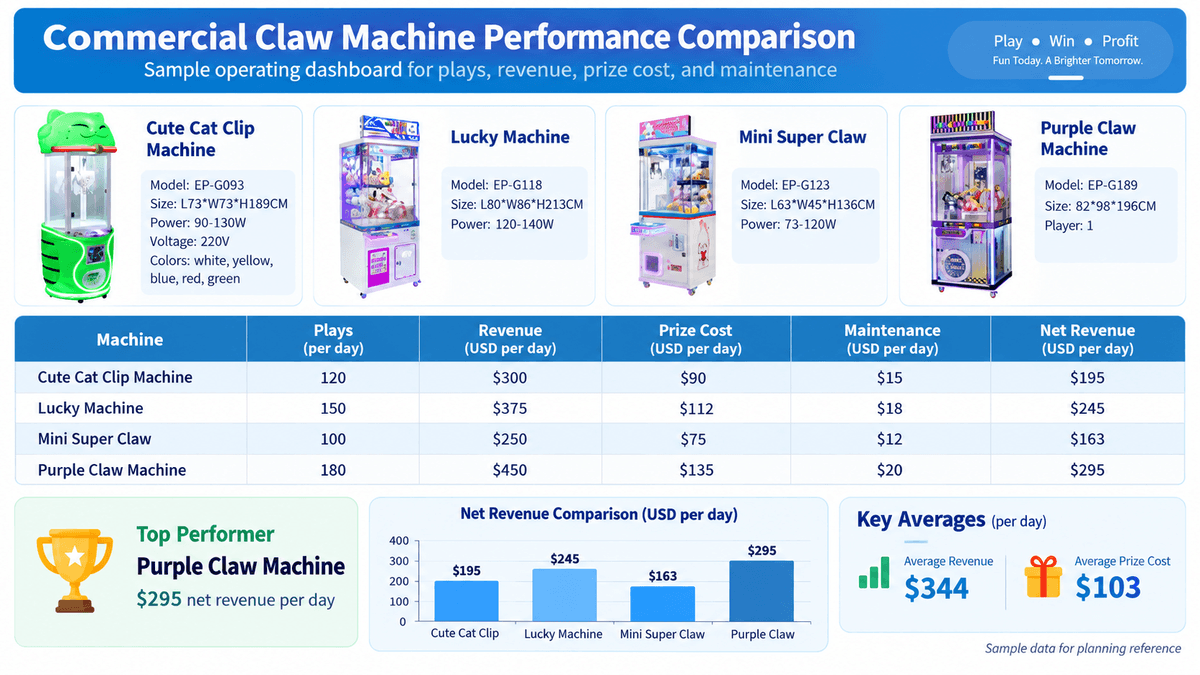
Track Each Machine Separately
Do not combine all machine revenue into one total and stop there.
Monitor:
- Plays
- Revenue
- Prize consumption
- Downtime
- Refill frequency
- Maintenance
- Location performance
This makes it possible to identify which machine or location should be adjusted.
Supplier Perspective: What to Check Before Buying Machines
From a supplier perspective, many first-time buyers start by asking:
“How much is one claw machine?”
For a business project, that is not enough information.
A better supplier conversation begins with:
- Country
- Venue
- Floor area
- Number of machines
- Target customers
- Prize category
- Payment system
- Voltage
- Opening date
- Customization requirements
Check Actual Manufacturing Capability
If purchasing direct from a manufacturer, evaluate:
- Factory and assembly capacity
- Technical team
- Quality-control procedures
- Product testing
- Parts availability
- Packaging
- OEM/ODM capability
- After-sales response
According to the supplied company information, EPARK is based in Panyu, Guangzhou, with more than 25,000 square meters of factory and showroom space and over 13 years of game-equipment manufacturing experience. The company supports factory-direct supply, OEM/ODM, production, customization and technical after-sales services.
Its current website likewise describes one-stop project services covering equipment selection and arcade planning.
Confirm Electrical Configuration
International buyers should specify:
- Voltage
- Frequency
- Plug type
- Destination country
EPARK's supplied information states that equipment can be configured for 110V/220V and regional plug standards, subject to the specific product and target market.
Ask About Spare Parts Before Shipping
Ask the supplier:
- Which parts fail most often?
- Which spare parts are included?
- Can extra parts ship with the order?
- Are wiring diagrams available?
- Is remote troubleshooting offered?
This matters especially when machines are imported and replacement shipments may take time.
Launch Your First 90 Days
Do not treat opening day as the end of the project.
Treat the first three months as a testing period.
Days 1–30: Establish a Baseline
Record:
- Revenue by machine
- Plays by machine
- Prize usage
- Customer complaints
- Machine downtime
- Busy days
- Busy hours
Avoid making major conclusions from one weekend.
Days 31–60: Optimize
Experiment with:
- Prize rotation
- Machine position
- Signage
- Display density
- Play pricing
- Cabinet grouping
Change one important variable at a time where possible so you can understand what caused the result.
Days 61–90: Decide Whether to Scale
After roughly three months, ask:
- Which machines are consistently strongest?
- Which prize categories move fastest?
- Which machines require the most service?
- Is the location financially viable?
- Can the same model work elsewhere?
Only scale after the unit economics make sense.
Common Claw Machine Business Mistakes
Mistake 1: Signing an Expensive Lease Before Testing Demand
High traffic does not automatically justify high rent.
Mistake 2: Buying Machines Only by Price
A small saving on procurement can disappear quickly if the machine has frequent downtime or difficult-to-source components.
Mistake 3: Ignoring Prize-Machine Compatibility
The claw, cabinet and prize should be selected as one system.
Mistake 4: Using the Same Prize Strategy Everywhere
A family FEC, tourist destination and youth shopping mall may require completely different merchandise.
Mistake 5: Forgetting Working Capital
Opening inventory is not enough. You need money for replenishment, repairs and other operating expenses.
Mistake 6: Assuming Revenue Equals Profit
Gross revenue still has to pay for prizes, space, payment fees, maintenance, taxes and labor.
Mistake 7: Scaling Too Quickly
Five profitable machines provide useful evidence.
Five profitable machines do not automatically prove that fifty machines will generate the same return.
Frequently Asked Questions About Starting a Claw Machine Business
How much money do I need to start a claw machine business?
It depends on the model. A one-machine placement requires much less capital than a dedicated claw arcade. Budget for machines, prizes, payment hardware, transportation, location costs, permits where required, spare parts and working capital—not just the purchase price.
How much can one claw machine make per month?
There is no reliable universal figure. Revenue depends primarily on paid plays, price per play, location traffic, visibility, audience fit and uptime.
Use:
Monthly Revenue = Plays per Day × Price per Play × Operating Days
Then deduct actual operating costs to estimate profit.
What is the best location for a claw machine?
Strong locations generally combine visibility, suitable demographics and dwell time. Malls, cinemas, arcades, FECs, bowling centers, restaurants and indoor playgrounds can all work, but each individual site should be tested.
Should I pay fixed rent or revenue share?
Neither model is automatically better.
Fixed rent can be attractive in a proven high-revenue location. Revenue share can reduce downside risk during a pilot. Model both scenarios using conservative revenue assumptions.
How many machines should a beginner buy?
There is no required number. Starting with a small pilot allows you to test the location, prizes, maintenance requirements and player response before committing more capital.
What prizes work best in claw machines?
The answer depends on your audience. Plush toys work well in many family environments, while collectibles, blind boxes and character merchandise may appeal more strongly to teenagers and young adults.
Prize size and weight also need to match the claw mechanism.
Do I need a business license for claw machines?
Requirements vary by country, state and city. Some jurisdictions regulate amusement machines, prize games, business premises or prize values. Check local authorities before opening.
Can claw machines use card or QR payments?
Many commercial machines can support cashless systems, but compatibility should be confirmed before purchase. Existing arcades may also want machines integrated with their current card platform.
Is it better to buy locally or directly from a manufacturer?
Local suppliers can offer faster delivery and potentially easier local servicing. Factory-direct sourcing can offer greater customization and economies for larger projects.
Compare the total landed and operating cost, not only the machine quotation.
Conclusion: Start Small, Measure the Numbers, Then Scale
Starting a claw machine business is not simply a matter of buying machines and finding an empty corner.
A stronger business plan follows this sequence:
- Choose the business model.
- Define the target customer.
- Test the location.
- Calculate the complete startup budget.
- Select machines around the prize strategy.
- Confirm payment and electrical requirements.
- Track plays, prizes and downtime.
- Calculate real operating profit.
- Optimize before expanding.
The most important number is not the cheapest machine price or somebody else's monthly revenue screenshot.
It is your own unit economics.
For buyers planning more than a few machines, supplier capabilities can also affect the project. EPARK's supplied company information describes manufacturing, OEM/ODM, arcade equipment configuration, venue planning, 3D design, installation-related support and remote technical after-sales service for international entertainment projects.
Before requesting an equipment proposal, prepare your country, venue size, planned machine quantity, customer profile, prize type, payment method and approximate budget. That gives the supplier enough information to recommend a practical machine mix rather than simply sending a generic catalog.
