
Hotels and resorts are increasingly looking for ways to create memorable guest experiences beyond accommodation, dining, and traditional leisure facilities. For properties that welcome families, a well-planned entertainment area can provide guests with another enjoyable activity during their stay.
Commercial claw machines are one option worth considering. They offer simple gameplay, colorful prize displays, and entertainment that can appeal to children, teenagers, and adults.
However, choosing claw machines for hotels requires a different approach from purchasing equipment for a dedicated arcade.
Hotel operators must consider more than machine appearance and potential revenue. Equipment should fit the property's interior design, available space, guest demographics, operating hours, payment systems, and maintenance arrangements.
A compact claw machine may work well in a family hotel lobby, while a larger resort could benefit from a dedicated game room with several different prize machines.
This guide explains how to choose suitable claw machines for hotels, resorts, and family leisure spaces, covering machine types, placement, prizes, payment systems, operating costs, and supplier selection.
1. Why Claw Machines Can Be a Good Fit for Hotels and Resorts
Entertainment facilities can help hotels provide more activities for guests, particularly families traveling with children.
While swimming pools, children's clubs, and outdoor recreation facilities remain important, indoor gaming options can provide an additional activity when guests prefer to stay inside.
Claw machines are particularly flexible because they do not always require a large dedicated arcade.
Simple Entertainment for Different Age Groups
The basic concept of a claw machine is easy to understand. Players control a mechanical claw and attempt to collect a prize from the cabinet.
Different machine designs, prize types, and gameplay settings can appeal to different age groups.
Children may enjoy plush toys and colorful displays, while teenagers and adults may be interested in collectible gifts or novelty merchandise.
The selected machine and prizes should always be appropriate for the intended users.
Flexible Installation Options
Commercial claw machines can be installed individually or in groups.
Potential locations include:
- Hotel game rooms.
- Resort entertainment centers.
- Family leisure areas.
- Suitable lobby recreation corners.
- Indoor family activity zones.
- Entertainment areas near other guest facilities.
The correct location depends on traffic patterns, available floor space, safety requirements, and the hotel's operating policies.
Additional Revenue and Guest Experience Opportunities
Claw machines may operate as paid attractions, complimentary guest activities, or part of a larger entertainment package.
For example, a family resort could offer guests a limited number of game credits as part of a promotional package.
Other properties may operate machines independently and charge per play.
These models offer different commercial benefits. A paid machine can generate direct revenue, while a complimentary experience is primarily an amenity cost intended to support guest satisfaction.
Hotel operators should select the model that fits their overall hospitality strategy.
2. Match Claw Machines to Your Property Type and Guest Profile
Not every hotel requires the same entertainment equipment.
A business hotel, family resort, beachfront property, and indoor leisure center can have very different audiences.
Before choosing a machine, identify who will use it and how the entertainment area supports the property.
Family Hotels
Family hotels often welcome guests traveling with young children.
Suitable equipment may include compact or standard claw machines with:
- Clear, easy-to-use controls.
- Bright but comfortable lighting.
- Age-appropriate plush toys.
- Suitable cabinet and control heights.
- Convenient payment methods.
- Easy access for cleaning and prize replenishment.
A small number of well-selected machines may be sufficient for a modest family entertainment corner.
Beach Resorts and Holiday Resorts
Resorts may receive families staying for several days, as well as couples and groups.
Because guests can spend more time on the property, resorts may benefit from a wider range of entertainment options.
A dedicated game room could combine standard claw machines, double-player machines, specialty prize machines, and other appropriate arcade attractions.
Machine cabinet colors and merchandise can also be selected to complement the resort's theme.
Luxury and Boutique Hotels
For upscale properties, equipment appearance and environmental compatibility may be especially important.
A standard brightly colored arcade cabinet may not suit every lobby or lounge.
Consider more restrained cabinet colors, coordinated graphics, carefully selected lighting, and premium-looking prize displays.
The goal is to integrate entertainment into the guest experience without making the area feel visually inconsistent with the hotel.
Family Leisure Centers and Mixed-Use Venues
Family leisure spaces often combine several activities, such as indoor playgrounds, restaurants, sports games, and arcade attractions.
These venues may benefit from multiple machine types and dedicated prize-game zones.
A mixture of single-player and multi-player machines can provide variety while accommodating customers arriving in groups.
Recommended Machine Configurations by Venue
| Venue Type | Suitable Machine Types | Main Consideration |
|---|---|---|
| Small family hotel | Mini or standard single-player machines | Limited space and simple operation |
| Large family hotel | Standard and double-player machines | Mixed-age guest entertainment |
| Beach or holiday resort | Standard, multi-player, and themed machines | Varied activities and guest experience |
| Luxury or boutique hotel | Customized compact or standard cabinets | Appearance, sound, and brand consistency |
| Family leisure center | Mixed claw and specialty prize machines | Equipment variety and visitor circulation |
| Dedicated resort game room | Standard, multi-player, and larger machines | Capacity, prize variety, and maintenance |
These are general equipment-planning recommendations. The final selection should reflect the individual venue's space, demand, and operating model.
3. Types of
Claw Machines to Consider for Hospitality Venues
Commercial claw machines are available in different formats.
Understanding their differences helps hotel buyers avoid purchasing equipment that is too large, too complicated, or unsuitable for the intended guests.
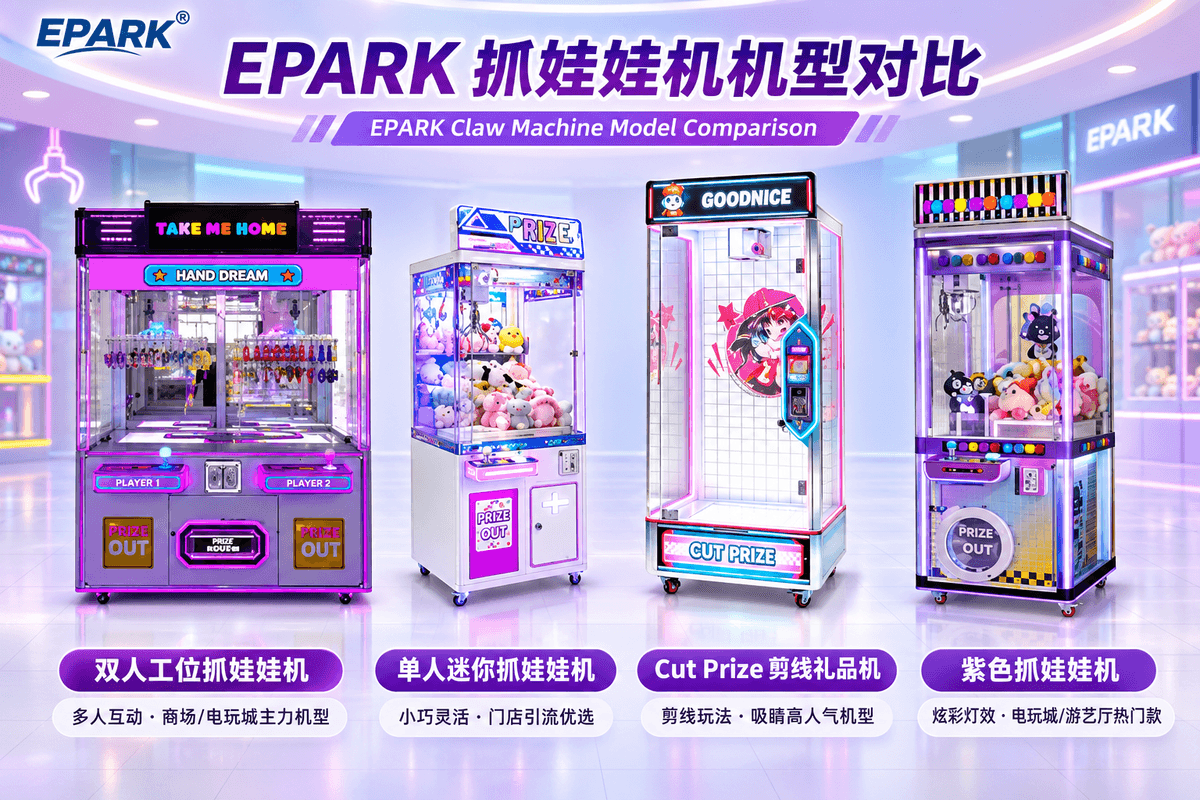
Mini claw machines feature compact cabinets and generally accommodate smaller prizes.
They may be suitable for hotels with limited entertainment space or properties testing an initial installation.
Their advantages include:
- Compact equipment footprint.
- Flexible positioning.
- Compatibility with suitable small prizes.
- Potential use in smaller recreation corners.
However, smaller cabinets do not automatically mean better accessibility. The location and height of the controls should still be evaluated.
Standard single-player machines are a versatile option for many hotel entertainment areas.
Each machine usually contains one operating station and a dedicated prize display.
They can be arranged individually or in rows, allowing operators to offer different prize categories.
For hotels introducing claw machines for the first time, standard single-player models are often a useful starting point because they can be moved or supplemented as the entertainment area develops.
Multi-player claw machines allow two or more customers to play simultaneously, depending on the model.
These machines are especially suitable for venues where families and groups often participate in activities together.
Their potential benefits include:
- Simultaneous gameplay.
- Social interaction.
- A more visually active entertainment area.
- Multiple playing positions within one cabinet configuration.
Before ordering, confirm whether each player station has independent controls and mechanisms.
Multi-player equipment may also require more floor space around the cabinet to accommodate customers standing on different sides.
Specialty machines, such as Cut Prize or Key Master-style equipment, can add variety to a dedicated entertainment area.
However, these machines may involve different gameplay systems, prize requirements, and legal classifications.
For a hospitality venue, specialty machines should be selected only after reviewing the intended audience, operating model, and applicable regulations.
Which Machine Type Should You Choose?
If the property has limited space and modest expected demand, start by evaluating compact or standard single-player models.
If the venue receives larger family groups and has a dedicated game room, double-player or multi-player machines may provide a more interactive experience.
If the property wants a distinctive branded entertainment area, customized cabinets may be preferable.
The best machine is not necessarily the largest or most expensive model. It is the one that fits the guest experience and can be operated effectively.
4. Best Locations for Claw Machines Within Hotels and Resorts
Machine placement can significantly affect visibility, guest convenience, noise, and daily operations.
For hotels, an attractive location is not automatically an appropriate installation location.
Hotel Lobby Recreation Corners
A lobby recreation corner may provide convenient access to guests waiting for check-in or transportation.
However, claw machines should not interfere with reception queues, luggage movement, entrance circulation, or the overall atmosphere.
Select compact cabinets and consider lower-volume sound settings where supported.
Avoid positioning machines directly beside quiet seating or guest service counters.
Dedicated Hotel Game Rooms
A dedicated game room offers greater flexibility in machine selection.
Operators can arrange several claw machines alongside other amusement equipment while keeping entertainment activity separate from quieter hotel facilities.
A dedicated room also makes it easier to manage opening hours, supervision, payment facilities, and maintenance.
Near Family Activity Areas
Claw machines can complement indoor playgrounds, family lounges, or organized children's activity areas.
However, machines should not block play-area entrances or emergency routes.
The hotel should also decide whether the machines form part of a supervised program or operate as an independent attraction.
A machine placed near a children's club should not be assumed to be supervised by club staff unless that responsibility has been formally assigned.
Resort Entertainment Centers
Larger resorts may operate dedicated amusement centers serving both staying guests and permitted external visitors.
In these environments, several claw machines can be grouped by prize category or player type.
A coordinated layout can improve visibility and create a more complete arcade experience.
Location Evaluation Checklist
Before selecting a position, evaluate:
- Guest visibility and access.
- Available floor space.
- Reception and circulation conflicts.
- Noise-sensitive nearby areas.
- Electrical supply.
- Maintenance and prize-refilling access.
- Security and supervision arrangements.
- Local building, fire, and accessibility requirements.
A good location balances commercial visibility with guest comfort and safe operation.
5. How to Plan Space and Layout for Hotel Claw Machines
A successful layout considers both the cabinet footprint and the surrounding operating space.
Hotel buyers should not rely only on the dimensions shown in product photographs.
Measure the Complete Installation Area
Before purchasing, request the machine's:
- Width.
- Depth.
- Height.
- Weight.
- Packed dimensions.
- Door opening requirements.
- Ventilation clearances.
- Maintenance access requirements.
The machine must also fit through the building's loading route, including doors, corridors, lifts, and turning points.
Allow Space for Players and Other Guests
Guests need room to stand in front of the controls.
Family members may watch, children may move around the machine, and other visitors still need access to nearby facilities.
For multi-player machines, evaluate each active player position.
The layout must preserve required circulation routes, accessible paths, and emergency exits.
Consider Small and Large Installations
One or Two Machines
For a small hotel, individual cabinets may be installed in a designated entertainment corner.
The arrangement should preserve surrounding circulation and provide easy maintenance access.
Three to Six Machines
A medium-sized entertainment area can use a wall-line or grouped arrangement.
Operators may offer several prize categories while keeping payment and customer access straightforward.
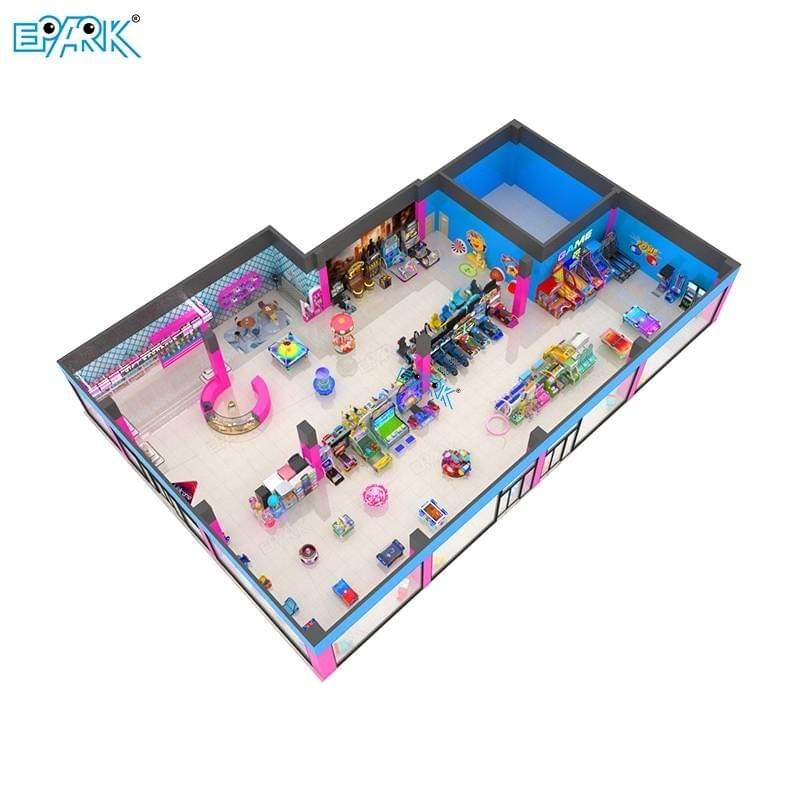
Larger Game Rooms
For dedicated resort game rooms, equipment can be arranged into themed zones.
A combination of perimeter machine rows and selected central attractions may be appropriate if circulation permits.
These equipment quantities are planning scenarios, not fixed recommendations for particular floor areas.
Avoid Overcrowding
Installing more machines does not necessarily create a better guest experience.
Crowded layouts can make it harder to supervise children, refill prizes, or provide suitable access for people with disabilities.
The final layout should be based on the actual machines and site conditions, with relevant local requirements verified before installation.
6. Choose Prizes That Match Your Guests and Hotel Brand
Prize selection is an important part of operating claw machines in hospitality venues.
Guests may be attracted by the game itself, but the displayed prizes influence whether they want to participate.
Plush Toys for Family-Oriented Venues
Plush toys are a familiar choice for family entertainment.
Hotels can select suitable sizes, colors, and themes based on their guest profile.
For example, a beach resort might choose marine-themed plush merchandise, while a nature resort might use animal designs.
Prize products should meet applicable labeling, age suitability, and product safety requirements.
Souvenir and Collectible Prizes
Some hotels may prefer merchandise that reflects the property's destination or identity.
Possible categories include:
- Themed plush toys.
- Novelty souvenirs.
- Small collectibles.
- Seasonal merchandise.
- Licensed character products purchased through authorized channels.
A coordinated prize selection can make the machine feel more integrated into the guest experience.
Consider Prize Dimensions and Weight
Not every prize is suitable for every claw mechanism.
Before ordering equipment, check:
- Recommended prize size.
- Prize weight range.
- Claw dimensions.
- Prize chute opening.
- Cabinet storage capacity.
- Refilling requirements.
Ask the supplier to confirm compatibility with representative prize samples.
Plan Prize Inventory Costs
Prize inventory is an ongoing operating expense.
The operator should monitor:
- Average merchandise cost.
- Number of paid plays.
- Prizes awarded.
- Replenishment frequency.
- Damaged or missing inventory.
- Seasonal demand.
For promotional or complimentary games, prize expenditure should be treated as an amenity or marketing cost.
For paid games, it should be incorporated into the attraction's operating economics.
7. Choose Payment Options That Are Convenient for Hotel Guests
Payment convenience is particularly important for international hospitality venues.
Guests may not carry local coins or tokens, especially when visiting from overseas.
A suitable payment system should match both guest preferences and the hotel's existing operating arrangements.
Coin and Token Payments
Coin-operated claw machines can be straightforward for venues that already operate arcade tokens or local cash payment facilities.
However, coin handling requires regular collection, reconciliation, and maintenance.
For international resorts, guests may find coins less convenient than cashless payment methods.
Card and QR Code Payments
Depending on the machine configuration, supported payment options may include:
- Credit or debit card terminals.
- Contactless payments.
- Membership cards.
- QR code payment systems.
- Prepaid game cards.
Compatibility depends on the payment provider, destination country, equipment interface, and commercial agreement.
Hotel buyers should specify the preferred payment method before equipment production.
Room-Charge Integration
Some hotels allow guests to charge recreation expenses to their room accounts.
This can be convenient, but it requires a compatible and authorized process.
A claw machine does not automatically support direct room-charge integration simply because it accepts electronic payments.
The hotel must confirm whether integration with its property management system, payment gateway, or guest account platform is technically and commercially feasible.
Where direct integration is unavailable, a hotel may use separately purchased game credits or another approved payment arrangement.
Complimentary and Promotional Game Credits
Hotels may also provide limited game credits through family packages, loyalty benefits, or seasonal promotions.
This approach may be attractive when the primary goal is enhancing guest experience rather than maximizing direct machine revenue.
However, operators should budget for prize costs and establish clear rules for credit distribution and redemption.
8. Safety, Accessibility, Noise, and Interior Design Considerations
Hospitality venues often operate around the clock and accommodate guests with different needs.
Claw machines should fit the property's safety expectations, accessibility requirements, and overall atmosphere.
Choose Equipment Suitable for Public Use
Commercial buyers should examine:
- Cabinet stability.
- Door locks and secure panels.
- Protected electrical components.
- Suitable cabinet materials.
- Safe edges and accessible controls.
- Product-specific safety documentation.
- Installation and operating instructions.
Machine stability should be checked during installation, particularly in areas used by children.
Confirm Local Legal Requirements
Prize-machine regulations vary between markets.
In some jurisdictions, certain crane machines may be classified as gaming machines rather than ordinary vending equipment.
For example, the UK Gambling Commission explains that crane machines with particular gameplay and payout mechanisms may fall under gaming-machine requirements, including permissions for the premises.
Buyers should verify the local rules governing machine type, stake and prize limits, age restrictions, licenses, and operating locations before purchase.
Consider Accessibility
Guests using wheelchairs or other mobility aids should be able to navigate relevant areas of the property.
Machine positions should not obstruct accessible routes.
Control height, reach, approach space, and surrounding circulation should be reviewed under the applicable local accessibility standards.
Manage Noise and Lighting
A hotel entertainment corner has different environmental requirements from a dedicated arcade.
Sound effects and flashing lights may disturb guests in nearby lounges, restaurants, corridors, or guestrooms.
Where supported, choose machines with adjustable sound and lighting settings.
Do not assume that all models offer these functions.
Coordinate the Cabinet Design With the Interior
Cabinet colors, graphics, LED lighting, and prize displays should complement the property's design.
Luxury hotels may prefer restrained branding, while family resorts may benefit from brighter themes.
EPARK offers customization options for suitable commercial claw machine models, including cabinet appearance, logos, colors, lighting, and payment configurations.
Hotel buyers can use these options to create a more consistent visual style without changing the wider interior design concept.
9. Plan Maintenance and Daily Operations Before Buying
Unlike a dedicated arcade, a hotel may not employ technicians who specialize in amusement machines.
Maintenance requirements should therefore be considered during purchasing.
Choose Machines That Are Easy to Service
Before purchasing, ask how staff or technicians access:
- The claw mechanism.
- Control board.
- Power supply.
- Payment hardware.
- Prize compartment.
- Cabinet locks.
- Lighting components.
Machines with practical service access can reduce maintenance disruption.
Decide Who Will Operate the Machines
Hotels commonly have several possible operating arrangements.
Hotel-Operated Model
The property purchases the machines and manages payments, prizes, cleaning, and basic operation.
This gives the hotel greater control but also creates maintenance and administrative responsibilities.
Third-Party Operator Model
An external amusement operator may provide machines and manage the operation under a commercial agreement.
The scope of responsibilities, machine ownership, revenue sharing, insurance, and maintenance should be clearly documented.
Complimentary Amenity Model
The hotel operates machines as part of its guest activity program.
This model requires budgeting for equipment, prizes, staff time, and maintenance rather than relying on play revenue.
Establish a Daily Operating Routine
A simple operating checklist can include:
- Inspecting the cabinet and control panel.
- Checking for visible damage.
- Testing payment functions.
- Confirming the prize chute is clear.
- Checking prize stock.
- Cleaning frequently touched surfaces.
- Reviewing machine faults.
- Recording unusual incidents.
Where faults involve electrical or mechanical components, repairs should be handled by qualified personnel.
Prepare for Seasonal Demand
Resorts may experience seasonal changes in occupancy and guest demographics.
Prize inventory, operating hours, and staffing plans may need adjustment during holidays or peak travel periods.
Monitoring actual machine usage provides a better basis for these decisions than relying on fixed assumptions.
10. Compare Budget, Operating Value, and Supplier Capabilities
The cheapest machine is not necessarily the most suitable choice for a hotel or resort.
Commercial buyers should compare total costs, technical specifications, and long-term service requirements.
Understand the Full Purchase Cost
A complete cost comparison should consider:
| Cost Category | What Hotel Buyers Should Check |
|---|---|
| Machine Purchase | Model, cabinet size, player capacity |
| Customization | Colors, logos, graphics, lighting |
| Payment System | Card, QR, coin, or other compatible systems |
| Shipping | Packing, freight, customs and local delivery |
| Installation | Electrical preparation, handling, commissioning |
| Prize Inventory | Initial merchandise and ongoing replenishment |
| Maintenance | Parts, service support, downtime |
| Operation | Staffing, payment fees, cleaning, utilities |
For international buyers, request a quotation with clear delivery terms and a detailed list of included accessories.
Calculate Revenue and Operating Contribution
For paid machines, a simple starting formula is:
Monthly Play Revenue = Average Paid Plays per Day × Price per Play × Operating Days
However, revenue alone does not represent profit.
Deduct prize costs, payment processing charges, routine maintenance, and other relevant operating expenses.
If a third-party operator manages the machines, review the revenue-sharing arrangement and the hotel's responsibilities.
For complimentary installations, consider the cost per guest use rather than relying on a direct financial return.
Do Not Assume Every Machine Must Generate Direct Profit
A machine placed in a hotel may serve several purposes.
Some properties primarily want an additional paid entertainment activity. Others may use games as part of a family-focused guest experience.
The purchasing criteria should reflect these different objectives.
A property focused on guest satisfaction may prioritize low noise, easy operation, and attractive prizes.
An independently operated resort arcade may place greater emphasis on transaction reporting, play volume, maintenance efficiency, and equipment utilization.
Choose a Manufacturer That Understands Venue Planning
For commercial buyers, the supplier should provide more than product photographs and a unit price.
Important capabilities include:
- Different commercial machine formats.
- Model-specific technical specifications.
- Cabinet customization.
- Payment system configuration.
- Quality inspection.
- Spare-parts availability.
- Installation documentation.
- Technical support.
- Venue layout assistance.
From a supplier's perspective, one common purchasing problem is choosing equipment before confirming the installation location.
A machine may look suitable in a product catalog but become inconvenient when placed beside a reception area, near a narrow passage, or in a room with limited maintenance access.
A more practical approach is to confirm the guest profile, operating concept, site dimensions, and payment preferences before finalizing the equipment.
How EPARK Supports Hospitality Entertainment Projects
Guangzhou EPARK Electronic Technology Co., Ltd. is a commercial amusement equipment manufacturer based in Guangzhou, China, with more than 13 years of industry experience.
EPARK offers claw machines, specialty prize machines, and other commercial entertainment equipment, with OEM/ODM customization and project planning support.
Its services include equipment selection, cabinet customization, venue planning, 3D design, manufacturing, and after-sales technical guidance.
For hotels and resorts, these capabilities can help coordinate equipment appearance, space requirements, payment options, and installation preparation.
Buyers should confirm the exact specifications, documentation, installation services, warranty coverage, and support arrangements for their selected models and destination markets.
11. Frequently Asked Questions About Claw Machines for Hotels and Resorts
Are claw machines suitable for hotel lobbies?
They can be suitable for designated lobby recreation areas if the space, operating rules, and local regulations allow them.
Operators should consider noise, lighting, guest circulation, reception activities, and maintenance access.
A dedicated game room may be more appropriate for properties that want to keep the main lobby quiet.
What type of claw machine is best for a family hotel?
Compact or standard single-player machines are often a useful starting point.
They can accommodate familiar prize types and are relatively flexible to position.
The final selection should depend on guest demographics, available space, operating requirements, and equipment specifications.
Are multi-player claw machines suitable for resorts?
Yes. Multi-player machines may work well in dedicated resort entertainment areas where families and groups want to play together.
However, the cabinet and surrounding player space requirements should be checked before purchase.
Can hotels customize claw machines to match their branding?
Many commercial manufacturers offer customization options, including cabinet colors, logos, graphics, lighting, and selected payment configurations.
EPARK supports customization for applicable models.
Buyers should confirm the available options, technical limitations, order quantity, and production lead time.
Can guests pay for claw machine games using their room account?
Room-charge payment may be possible when supported by the property's payment infrastructure and an approved integration or operating process.
It is not a standard function of every claw machine.
Hotels should verify compatibility before ordering.
How much space is needed for a hotel claw machine?
The required space depends on the cabinet dimensions and operating requirements.
Operators must account for the equipment footprint, player standing area, circulation, ventilation, and maintenance access.
A scaled site layout is more reliable than using a generic space estimate.
Do hotels need special permission to operate claw machines?
Requirements depend on the destination country, machine type, gameplay characteristics, prize values, and venue classification.
Some jurisdictions regulate particular prize machines as gaming devices.
Hotels should confirm licensing and operating requirements with the relevant local authority before installation.
Should a hotel buy machines or work with an external operator?
Both arrangements can be appropriate.
Purchasing gives the hotel greater control over equipment and guest experience but requires operational management.
A third-party arrangement may reduce some daily responsibilities, depending on the agreement.
The decision should consider capital investment, service capabilities, commercial terms, and brand standards.
12. Conclusion: Choose Claw Machines That Fit the Guest Experience
Choosing claw machines for hotels, resorts, and family leisure spaces requires more than comparing cabinet sizes and prices.
The right equipment should reflect the property's guest profile, entertainment strategy, interior design, available space, and operating capabilities.
For smaller family hotels, compact or standard single-player machines may provide a practical introduction to arcade entertainment.
Larger resorts and dedicated leisure centers may benefit from a combination of standard, multi-player, and specialty prize machines.
Payment convenience, prize selection, noise control, accessibility, maintenance, and local compliance should all be considered before purchasing.
Most importantly, operators should define whether the machines are intended to generate direct revenue, enhance the guest experience, or serve both purposes.
Working with an experienced amusement equipment manufacturer can help hotels coordinate equipment selection, customization, and venue planning.
EPARK provides commercial claw machines, custom cabinet configurations, OEM/ODM manufacturing, 3D layout design, and technical support for international entertainment projects.
Hotel and resort developers can contact the EPARK team to discuss their property type, guest profile, available entertainment space, preferred payment system, and equipment requirements.
With thoughtful planning, claw machines can become a complementary part of a welcoming and well-managed hospitality entertainment experience.
