
The best claw machines for an arcade or family entertainment center are not necessarily the biggest, most expensive, or most colorful machines.
The right choice depends on what each machine needs to do inside your venue.
A compact claw machine can be ideal for a children's corner. A standard commercial cabinet may work better along a main arcade aisle. A double or multi-player machine can increase capacity in a busy prize zone, while a large-format machine can act as a visual anchor near an entrance.
For an FEC operator, the better question is therefore not:
“Which claw machine is the best?”
It is:
“Which combination of claw machines best fits our customers, prizes, floor plan, payment system, and operating model?”
This buyer's guide explains the main commercial claw machine types, where each format works best, which specifications matter, and how to build a balanced prize-machine lineup for an arcade or FEC.
What Makes a Claw Machine “Best” for an Arcade or FEC?
Family entertainment centers typically operate a mix of attractions rather than one machine category alone. IAAPA describes FECs as permanent activity-based facilities that commonly combine arcade, redemption, bowling, go-karts, laser tag and other pay-to-play experiences.
That means a claw machine should be judged by the role it plays within the overall venue.
Six factors are especially important.
1. Player Fit
Who will use the machine?
Consider:
Young children
- Families
- Teenagers
- Young adults
- Collectible fans
- Mixed-age groups
- A cabinet designed around children's plush toys has a different role from one displaying premium figures or boxed merchandise.
2. Prize Compatibility
The cabinet, claw and prize must work together.
Check:
- Prize dimensions
- Weight
- Shape
- Packaging
- Surface material
- Claw opening width
- Cabinet clearance
- Choosing the prize after ordering the machine is a common procurement mistake.
3. Player Throughput
A single-player machine may be enough for a quieter aisle.
In a busy FEC prize zone, two-player or multi-player equipment can serve more customers without requiring separate standalone cabinets for every player position.
4. Floor Efficiency
Evaluate more than cabinet dimensions.
Include:
- Customer standing space
- Refill access
- Service-door clearance
- Traffic flow
- Queue space
- Sight lines
- The best machine per square meter is not always the physically smallest cabinet.
5. Maintenance Requirements
Commercial equipment may operate for many hours every day.
Operators should be able to access:
- Claw mechanism
- Motors
- Main board
- Payment hardware
- Power supply
- Prize chute
- Lighting components
- Ease of service directly affects downtime.
6. Integration With the Venue
For FEC projects, machines should also fit the existing:
- Payment system
- Voltage
- Interior theme
- Lighting design
- Prize strategy
- Operating procedures
- This is why commercial FEC buying guides increasingly recommend choosing equipment by project role rather than cabinet appearance alone.
Best Claw Machine Types at a Glance
There is no single format that fits every arcade.
A practical comparison looks like this:
| Claw Machine Type | Best Use | Typical Prizes | Main Advantage |
Main Buying Consideration |
|---|---|---|---|---|
| Standard single-player | General arcade floor | Plush, gifts, collectibles | Flexible and easy to place | Prize compatibility |
| Double / multi-player | Busy FEC prize zones | Plush and small gifts | Higher player capacity | Floor layout and service access |
| Mini claw machine | Children's zones and small spaces | Capsules, candy, mini toys | Small footprint | Commercial durability |
| Large / jumbo machine | Entrances and feature areas | Oversized plush | Strong visual impact | Space and freight |
| Cut prize machine | Premium prize zone | Hanging merchandise | Different gameplay | Mechanism and prize setup |
| Key / specialty gift machine | Higher-value gifts | Boxed merchandise | Diversifies prize offering | Local regulations and settings |
EPARK's current product range includes toy claw machines as well as cut-prize and key-style prize machines, allowing these formats to be combined rather than treated as one identical product category.
Standard Single-Player Claw Machines: Best All-Round Choice
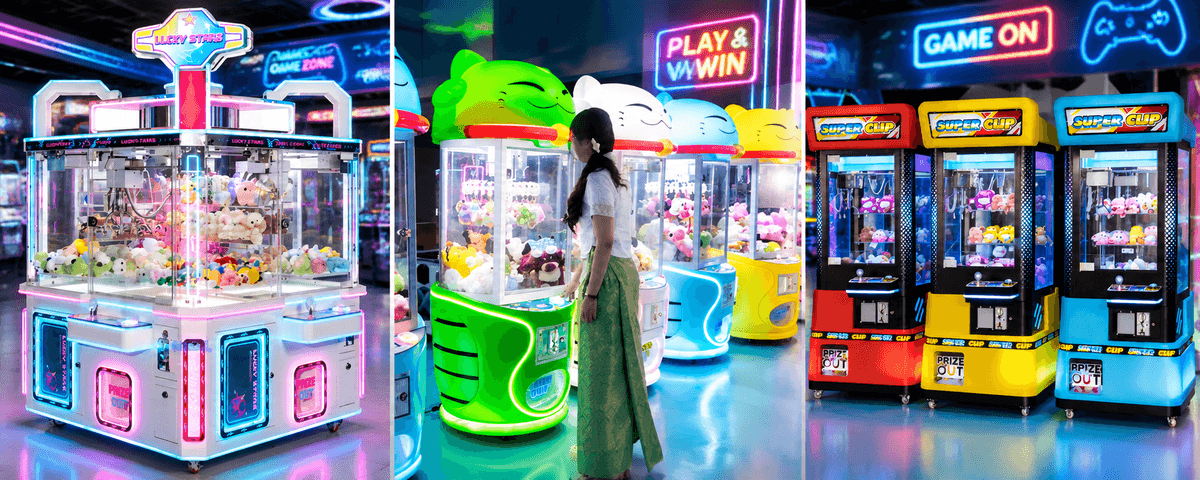
For many arcades and FECs, the standard single-player cabinet is the most versatile starting point.
It works well because it can accommodate different:
- Prize themes
- Player ages
- Locations
- Payment configurations
- Cabinet styles
- A row of standard machines can also be divided by prize category.
For example, one machine may contain small plush toys, another character merchandise, and another seasonal prizes. Operators can change merchandise without redesigning the entire game floor.
Where They Work Best
Standard machines are particularly suitable for:
- Main arcade aisles
- FEC prize zones
- Mall entertainment areas
- Cinema game corners
- Indoor playground exits
What to Check Before Buying
Ask for the exact:
- Cabinet dimensions
- Claw size
- Prize weight range tested by the supplier
- Controller settings
- Payment options
- Service-door configuration
- Packed dimensions
- Voltage specification
For an operator buying a mixed fleet, standard cabinets can form the core of the claw zone, with specialty machines added around them.
EPARK's current commercial claw machine range includes conventional toy cranes and related prize-game formats intended for arcade and FEC environments.
Double and Multi-Player Claw Machines: Best for High-Traffic Zones
When several customers want to play at the same time, player capacity becomes important.
A multi-player cabinet can help operators:
- Increase simultaneous play
- Reduce visible queues
- Create a more active prize zone
- Consolidate several play positions into one installation
- Build a stronger visual block
Do Not Compare Only the Cabinet Price
If a two-player machine costs more than a single-player cabinet, that does not automatically make it more expensive from an operating perspective.
Compare:
Cost per Player Position = Machine Investment ÷ Number of Simultaneous Playing Positions
Also consider floor area per position.
A larger shared cabinet may sometimes use floor space more efficiently than placing several separate machines with gaps between them.
Service Access Still Matters
High-throughput equipment can become a problem if servicing one component requires shutting down the entire machine.
Before purchasing, ask:
- Are player stations controlled independently?
- How are cashless readers installed?
- Can internal components be reached easily?
- What happens if one claw develops a fault?
- Are common spare parts shared across stations?
- For an FEC expecting weekend peaks, these questions can matter more than decorative lighting.
Mini Claw Machines: Best for Small Spaces and Low-Cost Prizes
Mini claw machines are useful when operators want to add more playable positions without occupying a large floor area.
Typical prize categories include:
- Capsules
- Candy
- Small plush toys
- Mini figures
- Keychains
- Small promotional products
They can work well in:
- Children's zones
- Retail entrances
- Café or restaurant waiting areas
- Indoor playgrounds
- Narrow arcade areas
Commercial buying guides distinguish mini machines from standard commercial cranes primarily by footprint and prize format.
Commercial Grade Still Matters
“Mini” should describe size, not build quality.
For an FEC, confirm that the machine is designed for repeated public operation rather than home use.
Check the:
- Cabinet stability
- Control hardware
- Lock system
- Power supply
- Coin or card reader
- Motor system
- Parts availability
A cheap consumer toy may look similar in an online photo but is not designed for the operating cycle of a commercial venue.
Large and Jumbo Claw Machines: Best as Visual Anchors
Large claw machines perform a different job.
They can function as an attraction before the customer even decides to play.
The main advantages are:
- Strong visibility
- Large prize display
- Oversized plush capability
- Photo-friendly presentation
- Higher perceived prize value
For a large FEC, one oversized machine near the entrance or center aisle can providecontrast against rows of standard cabinets.
When Bigger Is Not Better
Large machines need more:
- Floor area
- Ceiling clearance
- Shipping volume
- Prize inventory
- Refill space
A jumbo cabinet hidden at the back of an arcade may provide little benefit.
Use large-format machines where their size can actually influence customer attention.
Specialty Prize Machines: Best for Diversifying the Game Mix
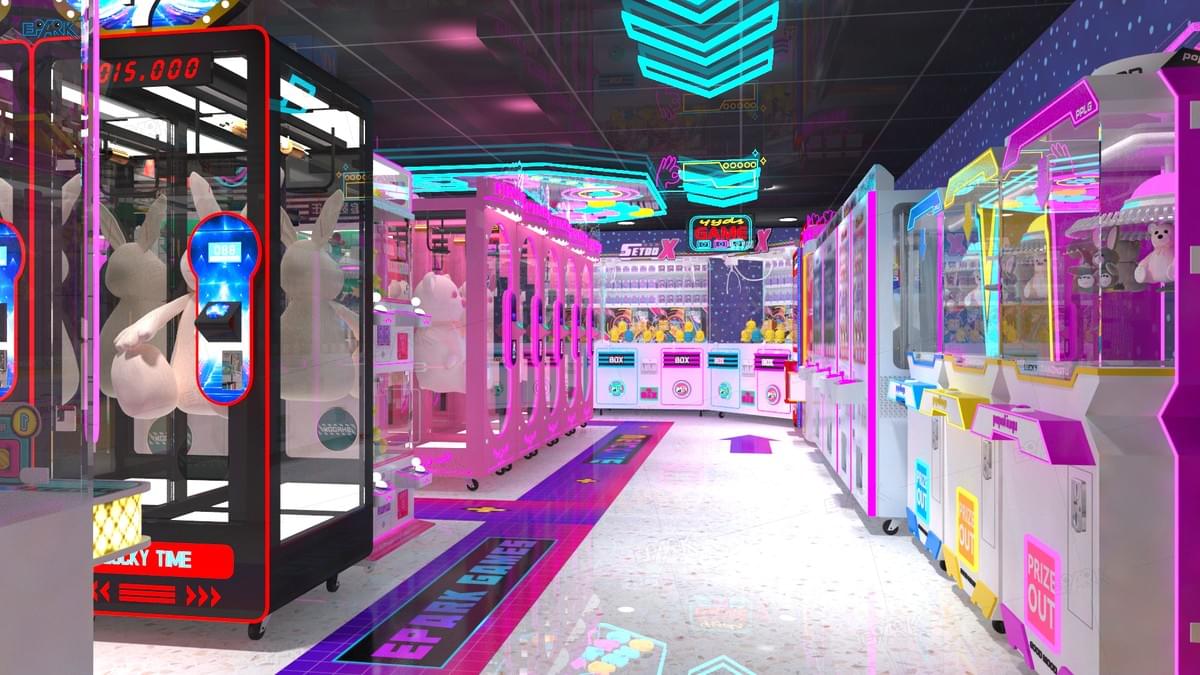
A complete prize zone does not need to use the same claw mechanic everywhere.
Specialty formats may include:
Inst
ead of lifting a plush toy, the player attempts to cut or release a suspended prize.
These machines work well when the operator wants a clearly different mechanic beside standard cranes.
Key-Style Prize Machines
These typically involve aligning or guiding a mechanism toward a target associated with a prize.
They can be used for boxed or premium gifts, subject to local amusement-game regulations.
Gift and Clip Machines
Other commercial formats use different gripping, clipping or release mechanisms.
EPARK's own product categories include Cut Prize Machine, Key Master Vending Machine and Toy Claw Machine formats.
Why Variety Matters
From a venue perspective, variety helps prevent the claw zone from feeling like a line of identical cabinets.
A balanced area can combine:
- Familiar gameplay
- Premium prizes
- Smaller impulse-play machines
- Larger visual attraction
- Multiple price points
The goal is not to maximize the number of machine types. It is to give each type a clear operational role.
Match the Best Claw Machines to Your Prize Strategy
The most important relationship is often not machine vs. venue.
It is machine vs. prize.
Start With the Prize
Before confirming the machine, record:
Prize dimensions
- Prize weight
- Packaging
- Approximate cost
- Intended selling/play price
- Target player group
- Then ask the supplier to recommend an appropriate claw and cabinet.
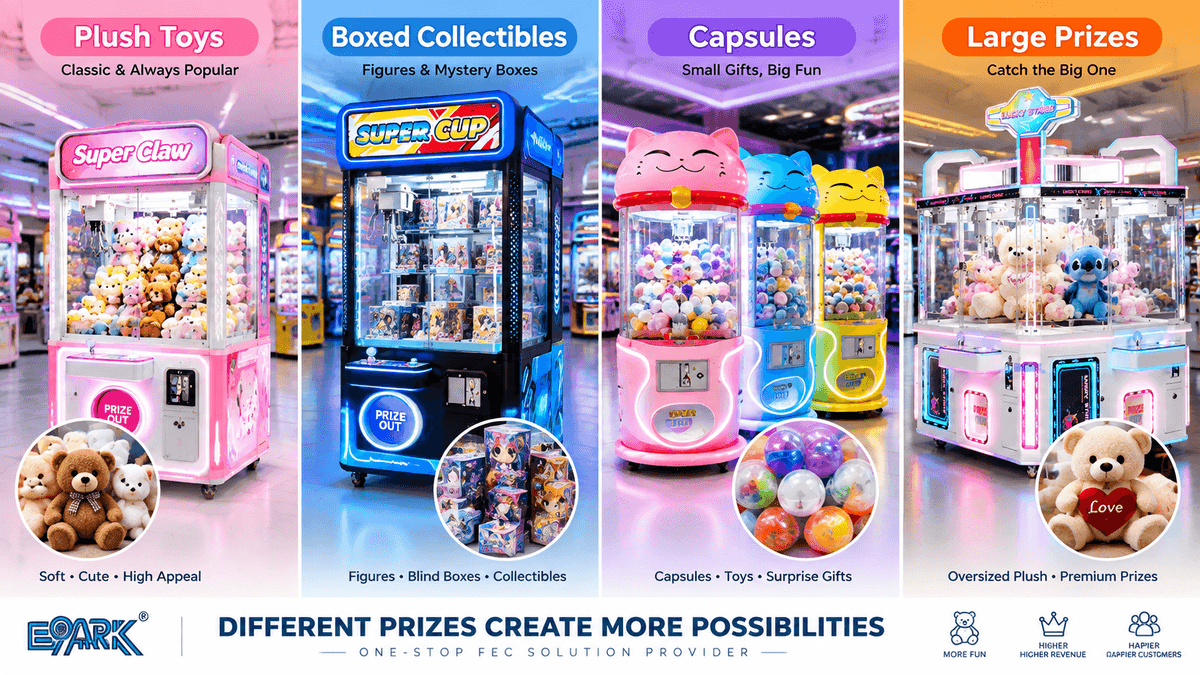
Plush Toys
Consi
der:
- Diameter of the plush
- Shape
- Filling density
- Surface friction
- Tags or accessories
- Two plush toys of the same weight can behave very differently when grabbed.
Boxed Collectibles
Box dimensions and smooth surfaces matter.
A claw designed for soft plush may not be appropriate for rigid packaging.
Small Capsules and Candy
These
are better suited to compact machines and smaller gripping systems.
Oversized Prizes
Large prizes require both a wider claw and enough clearance inside the cabinet for the gantry to move without obstruction.
From a supplier perspective, sending actual prize photos, dimensions and weights before production is much more useful than simply requesting “stronger claw power.”
Features FEC Operators Should Compare Before Buying
A B2B
quotation should let you compare machines beyond appearance.
Cabinet Construction
Check
:
- Frame material
- Transparent panel installation
- Lock quality
- Wiring
- Ventilation
- Wheels or leveling feet
- Internal service access
Claw Mechanism
Confirm:
- Claw dimensions
- Motor type
- Gantry construction
- Strength adjustment
- Drop height
- Movement speed
- Replacement procedure
Payment System
Comme
rcial machines may use:
- Coins
- Tokens
- Bills
- RFID cards
- Arcade cards
- QR codes
- Third-party cashless systems
A new FEC should ideally decide its payment ecosystem before ordering large quantities of machines.
EPARK's supplied company information states that its customization can accommodate coin, membership-card and QR payment requirements depending on the project.
Electrical Configuration
Intern
ational buyers should confirm:
- Voltage
- Frequency
- Plug type
- Rated power
- EPARK supports 110V/220V configurations and different plug standards, subject to the
- specific model and destination market.
Compliance Documentation
Buyers
should identify requirements for the destination country before production.
For the European market, the European Commission notes that CE marking applies only to products covered by relevant EU harmonisation rules and is not a general EU “safety approval.” Manufacturers and importers must determine the applicable requirements for the specific product.
European Commission CE marking guidance
How to Build a Balanced Claw Machine Zone
For a larger arcade or FEC, buying the “best machine” is less important than designing the right mix.
One practical approach is to assign each machine a role.
| Zone Role | Suitable Machine Type | Main Objective |
|---|---|---|
| Core prize row | Standard single-player | Broad appeal |
| High-traffic area | Double / multi-player | Player throughput |
| Kids area | Mini claw machine | Small prizes and accessible play |
| Entrance feature | Large / jumbo | Visibility |
| Premium area | Cut / specialty machine | Higher-value merchandise |
| Flexible filler | Compact standard unit | Use remaining floor space |
Avoid Filling Every Wall
Claw machines need visual space.
If cabinets are packed too tightly:
- Lighting competes
- Prize displays become harder to distinguish
- Customers crowd control panels
- Refill access becomes difficult
Think About Sight Lines
A prize zone should communicate from a distance:
- What can be won?
- Where can customers play?
- Which machines offer something different?
Coordinate the Payment Experience
Mixing several incompatible payment methods in the same zone creates friction.
For an FEC using a central card system, compatibility should be confirmed before production.
Design for Refill and Maintenance
Leave staff enough room to:
- Open doors
- Refill prizes
- Remove cash boxes
- Access payment hardware
- Replace parts
EPARK's documented project capabilities include venue planning, equipment configuration and 3D design in addition to machine supply, which can be useful when claw machines are one zone within a broader arcade or FEC.
View EPARK's arcade and FEC planning service
Supplier Perspective: How to Evaluate a Claw Machine Manufacturer
The machi
ne is only part of the purchase.
For an international FEC project, the supplier should also be able to support the project after the deposit is paid.
1. Verify Manufacturing Capability
Ask for evidence of:
- Production facilities
- Assembly processes
- Product testing
- Quality-control procedures
- Technical staff
- Showroom or sample availability
EPARK's supplied profile states that it operates more than 25,000 m² of factory and showroom space in Guangzhou and has more than 13 years of amusement-equipment manufacturing experience.
The company's current IAAPA Expo Asia listing also identifies EPARK as a Guangzhou manufacturer of claw machines and other FEC equipment and notes OEM/ODM and project-planning capabilities.
2. Confirm OEM/ODM Scope
Customizati
on may include:
- Logo
- Graphics
- Cabinet colors
- Lighting
- Exterior styling
- Payment system
- Voltage
- Plug standard
Ask which changes are standard options and which require additional engineering.
3. Ask How Machines Are Tested
A pre-shipm
ent test should cover relevant functions such as:
- Gantry movement
- Claw operation
- Controls
- Payment input
- Prize chute
- Lighting
- Audio
- Locks
- Wiring
For large orders, agree on inspection criteria before production is complete.
4. Plan Spare Parts
Ask which co
mponents are most commonly serviced.
It can be practical to include spare:
- Buttons
- Joysticks
- Power supplies
- Claw parts
- Motors
- Sensors
with the original shipment.
5. Review After-Sales Support
I
nternational buyers should understand:
- Warranty scope
- Response process
- Technical manuals
- Remote troubleshooting
- Replacement-part availability
EPARK's supplied company information includes remote technical guidance and maintenance-related after-sales support.
Frequently Asked Questions About the Best Claw Machines
What is the best claw machine for a family entertainment center?
For many FECs, a mixed lineup is more practical than relying on one format. Standard machines can provide broad appeal, multi-player units can handle high traffic, and mini or specialty machines can serve different prize categories.
What type of claw machine is best for an arcade?
A standard commercial single-player machine is often the most flexible starting point because it can accommodate many prize themes and locations. The final choice should still depend on your floor plan, audience and prize strategy.
Are multi-player claw machines better than single-player machines?
They are better when simultaneous capacity is important. Single-player machines remain useful for flexible placement and creating several distinct prize themes.
Are mini claw machines good for FECs?
Yes, particularly in children's zones or areas where floor space is limited. Buyers should confirm that the unit is commercial grade and designed for repeated public use.
What prizes are best for claw machines?
There is no single best prize. Plush toys, capsules, collectibles and boxed gifts can all work if their size, weight and shape are compatible with the machine.
Should every claw machine in an arcade use the same cabinet?
Not necessarily. Matching cabinet themes can create consistency, while different formats can create variety. A practical approach is to standardize key service components where possible while varying prize and gameplay formats.
Can claw machines use an FEC card system?
Many commercial machines can integrate card or other cashless systems, but compatibility must be confirmed with both the machine manufacturer and payment-system provider before production.
How many claw machines should an FEC install?
There is no universal number. It depends on available floor area, expected traffic, overall game mix, prize strategy and budget. For a new project, machine quantity should be planned alongside traffic flow and other attractions.
What should I ask a claw machine supplier before ordering?
Provide your destination country, venue size, quantity, target audience, prize dimensions, payment method and electrical requirements. Then confirm specifications, packing dimensions, lead time, spare parts, testing, documentation and after-sales support.
Conclusion: The Best Claw Machine Is the One That Fits Its Role
The best cla
w machines for arcades and family entertainment centers are not selected by appearance alone.
A better purchasing strategy is to decide what each cabinet must accomplish.
Choose:
- Standard machines for flexible everyday use
- Multi-player machines for high-throughput areas
- Mini machines for compact spaces and small prizes
- Large machines for visual impact
- Specialty prize machines for gameplay variety
Then evaluate the details that affect long-term operation: claw compatibility, cabinet construction, payment integration, electrical requirements, service access, spare parts and supplier support.
For a single machine, this process is relatively straightforward.
For a complete arcade or FEC, it becomes a project-planning decision.
EPARK's supplied company profile covers claw machines as well as racing, shooting, sport, redemption, VR, kiddie and indoor-playground equipment. It also supports OEM/ODM, venue planning, 3D design, equipment configuration and technical after-sales services for entertainment projects.
Before asking for a quotation, prepare your venue floor area, target audience, machine quantity, prize categories, payment system, destination country and approximate budget.
That information makes it possible to select the right machine mix instead of simply buying whichever cabinet looks most attractive in a catalog.
