
Importing claw machines from China can be a practical way to expand an arcade business, open a claw machine store, or purchase amusement equipment in bulk. Chinese manufacturers offer a wide range of commercial claw machines, including compact toy grabbers, standard plush prize machines, multi-player cabinets, and customized prize vending machines.
However, selecting a machine based only on its appearance or factory price can lead to unexpected problems. Incorrect voltage, incompatible payment systems, inadequate packaging, missing import documents, and unreliable after-sales support can all increase costs after an order has been placed.
For arcade operators, family entertainment center (FEC) owners, and amusement equipment distributors, successful importing requires more than finding an affordable supplier.
This guide explains 12 essential checks to make before placing an order, helping you evaluate manufacturers, confirm machine specifications, understand import requirements, and prepare your equipment for long-term commercial operation.
1. Define Your Business Requirements Before Contacting Suppliers
Before comparing claw machine manufacturers in China, determine how the machines will be used.
Different business models require different equipment configurations. A machine installed in a shopping mall may need a compact cabinet and a cashless payment option. A dedicated claw machine arcade may need multiple machines with consistent designs, adjustable settings, and simple maintenance access.
Identify Your Operating Environment
Consider the following questions:
- Will the machines be installed in an arcade, shopping mall, restaurant, or family entertainment center?
- Are the main players children, teenagers, adults, or families?
- Will the machines contain small toys, plush dolls, or premium prizes?
- How much floor space is available?
- Will you purchase one machine, a trial batch, or a full container?
- Do you need coin, token, card, or QR-code payment?
These details help suppliers recommend appropriate cabinet sizes, prize mechanisms, and configurations.
Compare Different Types of Claw Machines
| Machine Type | Typical Application | Main Purchasing Consideration |
|---|---|---|
| Mini claw machine | Cafés, small retail spaces, compact entertainment areas | Footprint and prize capacity |
| Standard plush claw machine | Arcades, shopping malls, FECs | Claw strength and prize compatibility |
| Double-player claw machine | High-traffic entertainment locations | Independent controls and maintenance access |
| Large claw machine | Premium prize displays and themed arcades | Structural quality and prize handling |
| Custom claw machine | Branded venues, distributors, themed projects | Design flexibility and production consistency |
The best claw machine is not necessarily the largest or most expensive. It is the one that fits your location, target audience, and operating plan.
2. Verify That Your Supplier Is a Reliable Manufacturer
One of the most important steps when importing claw machines from China is checking the supplier's actual manufacturing capabilities.
Some companies manufacture their own machines, while others purchase products from different factories and resell them. Both business models can work, but understanding who controls production is essential.
What to Verify Before Choosing a Manufacturer
Ask potential suppliers to provide:
- Registered company name and business license
- Factory location and production information
- Product catalogs and technical specifications
- Factory and production-line videos
- Quality control procedures
- Customization capabilities
- Export experience and shipping support
- Warranty and technical support policies
A factory visit or live video inspection can help confirm whether the supplier has production equipment, testing facilities, and an organized assembly process.
Why Factory Experience Matters
Commercial claw machines contain electrical, mechanical, and electronic components that must work together consistently.
An experienced manufacturer should be able to explain how machines are assembled, tested, adjusted, and prepared for shipment.
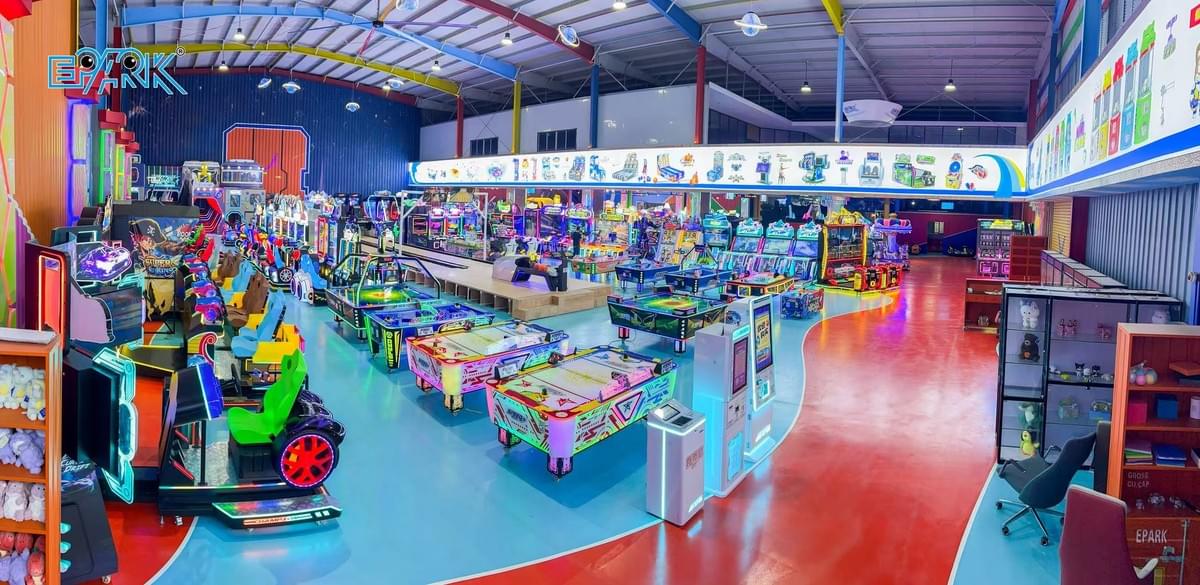
For example, Guangzhou EPARK Electronic Technology Co., Ltd. is based in Guangzhou, China, and has more than 13 years of experience manufacturing arcade and amusement equipment.
EPARK operates a factory and showroom covering over 25,000 square meters and provides OEM/ODM customization, equipment configuration, and technical support for international buyers.
For buyers planning to source multiple machines, reviewing both production capability and long-term service capacity is more useful than comparing quotations alone.
3. Evaluate Claw Machine Quality and Construction
The exterior design of a claw machine may attract players, but its internal construction determines how reliably it performs.
Machines installed in commercial locations may operate for long hours and experience repeated use of joysticks, buttons, doors, and grabbing mechanisms.
Check Cabinet Materials and Structure
Inspect the following components:
Cabinet frame: The frame should be stable, properly aligned, and suitable for the intended operating environment. Check welded or bolted connections and cabinet rigidity.
Glass and transparent panels: Inspect panel specifications, edge protection, mounting points, and resistance to normal commercial use.
Doors and locks: Operators should be able to refill prizes and access service compartments securely.
Lighting and wiring: Internal wiring should be organized, protected, and properly secured. Lighting should operate consistently without overheating.
Surface finish: Check painted surfaces, decorative panels, and cabinet edges for scratches, cracks, or manufacturing defects.
Test the Claw Mechanism
The grabbing system is one of the most important mechanical assemblies.
Ask the manufacturer to demonstrate:
- Horizontal claw movement
- Raising and lowering functions
- Claw opening and closing
- Prize gripping and release
- Return-to-home operation
- Adjustable gameplay settings
The claw should move smoothly without excessive vibration, sticking, or unusual noise.
It is also important to confirm whether replacement motors, cables, sensors, and claw assemblies are available.
Inspect the Main Control System
A reliable control board should support the operational settings required by the buyer.
Depending on the machine, these may include play duration, payment credits, claw strength, operational statistics, and prize-winning configuration.
Ask whether the manufacturer provides a user manual explaining how authorized operators can adjust these settings.
4. Confirm Electrical Specifications and Payment Compatibility
Claw machines manufactured for one country may not be immediately suitable for another market.
Before production begins, provide the supplier with your destination country and local operating requirements.
Verify Electrical Compatibility
Important specifications include:
| Technical Item | What to Confirm |
|---|---|
| Voltage | 110V, 220V, or other required configuration |
| Frequency | 50Hz or 60Hz compatibility |
| Plug type | Destination-country plug standard |
| Rated power | Actual consumption and circuit requirements |
| Grounding | Protective earthing and installation instructions |
| Machine dimensions | Width, depth, height, and access clearance |
| Net and gross weight | Handling, freight, and installation requirements |
Do not assume that a compatible plug automatically means the entire electrical system is suitable for your market.
Select the Right Payment System
Commercial claw machines may support different payment methods, depending on their controllers and installed hardware:
- Coin-operated payment
- Token-operated payment
- Bill acceptors
- Membership or prepaid cards
- QR-code payment
- Compatible cashless payment terminals
Verify the exact configuration before ordering.
For example, QR-code payment support does not automatically mean the machine integrates with every local payment platform. Some systems require regional payment service providers, network connections, or additional software.
EPARK supports customization of payment configurations, cabinet appearance, lighting, branding, and selected game settings. Buyers should confirm the required interfaces and compatibility for their destination market during the specification stage.
5. Check Product Certifications and Import Regulations
Regulatory compliance is a critical part of importing commercial claw machines.
Requirements vary by country, machine design, electrical configuration, and intended use.
A certificate that is relevant in one market may not satisfy the requirements of another.
European Union
For machines entering the European Economic Area, importers should determine which EU product rules apply to the specific equipment.
Depending on the product design, relevant requirements may include electromagnetic compatibility, electrical safety, hazardous substance restrictions, and other applicable regulations.
The European Commission's CE marking guidance explains the responsibilities of manufacturers and importers when placing products on the European market.
CE marking is not a general approval issued by the European Union. Applicable conformity assessment obligations, technical documentation, and declarations must be addressed according to the relevant legislation.
United States
For the United States, buyers should review applicable import requirements and relevant federal, state, and local regulations.
Depending on the configuration, potential considerations include:
- Electrical safety requirements
- FCC equipment authorization or electromagnetic compatibility rules, where applicable
- State or local amusement device regulations
- Import classification and customs documentation
- Consumer safety requirements relevant to the equipment or included prizes
Do not assume that every claw machine requires the same certification. Wireless payment accessories, electrical components, and machine configurations may introduce different obligations.
Other International Markets
Buyers in Southeast Asia, the Middle East, Australia, Africa, and Latin America should confirm applicable electrical standards, labeling requirements, import permits, and local amusement machine rules.
Also, machine approval and permission to operate an amusement business are separate issues. Certain jurisdictions may restrict or license prize-winning machines according to game mechanics, prize values, or chance-based operation.
Important: Request model-specific compliance documents rather than relying on general factory certificates. Ask a qualified importer, customs broker, or local compliance specialist to verify which rules apply.
6. Understand the Total Cost of Importing Claw Machines from China
The factory quotation represents only part of the total import cost.
A machine with a lower purchase price may become more expensive once shipping, customs, installation, and maintenance costs are included.
Identify the Major Cost Components
Typical cost categories include:
- Machine purchase price
- Optional customization
- Export packing
- Inland transportation in China
- International freight
- Marine cargo insurance
- Customs clearance and brokerage
- Applicable import duties and taxes
- Destination port or terminal charges
- Delivery to the operating location
- Installation and initial spare parts
Compare EXW, FOB, CIF, and DDP Quotes
|
Trade Term |
General Meaning | Buyer Consideration |
|---|---|---|
| EXW | Seller makes goods available at the named premises | Buyer handles most transport and export arrangements |
| FOB | Seller delivers goods on board at the named shipment port | Buyer generally arranges main sea freight and insurance |
| CIF | Seller arranges ocean freight and specified insurance to destination port | Buyer still needs to plan import clearance and onward delivery |
| DDP | Seller delivers to the named destination, cleared for import | Confirm taxes, importer arrangements, exclusions, and unloading responsibilities |
These descriptions summarize typical Incoterms® 2020 responsibilities; use the full rule and exact named location in the contract.
Example: Calculating a Landed Cost Budget
The following example is illustrative only, not a current supplier or freight quotation.
| Expense | Illustrative Amount (USD) |
|---|---|
| 10 claw machines at $900 each | $9,000 |
| Export packing and local charges | $400 |
| International freight and insurance | $1,800 |
| Customs duties and taxes (assumption) | $700 |
| Customs and port charges | $450 |
| Local delivery | $350 |
| Total estimated landed cost | $12,700 |
In this example, the effective landed cost is $1,270 per machine rather than the $900 factory price.
Actual costs vary by shipment size, country, classification, tariffs, trade terms, and freight market conditions.
7. Review Packaging, Container Loading, and Shipping Methods
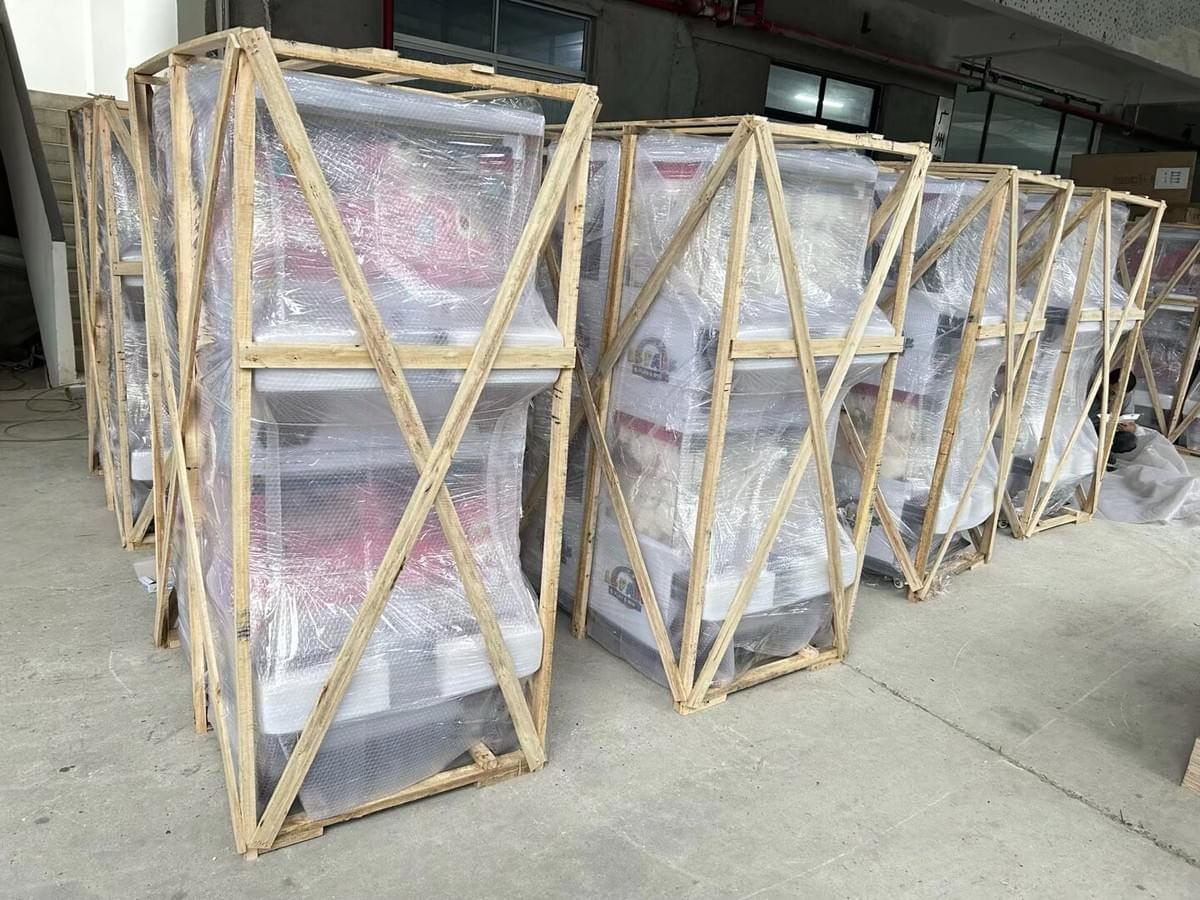
Claw machines contain glass panels, electronics, cabinets, and mechanical assemblies that can be damaged during transportation.
Adequate export packaging is particularly important for long-distance sea freight.
Confirm the Packaging Method
Before shipment, ask whether the factory provides:
- Protective wrapping for cabinets
- Corner and surface protection
- Secure internal mechanical components
- Reinforced cartons or wooden crates where appropriate
- Moisture protection
- Clearly labeled handling instructions
- Packing lists showing dimensions and gross weights
If wood packaging or pallets are used, check whether ISPM 15 requirements apply to the destination.
Choose Between LCL and FCL Shipping
Less than Container Load (LCL) may suit smaller shipments. Goods share container space with other cargo, but additional handling can increase the risk of damage.
Full Container Load (FCL) is often worth evaluating for larger wholesale orders, particularly when multiple machines can be loaded efficiently.
Ask suppliers to provide the packed dimensions and loading plan before determining the best option.
Do not estimate container capacity from the number of cabinets alone. Machine dimensions, packaging thickness, stacking restrictions, and loading safety all affect the final quantity.
8. Arrange a Pre-Shipment Quality Inspection
A pre-shipment inspection helps confirm that machines match the agreed specifications before they leave the factory.
For first-time importers or large orders, an independent inspection can provide additional reassurance.
What Should a Claw Machine Inspection Include?
| Inspection Area | Recommended Check |
|---|---|
| Model and quantity | Match purchase order and packing list |
| Cabinet condition | Check finish, glass, locks, and alignment |
| Electrical system | Verify voltage, grounding, and power operation |
| Claw mechanism | Test movement, gripping, release, and return |
| Controls | Test joystick, buttons, and settings |
| Payment functions | Verify the actual installed payment hardware |
| Lighting and sound | Confirm normal operation |
| Labeling | Check model labels and specified markings |
| Packaging | Inspect protection and shipment identification |
Request a video demonstrating the finished machine, not just a catalog model.
Conduct a Factory Acceptance Test
A practical factory acceptance test (FAT) should use a written checklist agreed before production.
Test actual prize sizes and representative weights. Confirm the machine can be configured for the intended operation, and document the tested settings.
Buyers ordering multiple machines should also check consistency across units, rather than testing only one sample.
Any defects should be documented and resolved before shipment approval or final payment under the contract.
9. Confirm Customs Documents, HS Classification, and Payment Terms
Import delays can occur when shipment documents are incomplete, inconsistent, or inaccurate.
Before shipping, identify who will prepare each document and who will serve as the importer of record.
Prepare Your Import Documentation
Depending on the destination country and shipment, documents may include:
- Commercial invoice
- Packing list
- Bill of lading or air waybill
- Certificate of origin, when required
- Applicable product compliance documentation
- Insurance certificate
- Import permits or customs declarations
- Inspection records, where relevant
Verify the HS Code
Claw machines are often considered within the broader category of amusement or arcade equipment. However, classification depends on the actual machine characteristics and the destination country's tariff schedule.
HS heading 9504 may be relevant to certain amusement machines, but buyers should not assume that every claw machine uses the same subheading.
Confirm the applicable national tariff classification with a licensed customs broker or appropriate customs authority.
U.S. Customs and Border Protection provides commercial invoice requirements, including merchandise descriptions, quantities, and valuation information.
Use Clear Payment and Purchase Terms
Your written order should identify:
- Exact machine models and quantities
- Technical specifications and approved customizations
- Unit prices and total contract value
- Trade term and named place
- Agreed production and delivery milestones
- Inspection and acceptance criteria
- Warranty obligations
- Spare parts and support commitments
- Payment schedule and dispute procedures
For a first order, consider payment methods with suitable documentary controls or buyer protections.
Avoid transferring payments to newly provided bank accounts without verifying the change through an established independent contact channel.
10. Assess Warranty, Spare Parts, and After-Sales Support
A claw machine is a long-term operating asset. Its ongoing performance depends on maintenance access, replacement parts, and technical assistance.
Before importing, check whether the manufacturer can support the machine after delivery.
Request a Spare Parts List
Common service components may include:
- Claw assemblies
- Motors and drive components
- Control boards
- Power supplies
- Sensors and switches
- Joysticks and buttons
- Coin acceptors
- Lighting components
Ask which parts are interchangeable across models and whether replacement components can be purchased separately.
Clarify the Warranty
A useful warranty agreement explains what is covered, how long coverage lasts, and which expenses are excluded.
Also confirm whether the manufacturer provides troubleshooting instructions, wiring diagrams, spare part identification, and remote technical guidance.
Consider the Supplier's Project Support Capabilities
From a supplier's perspective, buyers often focus on cabinet appearance and purchase quantity while overlooking installation and future service requirements.
For a single machine, support may involve basic operating instructions. For a larger arcade project, buyers may also need floor planning, machine selection, electrical coordination, and maintenance planning.
EPARK provides equipment configuration, 3D layout design, customization, installation guidance, and remote technical assistance for arcade and FEC projects.
Businesses planning a complete entertainment venue can also consider arcade equipment and project solutions alongside individual machine purchases.
11. Avoid These Common Claw Machine Importing Mistakes
Several preventable mistakes can reduce the value of an international equipment order.
Mistake 1: Choosing the Cheapest Quotation
A lower quote may exclude essential components, export packaging, service support, or customization.
Compare suppliers using an identical written specification and cost breakdown.
Mistake 2: Ignoring Local Compliance
A machine may operate correctly at the factory but fail to meet destination-market requirements.
Resolve electrical, labeling, and regulatory questions before approving production.
Mistake 3: Ordering Without Testing the Prize Mechanism
The claw assembly must be compatible with the intended prize size and weight.
Request a demonstration with representative merchandise and confirm that operators can make permitted adjustments.
Mistake 4: Overlooking Shipping Dimensions
Unexpected packaging size and weight can increase freight and delivery costs.
Check packed dimensions, handling restrictions, and final delivery access.
Mistake 5: Failing to Plan for Maintenance
A small replacement component can cause extended downtime if the buyer cannot source it locally or from the factory.
Order suitable initial spare parts and keep technical documentation available to staff.
Mistake 6: Assuming All Machines Are Ready for Immediate Operation
After import, machines may still require installation, payment configuration, site safety checks, prize loading, and game-setting adjustments.
Prepare an installation and commissioning plan before the machines arrive.
12. Final Checklist Before Importing Claw Machines from China
Use the following checklist before confirming a purchase order.
Completing these checks will not eliminate every import risk, but it can substantially improve purchasing clarity and reduce preventable problems.
Frequently Asked Questions About Importing Claw Machines
1. Can I import claw machines directly from a Chinese factory?
Yes. International buyers can purchase claw machines directly from Chinese manufacturers, provided they meet applicable import, customs, and local regulatory requirements.
Factory-direct sourcing may offer more flexibility in machine specifications, design customization, and bulk purchasing.
2. How much does it cost to import claw machines from China?
Costs depend on the machine model, quantity, configuration, packaging, shipping method, import taxes, and destination.
Buyers should request a detailed quotation and calculate the total landed cost rather than relying only on the listed machine price.
3. Do claw machines from China need CE certification?
For the European market, the applicable conformity requirements depend on the specific machine and relevant legislation.
Where CE marking is required, manufacturers and importers must meet the associated obligations. Buyers should verify model-specific technical documentation and declarations rather than relying on a generic certificate.
4. How long does it take to import claw machines from China?
The total timeline includes production, inspection, inland transport, international shipping, customs clearance, and final delivery.
Custom designs and large orders may require additional manufacturing time. Request a written production schedule and a current shipping estimate for the destination.
5. Can claw machines be customized for my arcade business?
Many manufacturers offer customized colors, logos, lighting, cabinet designs, payment systems, and selected game settings.
Customization availability depends on the machine model, technical feasibility, order quantity, and production requirements.
6. What is the best shipping method for wholesale claw machine orders?
Sea freight is commonly evaluated for bulk claw machine shipments due to cabinet dimensions and weight.
LCL may work for smaller shipments, while FCL can be more suitable for larger orders. Compare total freight, handling, packing, and delivery costs.
7. Should I inspect claw machines before shipment?
Yes. A pre-shipment inspection is especially valuable for first-time orders, customized machines, and large purchases.
Check machine functions, cabinet condition, electrical configuration, payment hardware, packing quality, and conformity with the purchase order.
8. What should I ask a claw machine manufacturer before placing an order?
Ask about production capability, machine specifications, customization, compliance documentation, quality testing, packing, shipping, warranty, replacement parts, and after-sales technical support.
Request a detailed written quotation and an agreed specification sheet before making payment.
Conclusion: Make Informed Decisions Before Importing
Importing claw machines from China can create opportunities for arcade operators, FEC investors, distributors, and amusement business owners. However, long-term operating value depends on much more than a competitive equipment price.
Manufacturer reliability, product quality, electrical compatibility, import compliance, packaging, shipping arrangements, and after-sales support should all be checked before purchasing.
Working with an established manufacturer can help buyers coordinate these requirements more efficiently, particularly when ordering multiple machines or planning a complete entertainment venue.
With over 13 years of experience in commercial amusement equipment manufacturing, EPARK provides claw machines, OEM/ODM customization, arcade project planning, and technical support for overseas buyers.
Whether you are preparing a trial order or developing a larger arcade project, start with a clear specification, verify the supplier's capabilities, and review the complete import process before committing.
Explore commercial arcade machine options or contact the EPARK team to discuss equipment configurations, customization requirements, and your purchasing plan.
