
Plan your claw machine zone before placing the equipment order. Define its role, map the space people will occupy, select compatible machines and prizes, and test the operating budget. Then confirm utilities, local requirements, supplier responsibilities, and opening procedures.
The goal is not to fit the most cabinets into a corner. It is to create a prize-play area that families can understand, staff can maintain, and operators can evaluate using real performance data.
1. Define the Zone’s Role and Target Guests
A claw machine zone groups games that award physical prizes directly. It serves a different purpose from ticket-redemption games, where players accumulate tickets or points to exchange later. IAAPA discusses both formats as parts of a broader arcade mix in its arcade planning guidance.
Decide whether your zone will be a visible introduction to the arcade, a destination for prize enthusiasts, or a short activity between larger attractions. Give it one primary role rather than expecting every machine to serve every audience.
Write a brief covering expected age groups, family group sizes, spending expectations, prize preferences, and staffing. For a family-led venue, test the experience with a child and accompanying adult—not just a lone player standing at the controls.
2. Choose a Visible Location Without Creating Congestion
Look for a position visible from a natural guest route, with space to stop without blocking people passing through. IAAPA’s arcade-operations guidance emphasizes circulation patterns and adequate spacing rather than treating the floor as a simple equipment grid.
Compare an entrance-adjacent position, a central arcade cluster, and a perimeter arrangement. Walk each option as a family arriving, a party group moving between attractions, and an employee carrying refill stock.
Keep the main entrance, recharge queue, and prize-game waiting area separate. Position attractive displays where they can be seen without allowing tall cabinets to hide neighboring activities or staff sightlines.
Near the entrance does not mean inside the entrance bottleneck. Mark where spectators and strollers would stand before approving the location.
3. Size the Claw Machine Zone Around People, Not Cabinets
Use a scaled drawing with verified dimensions, columns, exits, doors, and fixed services. For every proposed machine, draw its cabinet footprint, occupied player position, prize-retrieval area, and maintenance-door swing.
For two facing rows, check this complete cross-section:
Cabinet depth + player space + clear passing aisle + player space + cabinet depth, plus any required rear clearance.
As a purely geometric example, ten hypothetical cabinets measuring 0.8 × 0.9 meters occupy 7.2 square meters. That is only the equipment footprint—not a suitable estimate of the finished zone.
Allow separately for spectators, turning, payment access, and restocking. Do not assume an aisle remains usable when players occupy it.
For U.S. projects, the Access Board’s clear-floor-space guidance specifies a 30 × 48-inch minimum for spaces governed by ADA Section 305. This is not a complete machine allocation or a recommended family-traffic aisle width. Have the project designer determine applicable requirements and additional clearances.
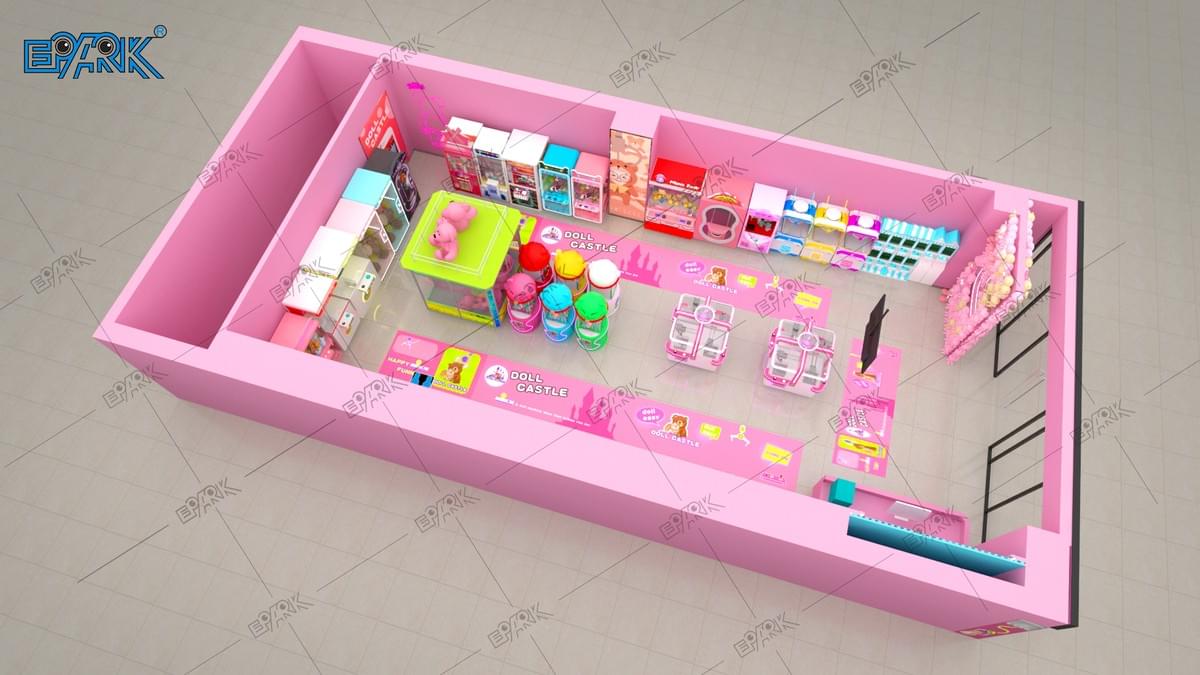
4. Select Machines by Their Job in the Zone
Build the equipment schedule around the experience each machine should provide. Use the following as a selection framework, not a required purchasing ratio.
| Machine format | Suggested role | What to verify before ordering |
|---|---|---|
| Standard plush claw | Core prize-play selection | Actual prize compatibility, controls, visibility, and service access |
| Compact claw | Smaller-prize option or constrained position | Control and payment reach; compact size alone does not establish accessibility |
| Large-format claw | Visual focal point with larger prizes | Delivery route, sightlines, handling, and tested prize retrieval |
| Specialty prize game | An additional experience where justified | Different gameplay, servicing needs, and local classification |
Avoid introducing many unrelated platforms solely for visual variety. Ask whether repeat models can share spare parts, operating procedures, and payment hardware.
Review EPARK’s commercial prize-game options against your requirements, then request model-specific drawings and demonstrations. Choose the final quantity only after the occupied layout and operating budget work.
5. Plan Prizes, Merchandising, and Clear Play Rules
Treat prizes as part of equipment selection, not a purchase left until delivery. IAAPA’s discussion of prize merchandising highlights the importance of what guests can see before deciding to play.
Send representative samples to the supplier. Test each prize’s dimensions, weight, shape, surface, and packaging with the actual claw, playfield, and exit chute. Repeat the test at different approved fill levels.
Create a simple prize record with purchase cost, landed cost, age suitability, supplier, reorder lead time, and compatible machines. Establish a photographed loading standard so different shifts can reproduce the approved presentation.
Display the play price and rules clearly. Do not describe outcomes as entirely skill-based, or promise a guaranteed prize, unless the actual operation and applicable rules support that description. Britain’s crane-machine classification guidance illustrates why the mechanism and configuration matter.
6. Coordinate Power, Payments, and Service Access
Confirm the complete electrical specification
Request voltage, frequency, rated current or power, grounding requirements, plug type, and any ventilation or installation clearances. Have the site electrician review the combined installation before outlets and circuits are finalized.
Ask the supplier to mark connection points on each drawing. Plan cable routing before positioning cabinets, and require a safe isolation procedure for maintenance.
Test payment integration—not just the reader
Specify the venue’s actual payment provider and reader model. Require an end-to-end demonstration of charging, game-start signals, credit handling, refunds, and fault recovery. Define what happens during a network outage.
IAAPA also identifies card-purchase and recharge congestion as an operating issue. Include payment access in the floor plan rather than adding it after machine placement. See its arcade-operations guidance.
Rehearse replenishment and repairs
Show how staff will reach locks, controls, prize storage, and service panels. Walk the refill route with a trolley or stock carton. Reject arrangements that require routine servicing through an occupied player position without a workable closure procedure.
7. Check Safety, Accessibility, and Local Game Rules
Keep building approval, equipment conformity, prize safety, and game licensing as separate review items. Ask the relevant local professionals and authorities to assess the actual project; a generic supplier statement should not replace that review.
Accessibility and physical safety
Check accessible routes, approaches to relevant controls, trip hazards, cabinet stability, and emergency circulation. A machine’s small footprint does not establish an accessible experience. The U.S. Access Board’s accessible-route guidance explains the relationship between routes and accessible spaces and elements.
Prize safety
For U.S. projects, consult the CPSC’s toy-safety business guidance. Toys intended primarily for children aged 12 or younger generally require applicable third-party testing and a Children’s Product Certificate from the responsible manufacturer or importer. Ask for documentation appropriate to the specific prizes and intended ages.
Game classification
Do not assume that awarding merchandise automatically settles a machine’s legal status. In Great Britain, the Gambling Commission states that a crane fitted with a compensator allowing gaming-machine operation is classified as a gaming machine even when not currently operating in that mode. Review the official crane-machine guidance and obtain destination-specific advice before purchase.
8. Build a Budget That Separates Revenue From Profit
Budget the installed operation
Request costs for equipment, payment hardware, shipping, insurance, import charges where applicable, local delivery, installation, electrical work, signage, opening prizes, spare parts, and training. Keep working capital and contingency separate from the cabinet purchase price.
Compare quotations on the same delivery scope and identify who carries each cost. Include recurring software, payment, and support charges where relevant. Opening inventory is a cash requirement; monthly prize expense should reflect prizes awarded rather than all stock purchased.
Use transparent operating assumptions
The following is a hypothetical calculation, not an EPARK quotation, industry benchmark, or revenue forecast.
Assume ten machines, 30 operating days, $1.50 tax-exclusive realized revenue per paid play after discounts, one $4 landed-cost prize per ten paid plays on average, and payment costs equal to 5% of play revenue. Assume another $2,200 monthly for assigned labor, utilities, routine maintenance, and supplies.
The example excludes free plays and assumes one prize per winning game. Its award frequency is a financial assumption—not a recommendation for game settings.
| Scenario | Paid plays per machine per day | Monthly play revenue | Contribution after the listed costs |
|---|---|---|---|
| Lower demand | 15 | $6,750 | $2,412.50 |
| Base assumption | 25 | $11,250 | $5,487.50 |
| Higher demand | 40 | $18,000 | $10,100.00 |
At the base assumption:
7,500 plays × $1.50 − $3,000 prize cost − $562.50 payment cost − $2,200 other direct costs = $5,487.50.
This contribution still excludes allocated rent, shared overhead, depreciation, financing, and taxes. Higher demand may also require more labor than assumed.
Use weekday and weekend demand separately in the real forecast. Include promotional games and their prize costs, downtime, and inventory losses. Evaluate payback from cash flow after relevant costs—not from gross machine revenue.
9. Evaluate Suppliers Through Deliverables, Not Promises
From a supplier’s perspective, a useful inquiry starts with the destination country, measured plan, target guests, prize samples, payment provider, budget, and intended opening date. Ask for a proposal that explains the recommended equipment rather than simply maximizing the quantity.
Consider a hypothetical compact FEC choosing between another cabinet and a clearer refill route. Compare the additional machine’s expected contribution with the effect on guest movement and staff access. Keep this as a project decision, not a universal rule that more equipment produces a better result.
EPARK is a Guangzhou-based arcade equipment manufacturer with more than 13 years of manufacturing history. It also provides venue planning, customization, and project support. Its published offering includes layout proposals and 3D design; these can help coordinate the equipment package with the wider venue. Review its equipment and project-planning services and 3D design examples.
Before production, approve a specification covering dimensions, artwork, prize compatibility, electrical configuration, payment integration, manuals, spare parts, and acceptance tests. Put warranty exclusions, remote-support arrangements, and replacement-part responsibilities in writing.
Work backward from opening through installation, delivery, clearance, shipping, inspection, and production. Confirm actual lead times with each responsible party rather than relying on a generic delivery promise.
10. Commission the Zone and Review the First 90 Days
Treat installation and opening as separate milestones. IAAPA’s arcade operating guidance stresses the continuing importance of maintenance; assign ownership before guests arrive.
| Stage | Main checks | Required output |
|---|---|---|
| Before shipment | Approved configuration, prize tests, payment demonstration, packing and spares | Signed acceptance record |
| Before public opening | Site safety, game starts, prize delivery, fault recovery, refunds, staff training | Completed opening checklist |
| Days 1–30 | Plays, downtime, congestion, complaints, refills, prize cost | Baseline by machine |
| Days 31–90 | Compare controlled changes to prizes, placement, and presentation | Retain, revise, or expand decision |
At opening each day, check controls, payment, visible damage, prize presentation, and clear routes. Record faults and remove affected equipment from service until appropriately resolved.
Track paid and promotional plays separately, along with revenue, prizes awarded, stock adjustments, and uptime. Reconcile physical prize inventory with the records.
When comparing machines, consider contribution per allocated square meter as well as revenue per cabinet. Change one variable at a time where practical.
11. Frequently Asked Questions
How many claw machines should a new FEC start with?
Start with the number supported by the occupied floor plan, realistic demand, staffing, and investment budget. A ten-machine financial example is not a recommendation for every venue. Keep expansion conditional on measured results.
How much space does each claw machine need?
Use the selected model’s dimensions plus player, retrieval, circulation, and maintenance requirements. Do not multiply cabinet footprint alone by machine count. Applicable accessibility clearances also require review; the Access Board’s guidance provides a U.S. reference.
Should the zone be beside the redemption counter?
Assess shared staffing and prize-storage access, but keep queues separate. Direct-prize claw games do not require the same guest journey as ticket exchange. Test both areas at peak occupancy before approving adjacency.
Are compact machines automatically better for children?
Do not use cabinet size as the deciding factor. Evaluate visibility, control reach, payment access, instructions, and prize retrieval with intended users. Confirm age suitability for prizes separately.
How should play prices be set?
Model realized revenue after discounts against prize cost, payment charges, and operating expenses. Test customer response within applicable rules. Do not rely on a supplier’s advertised payback period as a forecast for your venue.
What should buyers send EPARK for a proposal?
Send a dimensioned plan, site photos, country, audience profile, budget range, target opening date, preferred payment system, and proposed prizes. Request an equipment schedule, layout, customization scope, and itemized delivery responsibilities.
12. Build a Zone You Can Operate—and Improve
A practical claw machine zone starts with a clear guest experience and ends with a measurable operating plan. Approve the occupied layout, test real prizes, verify utilities and local requirements, and evaluate costs before committing to equipment.
For a new family entertainment center, prepare a complete site brief and discuss your equipment and layout requirements with EPARK. Request a coordinated proposal covering machine selection, planning, customization, installation responsibilities, and technical support.
Expand when the evidence supports it—not simply because another cabinet fits on the drawing.
