
A claw machine with attractive prizes can easily catch attention in an arcade or family entertainment center. However, even a popular machine can lose its appeal when the prize compartment becomes nearly empty, the remaining toys are difficult to reach, or the display looks neglected.
For arcade operators, knowing when to restock a claw machine is an essential part of daily business management. Restocking too late may lead to missed playing opportunities and customer complaints. Restocking too frequently can increase labor costs and create unnecessary service visits.
The challenge is finding a schedule that matches actual machine usage.
A busy claw machine in a shopping mall may need replenishment several times a week, while a lower-traffic machine may operate much longer between refills. Prize size, win frequency, customer traffic, and inventory availability all influence the ideal schedule.
This guide explains how often claw machines should be restocked, how to calculate prize consumption, and how to develop an efficient replenishment system for single machines or multiple arcade locations.
1. Why Claw Machine Restocking Matters
Prize replenishment is more than a routine task. It affects the visual appearance, operating readiness, and customer experience of a commercial claw machine.
Maintain an Attractive Prize Display
Customers typically look through the cabinet glass before deciding whether to play.
A well-stocked machine with clearly visible prizes can create a more inviting first impression than a cabinet containing only a few scattered items.
However, a good display does not mean filling every available space. The prizes must remain within the machine's recommended operating limits.
Keep Prizes Available for Normal Gameplay
As prizes are won, the remaining items may become unevenly distributed.
Some toys may collect near the corners, while others may no longer be positioned where the claw can reach them during normal operation.
Checking and replenishing prizes helps operators maintain the machine's intended playing conditions.
Reduce Avoidable Operating Interruptions
A machine that runs out of suitable prizes may need to be taken out of service until replacement stock arrives.
Regular replenishment planning reduces the likelihood of unexpected empty cabinets and rushed supply purchases.
Improve Operating Efficiency
Frequent unnecessary service visits consume staff time and travel resources.
An organized restocking schedule allows operators to combine prize replenishment with cleaning, visual inspections, and routine operating checks.
The objective is not simply to keep the machine full. It is to maintain an appealing, functional machine while using staff and inventory efficiently.
2. How Often Should You Restock a Claw Machine?
There is no universal restocking interval for every commercial claw machine.
The practical answer is to inspect machines according to their activity level and refill them before prize availability or normal gameplay becomes noticeably affected.
A high-traffic machine may need daily monitoring and frequent replenishment. A slower location may only require a weekly service visit, provided that the prize level remains suitable between visits.
The following table offers starting points for planning.
Suggested Restocking Frequency by Location
| Operating environment | Suggested inspection frequency | Initial refill planning approach |
|---|---|---|
| Busy arcade center | Daily, with extra checks during peak periods | Consider every 1–3 days if prize consumption is high |
| Family entertainment center | Daily during operation | Plan around weekend and holiday demand |
| Shopping mall entertainment zone | Daily or according to available monitoring | Adjust to actual daily prize depletion |
| Cinema or bowling center | Check around operating peaks | Refill based on event and weekend activity |
| Small restaurant or hotel play area | Regular staff checks | Start with weekly review if activity is low |
| Multi-location claw machine route | Monitor remotely when supported; verify during visits | Schedule by location-level consumption and travel needs |
These intervals are illustrative operational starting points, not industry standards or guaranteed requirements.
The most suitable interval should be based on observed prize consumption, the machine's actual usable stock, and how quickly staff can respond when replenishment is needed.
Separate Inspections From Actual Restocking
An important distinction is that checking a machine does not mean it needs to be refilled.
For example, staff may inspect a cabinet every morning but only add prizes twice during the week.
Daily visual inspections help identify problems early without automatically increasing prize inventory or labor costs.
3. Factors That Determine Restocking Frequency
Several operating factors influence how quickly a claw machine consumes prizes.
Understanding them makes it easier to create a realistic schedule.
Daily Play Volume
The number of plays is one of the most useful measurements for estimating prize consumption.
A machine receiving 150 plays per day has more opportunities to distribute prizes than a machine receiving only 30, assuming similar winning behavior and game conditions.
Operators should review the machine's available play counters or management records rather than relying entirely on estimates of venue traffic.
Actual Prize Dispensing Frequency
Two machines receiving the same number of plays may distribute different numbers of prizes.
Prize consumption depends on the machine's game design, configuration, player behavior, and prize characteristics.
For inventory planning, use the actual number of prizes awarded rather than assuming a fixed win rate.
For example, if a machine records 600 plays and dispenses 60 prizes over a representative period, its observed consumption is:
60 ÷ 600 × 100 = 10 prizes per 100 plays
This figure describes past operation. It is not a guarantee of future results.
Operators should also follow applicable local rules governing amusement machines and prize games.
Prize Size and Cabinet Capacity
Larger plush toys occupy more physical space than smaller prizes.
A cabinet designed for medium-sized plush items may hold a different quantity from one using compact toys.
The available stock should be assessed using the actual dimensions of the prize compartment and the manufacturer's recommended operating configuration.
Venue Traffic Patterns
Customer activity may change throughout the week.
Family entertainment centers often experience different demand during school holidays, weekends, and special events.
Machines installed in tourist locations or shopping malls may also experience seasonal changes.
A fixed schedule that works during a quiet period may be unsuitable during a busy holiday.
Availability of Replacement Stock
Operators with replacement prizes stored on site can respond quickly to depletion.
Businesses that depend on an external warehouse or supplier need to plan earlier.
Longer replenishment lead times make inventory forecasting especially important.
4. How to Calculate Your Claw Machine Restocking Schedule
Restocking decisions become more reliable when operators use simple inventory calculations.
Two numbers are particularly useful: average daily prize consumption and the number of days remaining before the machine reaches its chosen refill threshold.
Step 1: Calculate Average Daily Prize Consumption
Use the formula:
Average daily prize consumption = Total prizes dispensed ÷ Operating days
For example, suppose a machine dispenses 63 prizes over seven operating days.
63 ÷ 7 = 9 prizes per day
This average provides a starting point for estimating future consumption.
If weekend activity is substantially higher, consider separate weekday and weekend averages rather than relying on a single number.
Step 2: Establish a Refill Threshold
The refill threshold is the minimum number of prizes that should remain before replenishment is scheduled.
It must reflect the machine's design, prize accessibility, and visual presentation requirements.
Suppose a machine begins with 60 suitable prizes, and the operator chooses 24 remaining prizes as the refill trigger after testing the arrangement.
The estimated usable stock before the trigger is:
60 − 24 = 36 prizes
This is an illustrative threshold, not a universal fill-level recommendation.
Step 3: Calculate Days Until the Threshold
Use the formula:
Days until refill threshold = (Starting prize count − Refill threshold) ÷ Average daily consumption
With the example above:
(60 − 24) ÷ 9 = 4 days
This means the machine may reach its refill threshold after approximately four operating days if consumption remains similar.
The operator could schedule a service visit before that point, with additional checks for unexpected demand.
Step 4: Allow for Demand Variation
Average consumption is not perfectly predictable.
For example, a machine normally distributing nine prizes per day may dispense more during a holiday promotion.
Operators should consider a reasonable operating buffer and maintain the ability to respond when consumption exceeds forecasts.
Example Restocking Calculation
| Planning variable | Example value |
|---|---|
| Starting prize count | 60 |
| Refill threshold | 24 |
| Average daily prizes dispensed | 9 |
| Estimated days to threshold | 4 |
| Initial planned refill visit | Around day 3 |
| Prizes to restore starting count at threshold | 36 |
Illustrative calculation only; actual quantities depend on machine design, game behavior, and venue conditions.
This method is more useful than automatically refilling every machine on the same day.
5. How Full Should a Claw Machine Be?
Many operators ask whether a claw machine should always be completely full.
The answer depends on the equipment and its intended gameplay.
A cabinet that looks visually full may not have enough suitable space for claw movement.
Avoid Overfilling the Prize Compartment
Excessively packed prizes can create several problems:
- Toys become difficult to distinguish.
- The claw may have insufficient operating clearance.
- Prizes may become compressed or wedged together.
- The prize chute or movement area may become obstructed.
Operators should follow the manufacturer's loading instructions and test the equipment with the actual prizes being used.
Avoid Letting the Display Become Too Sparse
An almost empty cabinet may look neglected.
It may also leave a small number of prizes in awkward positions where the game no longer functions as intended.
Do not assume that every remaining toy is accessible simply because it is still inside the cabinet.
Use a Playability Check Instead of a Universal Percentage
Before deciding that the machine has enough stock, evaluate:
- Can players clearly see the available prizes?
- Can the claw move through its intended operating area?
- Are the remaining prizes accessible under the machine's normal game design?
- Is the prize chute clear?
- Does the current arrangement follow the manufacturer's instructions?
These practical checks are more reliable than applying an arbitrary fill percentage to every machine model.
For more presentation ideas, operators can consult prize display and arrangement tips.
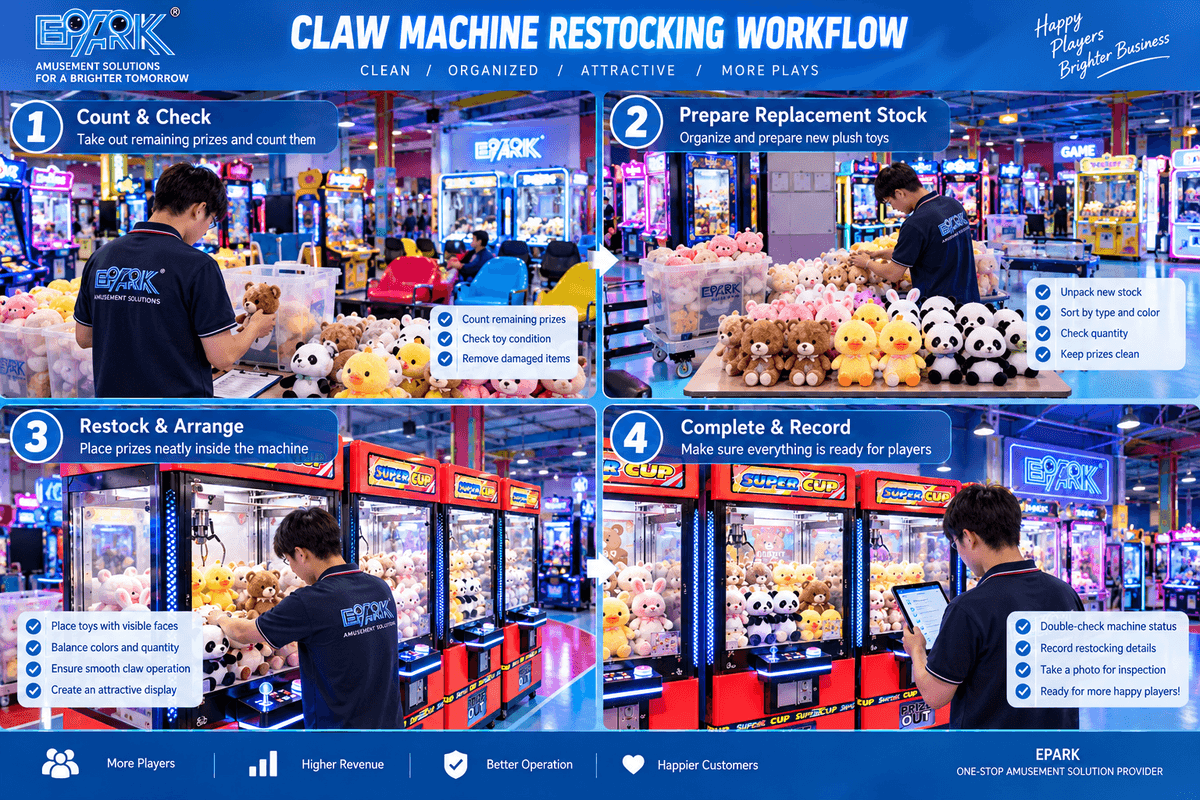
6. A 7-Step Claw Machine Restocking Process
A consistent restocking procedure helps staff maintain several machines without overlooking important tasks.
The following process can be adapted to individual arcade operating procedures and machine manuals.
Step 1: Check the Machine's Current Status
Before opening the cabinet, inspect the viewing area and review available operating records.
Check whether the machine has reported faults, whether prizes are still accessible, and whether the dispensing area is clear.
Record the current play count and other available information.
Step 2: Prepare Suitable Replacement Prizes
Bring replacement items that have already been checked for:
- Compatible dimensions and weight
- Appropriate condition and packaging
- Relevant age suitability and safety requirements
- Correct inventory identification
- Compatibility with the machine's operating configuration
Avoid using unfamiliar prize types without first confirming their suitability.
Step 3: Secure the Machine for Servicing
Follow the manufacturer's instructions for opening and restocking the machine.
Stop gameplay and prevent customer access while the prize compartment is open.
If the task exposes staff to hazardous moving parts, unexpected startup, or electrical hazards, use the required energy-control procedures and trained personnel.
The OSHA control of hazardous energy standard describes requirements for covered servicing and maintenance activities in the United States.
Routine loading procedures and more invasive maintenance tasks may involve different controls. The appropriate safety procedure depends on the specific equipment and task.
Step 4: Count the Remaining Prizes
Record the number of prizes still inside the machine.
If different prize types are used, count them separately.
Remove damaged, unsuitable, or otherwise noncompliant stock from circulation.
Step 5: Add Prizes According to the Approved Arrangement
Replenish the playfield without exceeding the recommended loading limits.
Distribute prizes in accordance with the machine's intended gameplay and the manufacturer's instructions.
Avoid stacking toys in ways that block claw movement, restrict prize delivery, or create inaccessible areas.
Step 6: Inspect and Test the Machine
After closing and securing the cabinet, perform the necessary functional checks.
Depending on the model and approved operating procedure, these may include checking the controls, claw movement, payment functions, and prize delivery system.
Use authorized test functions where available. Do not leave the machine in customer operation if an unresolved fault is detected.
Step 7: Update the Restocking Record
Before completing the service visit, record how many prizes were added, which stock items were used, and whether any issues were identified.
A reliable service record helps the operator calculate consumption and plan the next visit.
7. Prize Inventory Management for Claw Machine Operators
Restocking the machine is only one part of inventory management.
Operators also need sufficient replacement stock available when the next service visit occurs.
Track Inventory Across Three Locations
For practical planning, separate inventory into:
Machine stock: Prizes currently inside each cabinet.
On-site reserve: Replacement prizes available at the venue.
Warehouse stock: Additional inventory stored centrally or held for future deliveries.
This distinction is especially important for operators managing several machines.
Calculate the Prize Reorder Point
A simple purchasing formula is:
Reorder point = Average daily prize consumption × Replenishment lead time + Safety stock
Suppose an operator uses an average of eight prizes per day across a particular prize category.
The supplier's replenishment lead time is seven days, and the operator chooses a safety stock of 24 prizes.
The reorder point is:
(8 × 7) + 24 = 80 prizes
When total available and incoming inventory, adjusted for committed demand, approaches the required level, the operator should review whether another order is needed.
For a simple operation without outstanding orders, the formula provides an initial reorder trigger.
The safety stock should reflect demand variation, supplier reliability, and the consequences of running out.
Maintain a Simple Inventory Log
| Date | Machine ID | Opening stock | Prizes added | Prizes dispensed | Closing stock |
|---|---|---|---|---|---|
| Monday | CM-01 | 45 | 15 | 8 | 52 |
| Tuesday | CM-01 | 52 | 0 | 10 | 42 |
| Wednesday | CM-01 | 42 | 18 | 9 | 51 |
Example values for illustration.
The calculation is:
Closing stock = Opening stock + Prizes added − Prizes dispensed − Other removals
Other removals, such as damaged items or authorized stock transfers, should be recorded separately.
Where exact prize-dispensing counters are unavailable, verify changes by physically counting stock and reconciling service records. Do not treat every claw movement or payment as a prize awarded.
Use Consistent Prize Identification
When operating multiple machines, assigning stock-keeping units (SKUs) to prize categories can help simplify purchasing and inventory tracking.
For example:
- PLUSH-SMALL-01
- PLUSH-MEDIUM-02
- CAPSULE-GIFT-03
Operators can connect these codes to prize descriptions, quantities, purchase costs, and storage locations.
Review Slow-Moving Inventory
Stock that remains unused for long periods can occupy storage and tie up working capital.
Review unused prize inventory periodically.
Depending on the items involved, operators may be able to use existing suitable stock in a different machine configuration or future promotion.
All substitutions should remain compatible with the equipment and applicable product requirements.
8. Restocking Multiple Claw Machines and Locations
Managing one claw machine is relatively simple compared with operating a network of machines across multiple commercial locations.
As the number of cabinets increases, transport time, staff scheduling, stock allocation, and reporting become more important.
Group Machines by Operating Location
Operators should maintain separate records for each machine while also viewing performance at the venue level.
This makes it easier to identify which locations require frequent service.
For example, a shopping mall with six machines may need more frequent attention than a hotel with one low-traffic cabinet.
Create Practical Service Routes
A good service route considers:
- Expected prize consumption
- Current reserve stock
- Distance between venues
- Access hours and site restrictions
- Staff availability
- Machine faults requiring attention
The shortest driving route is not always the best operational route.
A machine approaching its minimum prize threshold may require attention before a closer location with sufficient inventory.
Use Available Monitoring Features
Some commercial claw machines or compatible management systems can provide useful operating information, such as play counts, revenue, or machine status.
These features vary by model and configuration.
Where reliable remote monitoring is available, operators can use the data to prioritize service visits.
However, remote play counts alone do not always show the exact physical condition of remaining prizes.
Periodic on-site inspection remains necessary.
Prepare for Peak Demand
Holidays, school breaks, and special entertainment events may create temporary increases in play volume.
Before such periods, operators can review past consumption data, prepare additional stock, and arrange extra inspections where needed.
This is more effective than waiting until multiple machines are running low on prizes simultaneously.
9. Common Claw Machine Restocking Mistakes to Avoid
Even experienced operators can encounter avoidable inventory and service problems.
Mistake 1: Waiting Until the Machine Is Empty
A nearly empty machine may look unattractive and leave prizes difficult to access.
Better approach: Establish a tested refill threshold and inspect the machine before reaching it.
Mistake 2: Applying One Schedule to Every Machine
Different locations and machine configurations consume prizes at different rates.
Better approach: Track each machine's activity and adjust replenishment intervals based on actual data.
Mistake 3: Overfilling the Prize Compartment
More toys do not automatically create a better game.
Better approach: Follow the manufacturer's recommended loading arrangement and preserve normal claw movement.
Mistake 4: Mixing Incompatible Prizes
Replacement prizes with significantly different dimensions, weights, or shapes may behave differently.
Better approach: Validate new prizes against the machine's specifications and approved operating settings before using them.
Mistake 5: Failing to Record Prize Consumption
Without reliable inventory records, operators may struggle to explain unexpected shortages or changes in operating costs.
Better approach: Record additions, removals, prize awards, and closing stock during every service visit.
Mistake 6: Ignoring Product Safety and Recalls
Children's toys may be subject to safety, labeling, and documentation requirements.
In the United States, the CPSC toy safety business guidance explains relevant requirements, including those related to ASTM F963 and applicable children's product certification.
Operators should also check the CPSC recalls and product safety warnings database when reviewing potentially affected merchandise.
Applicable obligations vary by product type, operator role, and destination market.
Mistake 7: Confusing Restocking With Prize Rotation
Adding replacement prizes and changing the prize selection are different activities.
Restocking maintains the supply of existing suitable prizes.
Prize rotation changes the assortment or theme to provide variety.
Operators may perform both tasks during the same service visit, but they should track them separately.
10. A Manufacturer's Perspective: Planning Restocking With EPARK
From a commercial claw machine supplier's perspective, restocking efficiency should be considered during equipment selection.
Operators sometimes focus on cabinet appearance, price, and payment methods without examining how the equipment will be serviced after installation.
However, practical access to the prize compartment, equipment dimensions, and compatibility with intended prizes can influence daily operating costs.
Consider Restocking Before Purchasing Machines
When comparing commercial claw machines, ask the manufacturer about:
- Prize compartment dimensions
- Suitable prize sizes and weights
- Access doors and loading procedures
- Recommended loading arrangements
- Operating counters and available management features
- Maintenance instructions and technical documentation
These details can help buyers choose equipment that suits the intended prize inventory and operating model.
How EPARK Supports Commercial Claw Machine Projects
Guangzhou EPARK Electronic Technology Co., Ltd. is a commercial arcade and amusement equipment manufacturer based in Guangzhou, China.
With more than 13 years of industry experience and over 25,000 square meters of factory and showroom space, EPARK supplies commercial amusement equipment for arcade centers, family entertainment centers, and other entertainment projects.
EPARK's product range includes toy claw machines, cut prize machines, Key Master gift machines, and other arcade equipment.
Its business also supports OEM/ODM customization, equipment selection, project layout planning, 3D design, and after-sales technical assistance.
For buyers selecting claw machines, EPARK can help clarify available cabinet configurations, suitable operating requirements, and technical specifications before an order is finalized.
Operators can explore commercial claw machine models when comparing equipment for new venues or existing arcade operations.
Ask the Right Questions Before Ordering
For an efficient operating setup, commercial buyers should discuss the following with their supplier:
- What prize dimensions and weights are supported?
- What are the recommended prize-loading procedures?
- How is the prize compartment accessed for restocking?
- Which operating counters are available on the selected model?
- Can the machine support the required payment method?
- What maintenance documentation and technical support are provided?
- Are different cabinet or lighting configurations available?
Confirm these details for the specific machine model rather than assuming that every claw machine offers the same functions.
Support Efficient Multi-Machine Planning
When developing a claw machine arcade, consistent machine specifications can make inventory and service planning easier.
For example, compatible equipment may allow operators to standardize certain prize categories and staff procedures.
However, different game formats may still require different merchandise and loading methods.
The supplier's role is to help buyers understand these operational differences before selecting the final equipment mix.
11. Frequently Asked Questions
How often should you restock a claw machine?
Restocking frequency depends on play volume, actual prize consumption, cabinet capacity, and venue traffic. Busy locations may require replenishment every few days or more frequently, while lower-traffic machines may need less frequent refills. Regular inspection and a tested refill threshold provide a more reliable schedule than a fixed universal interval.
Should I check a claw machine every day?
Daily visual checks are a useful practice for actively operated machines, especially in busy venues. They help identify low inventory, blocked prize chutes, and other obvious problems. However, checking a machine daily does not necessarily mean adding prizes every day.
How many prizes should I put in a claw machine?
The correct number depends on the cabinet size, prize dimensions, and manufacturer's operating instructions. Operators should maintain suitable prize visibility and normal gameplay without overfilling the compartment.
Can a claw machine be too full?
Yes. Excessive prize loading may restrict claw movement, compress prizes, obstruct the prize chute, or make individual toys difficult to see. Follow machine-specific loading guidance instead of filling every available space.
How do I know when my claw machine needs more prizes?
Check the remaining prize count, playfield condition, visual presentation, and actual consumption data. Replenishment may be needed when inventory approaches the chosen refill threshold or when the remaining prizes no longer support normal gameplay.
How much backup prize inventory should I keep?
Backup inventory should reflect average daily prize consumption, supplier lead time, demand variation, and planned service frequency. A reorder-point calculation can help determine an appropriate stock buffer without relying on a universal quantity.
Should I change the prizes every time I restock?
No. Routine replenishment can use the same prize assortment. Prize rotation is a separate merchandising decision and should be based on customer preferences, stock availability, and compatibility with the machine.
Can claw machine manufacturers help with restocking requirements?
Commercial equipment manufacturers can provide product specifications, loading guidance, and technical information to support an operator's restocking process. EPARK provides commercial claw machines and technical support, helping buyers understand model specifications and suitable equipment configurations.
12. Conclusion: Build a Smarter Claw Machine Restocking Schedule
Knowing how often to restock a claw machine is an important part of managing a reliable arcade operation.
There is no single refill schedule that works for every location. The best approach is to monitor actual prize consumption, establish a suitable refill threshold, and adjust service intervals as customer activity changes.
A well-organized replenishment process also helps operators control inventory, reduce unnecessary service visits, and maintain an appealing prize display.
Whether operating one machine or managing multiple locations, accurate records and consistent procedures make restocking decisions easier.
For new arcade projects, selecting machines that suit the intended prize size, operating environment, and maintenance requirements can simplify future operations.
EPARK supplies commercial claw machines, OEM/ODM customization options, and technical support for international amusement equipment buyers.
If you are planning a new claw machine arcade or expanding your existing equipment lineup, contact the EPARK project team to discuss suitable machine models, prize compatibility, and equipment configurations for your business.
