
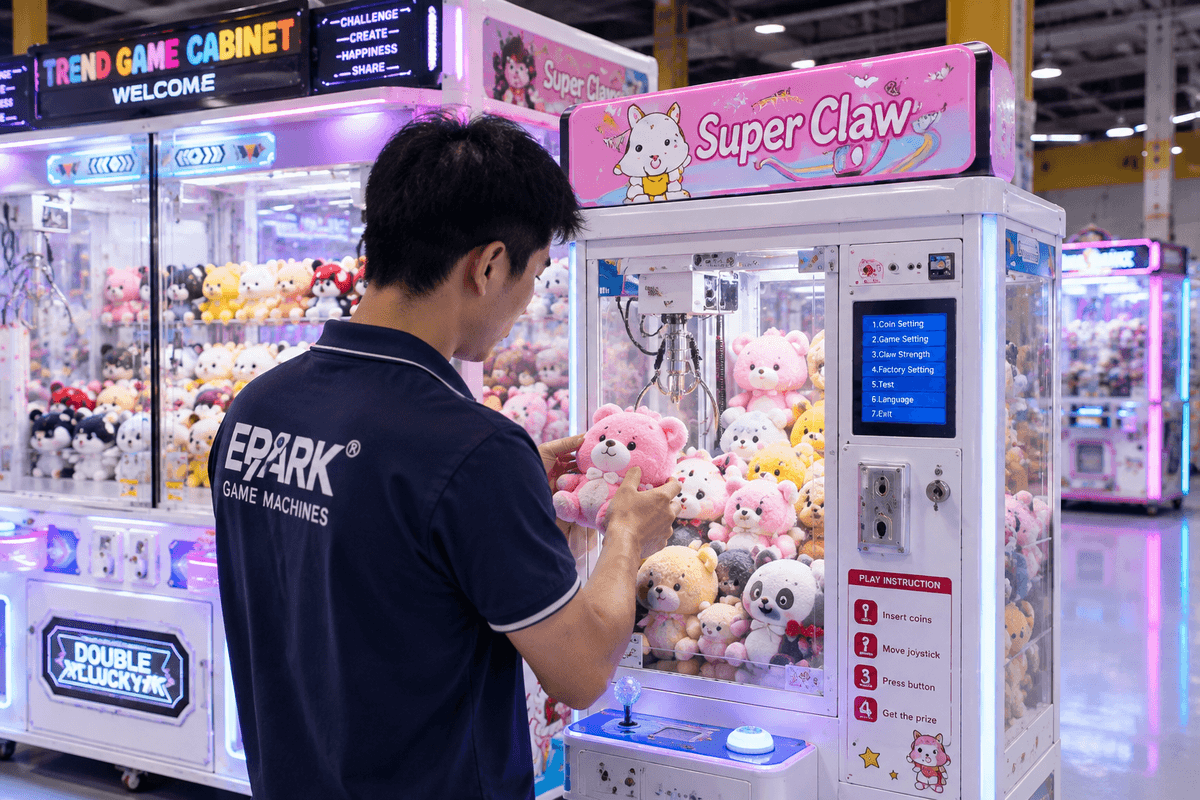
For an arcade operator, adjusting claw machine settings is not simply a matter of making the claw “stronger” or “weaker.” A commercial claw machine may use separate controls for pickup strength, holding strength, timing, game duration, movement and prize detection. Some machines also include payout-related logic.
That is why two claw machines with similar cabinets can feel completely different to play.
The most important point is to separate three ideas: claw strength, prize rate and overall game difficulty. They interact, but they are not interchangeable. Understanding the difference helps operators create a game that is enjoyable for players, financially manageable and easier to maintain.
1. What Do Claw Machine Settings Actually Control?
A useful way to understand claw machine settings is to divide them into four layers.
| Setting area | What it controls | What it does not automatically tell you |
|---|---|---|
| Claw power | How firmly the claw closes or holds | The actual win percentage |
| Pickup timing | How long stronger grip is maintained | Whether the prize will stay inside the claw |
| Payout / prize logic | How some controllers regulate award opportunities | A guaranteed win on a specific attempt |
| Game difficulty | Time, speed, prize position and physical challenge | Claw strength alone |
Commercial machines vary significantly by controller and manufacturer. For example, ELAUT's E-Claw documentation separates pickup power, retaining power and pickup time instead of treating claw strength as one fixed number. Betson Enterprises
Similarly, ICE states that its Grab N' Win platform has customizable software that allows operators to fine-tune settings and distribute configurations to other machines.
2. Claw Strength: Pickup Power vs. Retaining Power
One of the biggest misunderstandings about claw machine settings is the assumption that the claw uses one constant grip from the moment it closes until it reaches the prize chute.
Many commercial designs can use different power levels during different stages.
Pickup power
Pickup power is the force used when the claw initially closes and attempts to lift a prize from the playfield.
If this value is too low for the merchandise, the claw may close around the prize but fail to lift it.
Retaining power
Retaining power refers to the force used while the claw carries the prize after the initial pickup.
This explains a common player experience: a claw successfully lifts a plush toy but loses it during the return movement.
ELAUT's E-Claw manual treats retaining power separately from pickup power and recommends testing the actual merchandise to determine an appropriate relationship between the two. Betson Enterprises
Pickup time also matters
Strength alone is not enough.
If stronger pickup power is maintained for only a short period, the prize may rise from the playfield and then experience a lower holding force. A machine may therefore have identical peak strength but feel very different after its pickup timing is changed.
This is why copying a strength percentage from another machine is rarely a reliable setup method.
3. Prize Rate, Win Rate and Payout Percentage
“Prize rate” is often used as if it has one universal definition. In practice, operators should first establish what the controller or supplier means by it.
Observed win frequency
The simplest measurement is:
Win frequency = winning plays ÷ total paid plays × 100%
If 10 prizes are successfully awarded during 100 paid games, the observed win frequency is 10%.
That is historical operating data. It does not necessarily mean every play independently has a 10% probability of winning.
Prize-cost payout percentage
An operator may instead measure how much of the machine's revenue is being returned in merchandise cost:
Prize-cost payout = cost of prizes awarded ÷ play revenue × 100%
Consider a simplified example:
- 100 plays generate $100 in revenue.
- Each awarded prize costs the operator $3.
- 10 prizes are awarded.
- Merchandise cost is therefore $30.
The observed win frequency is 10%, while the prize-cost payout is 30%.
They describe different aspects of the business.
ELAUT's E-Claw documentation provides a good illustration of this distinction. On that specific controller, the desired payout percentage is calculated using product cost and the amount the merchandise is expected to generate. The manual also describes prize distribution as following a random pattern rather than simply turning the target percentage into a predictable “every Nth play” sequence. Scribd
Strong-grip frequency is a third concept
Some crane controllers can also regulate how often stronger claw power becomes available.
That should not automatically be described as a guaranteed win.
A stronger grip can improve the opportunity to carry a prize, but the outcome can still depend on claw alignment, prize shape, surrounding objects and whether the claw closes in a stable position.
When comparing machines, ask the supplier exactly what terms such as win rate, prize rate, payout ratio, strong grab and probability setting mean on that controller.
4. What Makes a Claw Machine Easy or Difficult?
Game difficulty is broader than claw power.
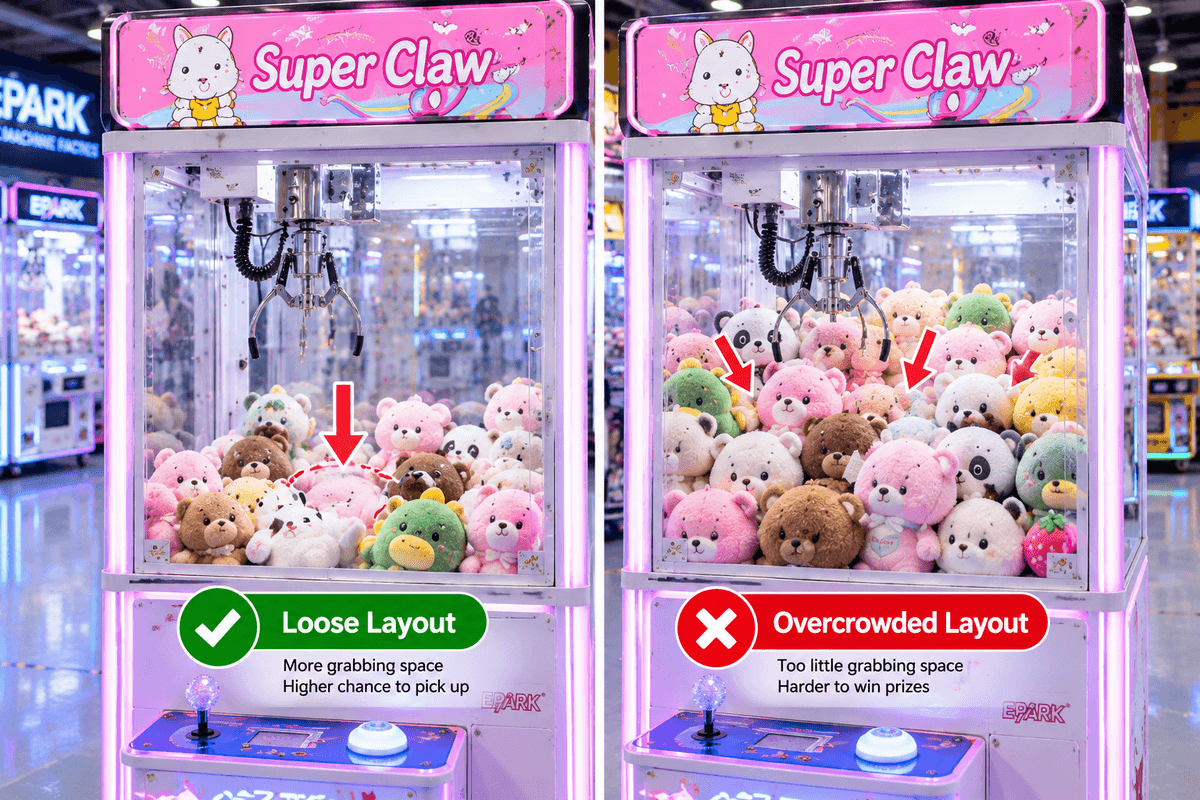
A machine with relatively strong grip can still be difficult if the merchandise is tightly packed or difficult to approach. Conversely, a moderate grip may perform consistently when prizes are positioned with accessible edges and enough space for the claw fingers.
Important difficulty factors include:
- available aiming time;
- carriage movement speed;
- claw size and finger geometry;
- prize size and weight;
- surface material;
- how tightly merchandise is packed;
- distance to the prize chute;
- prize orientation;
- pickup and retaining power;
- grip duration.
A useful diagnostic question is:
At what stage does the attempt fail?
If players cannot position the claw accurately, investigate controls, movement and aiming time.
If the claw closes correctly but does not lift the merchandise, investigate initial pickup power, claw size and prize compatibility.
If the prize rises but falls during transport, investigate retaining power, prize stability and physical arrangement.
This approach is more useful than simply increasing overall strength.
5. How Prize Size, Weight and Placement Affect Claw Machine Settings
The same claw machine settings should not be expected to work equally well for every prize.
A large lightweight plush toy behaves differently from a small dense toy. A capsule behaves differently from a boxed collectible.
| Prize type | Key issue to test | Typical setup consideration |
|---|---|---|
| Soft plush | Compression and accessible edges | Finger spacing and stable grip points |
| Dense plush | Weight relative to claw | Pickup and retaining capacity |
| Capsule / ball | Rolling and smooth surface | Finger geometry and prize spacing |
| Boxed item | Flat surfaces and dimensions | Claw opening width and orientation |
| Irregular novelty item | Unpredictable balance | Multiple-position testing |
Prize placement can also change difficulty without any electronic adjustment.
For example, a plush toy near the surface with open space around its body may be relatively accessible. The same toy pressed underneath several other prizes can become substantially harder to secure.
For this reason, changing merchandise should trigger a new test cycle.
6. How to Set Up a Claw Machine Step by Step
A repeatable process is safer than adjusting parameters by feel.
Step 1: Start with the exact machine manual
Confirm what each parameter controls.
Do not assume that “strength,” “payout” or “probability” means the same thing across different main boards.
Manufacturer documentation should be your primary technical reference. For example, ICE maintains a dedicated support area for Grab N' Win manuals and troubleshooting materials. ICE Grab N' Win technical support
Step 2: Define the merchandise
Record:
- dimensions;
- approximate weight;
- material;
- packaging;
- typical orientation;
- landed prize cost.
The claw and merchandise should be considered as one system.
Step 3: Establish the business variables
Before adjusting payout-related settings, confirm the play price and merchandise cost.
Otherwise, a percentage has little commercial meaning.
Step 4: Adjust pickup and retaining behavior
Use the actual intended merchandise.
Test whether the claw can first lift it and then whether it can hold it appropriately during the return movement.
ELAUT's E-Claw procedure recommends using test games and adjusting claw power and pickup time based on actual results. Betson Enterprises
Step 5: Test multiple prize positions
Do not test only an ideal item in the middle of the playfield.
Try prizes near the front, rear and sides, plus several orientations. The objective is to understand the real operating range, not produce one successful demonstration.
Step 6: Verify prize detection
On machines using a prize sensor, ensure the system correctly records successful awards.
ICE documents a three-infrared-sensor arrangement on Grab N' Win that detects a prize when it passes through the chute and interrupts the beams. ICE Support
A faulty or poorly aligned sensor can make operating statistics misleading.
Step 7: Record changes
Change one major variable at a time.
If pickup power, retaining power, prize layout and timing are all changed simultaneously, it becomes difficult to identify which adjustment improved or damaged the result.
7. Supplier Perspective: What Operators Often Overlook
From a supplier perspective, one of the easiest mistakes is to treat claw machine settings as a standalone specification.
For procurement, the machine should be evaluated together with the intended merchandise, payment system, local voltage, venue type and operating model.
Useful questions to send a supplier include:
- Can pickup and retaining power be adjusted separately?
- What prize sizes and weights is the claw designed for?
- How does the controller define payout or prize rate?
- Does the machine include reliable prize detection?
- Can game time and movement parameters be adjusted?
- What payment systems can be integrated?
- Are spare claws, coils, motors and sensors available?
- Is technical setup documentation supplied?
EPARK's current product range includes commercial claw machines and other amusement equipment, while its service scope includes OEM/ODM, equipment configuration, venue planning, 3D design, installation and after-sales technical support. The supplied company profile also states support for coin, membership-card and QR-based payment configurations, as well as 110V/220V export adaptation.
For buyers building a new prize area or FEC, this broader integration can matter as much as the machine menu itself. You can review [commercial claw machine options](/claw-machines/) together with the overall equipment mix rather than evaluating each cabinet in isolation.
8. How to Measure Whether Your Settings Are Working
Operators should monitor results instead of relying on impressions such as “the machine feels too easy.”
A basic operating sheet can include:
| Metric | Calculation / record | Why it matters |
|---|---|---|
| Paid plays | Total customer games | Measures activity |
| Play revenue | Paid plays × actual play price | Revenue baseline |
| Successful wins | Sensor-confirmed or audited prizes | Measures award frequency |
| Win frequency | Wins ÷ paid plays | Shows observed result |
| Prize cost | Actual cost of awarded merchandise | Tracks merchandise expense |
| Prize-cost payout | Prize cost ÷ revenue | Connects prizes to economics |
| Sensor / mechanical faults | Logged incidents | Identifies unreliable data |
| Setting changes | Date + parameter changed | Makes testing traceable |
Test plays should also be separated from normal customer statistics where possible.
ELAUT's E-Claw documentation specifically provides a normal-game test function that can be used without affecting the machine's accounts or payout regulator. Betson Enterprises
After changing the prize type, claw assembly or major configuration, collect a new sample before drawing conclusions.
9. Common Claw Machine Setting Mistakes
Copying another machine's numbers
A strength value that works with one claw, coil and prize assortment may not transfer to another cabinet.
Treating prize rate as guaranteed win frequency
Always check the controller manual. A payout target, random strong-grip opportunity and measured win rate are different concepts.
Increasing pickup strength but ignoring retaining power
A prize may lift perfectly and still fall halfway to the chute.
Overfilling the playfield
Dense prize packing can create a physical difficulty problem that electronic settings cannot solve cleanly.
Ignoring the prize sensor
If successful awards are not recorded correctly, payout data becomes unreliable.
Changing too many variables simultaneously
Make controlled adjustments and keep a simple change log.
Never retesting after restocking
A new batch of prizes can differ in weight, fabric, packaging or dimensions. Recalibration is therefore part of routine operation rather than a one-time installation task.
10. What to Look for When Buying an Adjustable Claw Machine
For commercial buyers, flexibility is more valuable than a single impressive “maximum strength” number.
Look for a machine that provides clear control over the parameters relevant to your business.
A practical procurement checklist should cover:
- adjustable initial and holding power;
- understandable timing controls;
- suitable claw sizes or interchangeable options;
- reliable prize detection;
- adjustable game time;
- clear error codes or diagnostic functions;
- easy access for maintenance;
- play and win counters;
- payment-system compatibility;
- voltage compatibility for the destination market;
- spare parts availability;
- technical manuals and after-sales support.
Also ask the manufacturer to demonstrate the machine using prizes close to those you intend to operate.
A setup that performs well with a supplier's lightweight sample plush is not automatically suitable for your own merchandise.
For larger projects, [arcade center planning support](/arcade-center-solution/) can also help coordinate claw machines with redemption games, racing machines, VR equipment and other attractions instead of planning the prize area separately.
11. FAQ About Claw Machine Settings
What is the best claw strength for a claw machine?
There is no universal best value. Suitable strength depends on the claw mechanism, coil, prize dimensions, weight, material and the machine controller. Use the actual merchandise and follow the manufacturer's calibration procedure.
Does a 1:10 prize rate mean every tenth player wins?
Not necessarily.
Some people use 1:10 as a planning ratio, while a controller may use payout regulation, random strong-grip logic or another method. Check exactly how the specific machine defines the setting.
Why does the claw pick up a toy and then drop it?
Possible causes include lower retaining power, a short pickup-power duration, unstable prize orientation or a grip point that allows the merchandise to slip.
A drop does not automatically prove that the machine is malfunctioning.
Can claw machine operators adjust the win rate?
Many commercial machines provide configurable parameters that influence prize outcomes, but the available controls differ by model.
Some systems regulate claw power or payout-related behavior, while others emphasize skill-based operation. Always use the controller documentation for the specific machine.
What is the difference between win rate and payout percentage?
Win rate normally describes how often prizes are actually won.
Prize-cost payout percentage describes the cost of awarded merchandise relative to the money collected.
They should be monitored separately.
How often should claw machine settings be checked?
Check them whenever you materially change prizes, claw components or controller parameters, and whenever operating data starts behaving differently from normal.
Routine mechanical maintenance should also include checking the claw, cord, movement and prize sensor.
Does “play until you win” mean the first grab will succeed?
No.
The term generally describes a gameplay or credit mode rather than guaranteeing that the first physical pickup is successful. Exact implementation varies by controller, so verify the machine manual.
How can operators balance player experience and prize cost?
Start with the actual prize cost and play price, then test the physical grab using real merchandise.
Track both win frequency and prize-cost payout, review customer play behavior and adjust gradually instead of simply making the claw weaker.
12. Conclusion: Build a Fair, Testable Claw Machine Configuration
Good claw machine settings come from understanding the whole system.
Claw strength determines how the machine picks up and carries merchandise. Prize-rate or payout settings relate to how the controller and operator manage awards and economics. Game difficulty also depends on timing, movement, claw geometry and how prizes are arranged.
The most reliable setup process is therefore:
define the prize → understand the controller → calibrate the grip → verify prize detection → test multiple positions → measure actual operating data.
For operators purchasing new equipment, prepare the prize dimensions, weight, photos, play price, target payment method, destination voltage and venue type before asking a supplier for configuration advice.
EPARK provides commercial claw machines as part of a broader amusement equipment portfolio and supports machine customization, venue planning, equipment configuration and technical after-sales service. For arcade or FEC projects, those details can be evaluated together rather than treating claw strength as an isolated specification.
