
Claw machines are familiar attractions in arcades, shopping malls, family entertainment centers (FECs), and other commercial entertainment venues. Their colorful cabinets and simple controls attract players of different ages, but safe operation requires more than an appealing design.
For venue operators and equipment buyers, claw machine safety includes electrical protection, mechanical integrity, stable installation, appropriate prizes, clear instructions, and regular maintenance. A malfunctioning power supply, damaged cabinet, or poorly protected moving component can create hazards for visitors and staff.
Safety requirements also vary between countries. A standard or certification relevant to one market may not automatically satisfy another market's requirements.
This guide explains the main safety considerations for commercial claw machines, the technical standards buyers should investigate, and the practical steps operators can take from equipment selection through daily operation.
1. What Safety Requirements Apply to Commercial Claw Machines?
There is no single safety certification that automatically makes every claw machine compliant worldwide.
Applicable requirements depend on the machine's design, electrical specifications, legal classification, intended users, and destination market.
Two important technical references are UL 22 and IEC 60335-2-82.
UL 22: Amusement and Gaming Machines
UL 22 addresses electrical, electronic, and electromechanical commercial amusement and gaming machines and accessories. It covers equipment intended for use under relevant U.S. electrical installation requirements.
The standard generally addresses indoor equipment, with additional evaluation possible for products specifically designated for outdoor or protected-location use.
Buyers should confirm whether the particular claw machine is covered by the standard and whether there is valid certification or evaluation evidence for the exact model.
IEC 60335-2-82: Amusement Machine Safety
IEC 60335-2-82:2024 addresses the safety of electric commercial amusement machines and personal service machines within its defined scope.
It covers relevant hazards encountered by users and maintenance personnel. However, it excludes certain product categories, including vending and dispensing appliances covered by other standards.
Because claw and prize machines can differ in their design and classification, buyers should confirm the appropriate product standard rather than assume IEC 60335-2-82 applies to every model.
European Market Requirements
For equipment entering the European Union, relevant rules may include electrical safety, electromagnetic compatibility, restricted substances, and other product-specific legislation.
Where applicable, the manufacturer must conduct the required conformity assessment, prepare technical documentation, and issue an EU Declaration of Conformity before affixing the CE marking.
The European Commission's CE marking guidance explains that CE marking applies only to products covered by legislation requiring that mark.
Important: CE marking, UL certification, and IEC standards are not interchangeable. Each has a different regulatory or technical role.
2. Electrical Safety Requirements for Claw Machines
Electrical protection is one of the most important areas of commercial claw machine safety.
These machines may contain power supplies, controllers, lighting, motors, displays, payment systems, and internal wiring that must operate safely under their intended conditions.
Confirm Voltage and Power Compatibility
Before installation, check the machine's rated voltage, frequency, power requirements, plug type, and electrical instructions.
A machine designed for one electrical supply should not be connected to an incompatible supply without a manufacturer-approved solution.
For overseas buyers, confirm the exact electrical configuration before shipment. A general statement such as "110V/220V available" does not replace checking the specifications of the actual unit.
Use Appropriate Grounding and Electrical Protection
Where required by the machine's design and local electrical rules, protective earthing and suitable circuit protection help reduce electrical risks.
Operators should use appropriate outlets and avoid improvised wiring, overloaded extension cords, or unauthorized modifications.
Any protective devices must be selected and installed according to the applicable electrical code and manufacturer's instructions.
Inspect Power Cords and Internal Wiring
Damaged cables, exposed conductors, loose connectors, and overheating components can indicate unsafe conditions.
Routine inspections should include accessible cords, plugs, cable entries, and ventilation openings. Internal electrical examinations should be performed only by qualified personnel.
If operators notice a burning smell, smoke, repeated electrical trips, or exposed wiring, the machine should be removed from service until inspected.
3. Mechanical and Cabinet Safety Requirements
Commercial claw machines combine moving mechanical assemblies with a cabinet accessible to the public.
The design should minimize the risk of injury during normal operation and reasonably foreseeable misuse.
Cabinet Stability and Structural Integrity
The cabinet should remain stable under the conditions for which it was designed.
Buyers should evaluate cabinet construction, door hinges, glazing, fasteners, and the suitability of any floor anchoring or stability provisions.
Operators should inspect machines for leaning, damaged supports, loose panels, and signs of instability.
Do not allow customers to climb onto, hang from, or rock the machine.
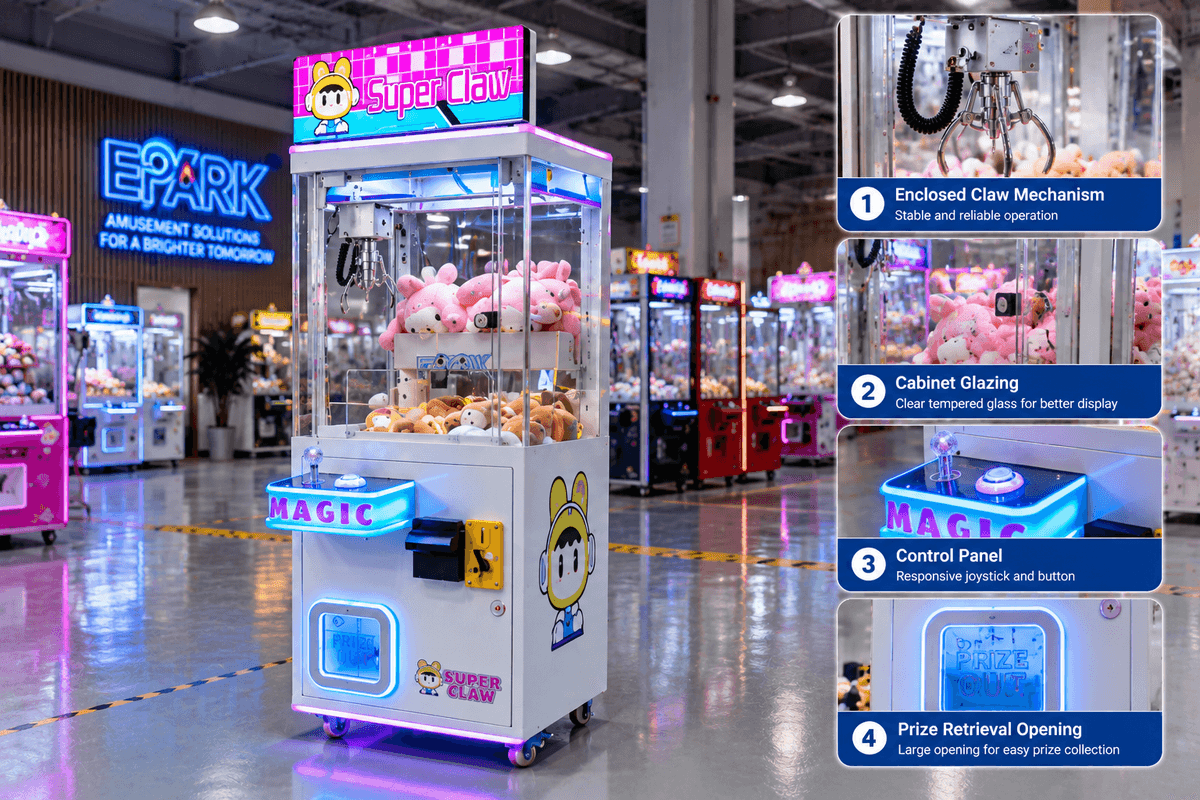
Claw Mechanism and Gantry Safety
The claw assembly typically moves along a gantry system using motors, cables, belts, or other drive components.
Mechanical hazards can arise from damaged moving parts, unexpected movement, or unauthorized access to the mechanism.
Operators should check for unusual noises, jerky movement, incomplete travel, damaged claw cables, and failed position sensors.
Do not operate equipment with exposed moving components or damaged protective barriers.
Glass Panels, Doors, and Prize Chutes
Transparent panels and cabinet doors should be appropriate for the equipment's design and commercial environment.
Inspect them for cracks, loose mounting hardware, and sharp or damaged edges.
Prize retrieval openings should allow the intended collection of prizes while limiting hazardous access to internal components.
Staff should never encourage users to reach into restricted mechanical areas to retrieve stuck prizes.
4. Safe Installation and Placement in Entertainment Venues
A well-designed machine can become hazardous if it is installed incorrectly or placed in an unsuitable location.
Installation should consider structural support, surrounding clearance, electrical access, customer movement, and the venue's emergency arrangements.
Choose a Stable and Suitable Surface
Install machines on a level, stable floor capable of supporting the equipment under expected operating conditions.
Follow manufacturer instructions for positioning, leveling, and anchoring where required.
After relocation, recheck stability and inspect power connections before resuming operation.
Keep Emergency Routes Clear
Claw machines should not block emergency exits, required escape routes, fire protection equipment, or accessible circulation paths.
A venue may need approval from building management or local authorities before making substantial layout changes.
The required clearance depends on local building and fire rules, not on a universal distance applicable to all arcade machines.
Protect Ventilation and Service Access
Allow sufficient space for any manufacturer-specified ventilation and maintenance access.
Avoid placing heat-producing equipment immediately against blocked vents or other installations that restrict airflow.
For larger arcades, consider both customer circulation and technician access when arranging rows of machines.
5. Prize Safety and Child Protection
The prizes inside claw machines are part of the customer experience, but they can also create safety concerns.
Appropriate prize selection is especially important in venues frequented by families with young children.
Choose Age-Appropriate Prizes
Select toys and merchandise that suit the intended users and meet applicable product requirements.
For U.S. markets, the Consumer Product Safety Commission's guidance on small parts explains restrictions involving products intended for children under three and choking hazards.
Prize buyers should verify relevant age labeling, product information, and documentation instead of assuming every plush toy or novelty item is suitable for all ages.
Inspect Prize Condition
Before stocking machines, check that prizes are clean, in acceptable condition, and free from obvious damage.
Pay particular attention to detachable accessories, exposed sharp components, loose batteries, or damaged packaging.
Remove prizes that present a suspected hazard.
Consider Prize Size and Weight
Prize dimensions and weight should be compatible with the machine's claw mechanism and prize chute.
Oversized or unusually heavy merchandise may cause jams, strain mechanical components, or interfere with prize retrieval.
Follow the machine supplier's specifications when choosing prizes and configuring the equipment.
6. Player Instructions, Warnings, and Accessibility
Clear communication helps customers use commercial claw machines correctly.
Instructions should be understandable to the venue's intended audience and available in appropriate languages where necessary.
Display Clear Operating Instructions
Provide simple directions explaining how to begin a game, use the controls, and retrieve a prize.
Operators should also display information about pricing, age recommendations where relevant, and how to request staff assistance.
Instructions should discourage climbing, shaking the cabinet, or attempting to access internal equipment.
Use Appropriate Safety Notices
Warnings should address actual hazards identified for the machine and venue.
Avoid relying on excessive warning labels to compensate for defects or missing protective measures.
Consider Different Users
Controls, display visibility, approach space, and machine placement influence whether customers can use the equipment comfortably.
Accessible route and operable-part requirements may apply depending on the venue, equipment category, and jurisdiction.
Review applicable accessibility rules and reasonable accommodation needs during venue planning, rather than after installation.
7. Staff Training and Emergency Safety Procedures
Staff members play a central role in maintaining machine safety.
Even reliable equipment can develop faults or be damaged by accidental impacts, unauthorized adjustments, or improper maintenance.
Train Employees to Recognize Hazards
Frontline employees should understand how to identify:
- Damaged plugs, cables, or electrical fittings
- Cracked panels or unstable cabinets
- Unusual mechanical noises or movement
- Prize retrieval problems
- Overheating, smoke, or burning odors
- Unauthorized access to service compartments
Staff should know when to stop a machine, whom to notify, and how to keep customers away from potentially unsafe equipment.
Use Safe Energy Isolation Procedures
Servicing moving or energized machinery can expose workers to electrical and mechanical hazards.
The U.S. Occupational Safety and Health Administration's hazardous-energy guidance explains the importance of controlling unexpected startup or release of stored energy during applicable servicing activities.
Maintenance staff should follow the machine's instructions, site procedures, and applicable legal requirements. Simply pressing the game-start or stop button is not necessarily a safe means of electrical isolation.
Prepare for Incidents
If a machine shows evidence of an immediate hazard, staff should stop public use, isolate the affected area, and follow the venue's emergency procedures.
Arrange qualified technical assistance and contact emergency services when the circumstances warrant it.
Document the problem, corrective work, and authorization to return the equipment to service.
8. Preventive Maintenance and Safety Inspections
Regular inspections can identify deterioration before it becomes a serious safety issue.
The precise schedule depends on the manufacturer's recommendations, the operating environment, and usage intensity.
The following table provides a practical starting point, not a universal statutory inspection frequency.
| Frequency | Recommended inspection | Responsible personnel |
|---|---|---|
| Daily | Exterior condition, glazing, controls, visible cords, normal game function | Trained venue staff |
| Weekly | Cabinet stability, access panels, prize chute, abnormal movement | Trained operator |
| Monthly | Accessible fasteners, moving components, wiring condition and wear indicators | Authorized technician |
| Quarterly | Review mechanical wear, electrical faults, maintenance history and risk controls | Qualified maintenance personnel |
| Annually or as required | Comprehensive safety assessment and review of continued service suitability | Appropriately qualified personnel |
Keep a Maintenance Log
Record each machine's identification, inspection dates, reported faults, replacement parts, and corrective actions.
A log helps operators recognize recurring problems and verify that faults have been addressed.
Stop Operation When Critical Faults Occur
Machines should be withdrawn from service when faults create unacceptable risks.
Examples include exposed energized parts, broken safety glazing, uncontrolled movement, severe cabinet instability, or unresolved overheating.
A machine should return to service only after the necessary repairs and checks are completed.
Use Compatible Replacement Components
Replacement motors, power supplies, sensors, and other parts should meet the machine's technical requirements.
Do not bypass safety features or install incompatible components simply to restore operation quickly.
9. Compliance Documents International Buyers Should Request
Commercial claw machines are often sourced internationally, making documentation particularly important.
A supplier should be able to clarify the technical specifications and relevant compliance evidence for the exact model and destination market.
| Document or information | Why it matters |
|---|---|
| Product identification and specifications | Confirms the supplied machine and configuration |
| Electrical ratings and installation instructions | Supports correct electrical installation |
| Operating and maintenance manual | Explains proper use and servicing |
| Applicable test reports | Provides evidence for specific technical requirements |
| Relevant certifications or declarations | Supports applicable market compliance checks |
| Spare-parts information | Supports repairs and long-term maintenance |
| Warranty and technical support terms | Clarifies responsibilities after delivery |
Do Not Rely on Certification Logos Alone
A certificate or badge shown on a supplier's general website does not automatically establish that every product model has the same certification status.
Ask for documentation identifying the relevant equipment, standard, issuing organization, and scope.
For EU products requiring CE marking, technical documentation and an EU Declaration of Conformity are important elements of the manufacturer's responsibilities.
Check Local Operating Requirements
Equipment compliance and venue operating permission are separate matters.
Depending on the jurisdiction, an operator may also need to consider business licenses, electrical inspections, fire safety, accessibility, consumer protection, and prize-game regulations.
A claw machine should not automatically be treated as an amusement ride or gambling device merely because it is located inside an entertainment center. Its legal classification must be checked under the rules of the destination market.
10. How to Evaluate a Claw Machine Manufacturer
Safety-related purchasing decisions begin before equipment arrives at the venue.
A good supplier evaluation should examine product construction, technical documentation, maintenance support, and the manufacturer's ability to explain configuration options.
Manufacturer Safety Evaluation Checklist
| Evaluation area | Key buyer question |
|---|---|
| Cabinet quality | Is the cabinet suitable for the intended commercial environment? |
| Electrical design | Are voltage, wiring, grounding, and protective features documented? |
| Mechanical design | Are moving components enclosed and accessible only as intended? |
| Prize compatibility | What size and weight limitations apply? |
| Compliance evidence | What documents are available for the exact model and market? |
| Testing | Which functional and safety-related checks are performed before shipment? |
| Installation support | Are setup and electrical installation instructions provided? |
| Spare parts | Are compatible replacement components available? |
| After-sales service | What technical guidance and warranty support can the supplier provide? |
A Manufacturer's Perspective: Why Early Planning Matters
From a supplier's perspective, safety-related problems are easier to address before the venue layout and product configurations are finalized.
Buyers should provide details about their target market, expected users, available voltage, operating environment, proposed machine location, and prize types.
A machine suitable for a supervised indoor arcade may not be appropriate for an outdoor installation or a location exposed to significant moisture.
During customized projects, it is also important to assess whether changes to cabinet dimensions, electrical components, lighting, or payment systems affect the required technical evaluation.
How EPARK Supports Commercial Claw Machine Projects
Guangzhou EPARK Electronic Technology Co., Ltd. is a commercial amusement equipment manufacturer based in Guangzhou, China.
With more than 13 years of industry experience and over 25,000 square meters of factory and showroom space, EPARK provides claw machines, prize machines, arcade equipment, and entertainment venue solutions.
EPARK's services include equipment manufacturing, OEM/ODM customization, venue planning, 3D design support, installation guidance, and after-sales technical assistance.
For international buyers, discussing electrical requirements, equipment configurations, available compliance documents, and ongoing maintenance needs early in the procurement process can help reduce avoidable project risks.
Explore EPARK's commercial claw machine options and confirm model-specific specifications and documentation with the supplier before ordering.
11. Frequently Asked Questions
Are commercial claw machines required to have safety certification?
Requirements depend on the machine's legal classification, destination market, and applicable regulations. Buyers should identify relevant standards and request documentation for the exact model. No single certification is universally required for every claw machine worldwide.
What electrical safety features should a claw machine have?
Appropriate electrical safety provisions may include protective earthing, suitable insulation, circuit protection, secured wiring, and proper enclosure design. The exact requirements depend on the machine and applicable standard.
Can claw machines be used outdoors?
Only when the specific model is designed and evaluated for the intended outdoor conditions. Most standard indoor arcade machines should not be assumed suitable for rain, moisture, or direct weather exposure.
How often should commercial claw machines be inspected?
Operators should conduct routine visual and functional checks and arrange more detailed inspections according to manufacturer instructions, usage, and local requirements. High-traffic venues may need more frequent maintenance.
Are claw machines safe for young children?
Commercial claw machines can be used in family-oriented venues when appropriately designed, installed, maintained, and operated. Age-appropriate prizes, suitable instructions, and supervision arrangements are important. No machine should be described as entirely risk-free.
Does CE marking mean a claw machine is safe worldwide?
No. CE marking indicates conformity with applicable EU product legislation requiring that mark. It does not automatically establish compliance with regulations in other countries.
What should operators do if a claw machine becomes unsafe?
Stop public use, restrict access to the machine, and arrange an appropriate inspection. Repair the underlying issue and complete relevant checks before returning the machine to operation.
What should I ask a claw machine supplier before buying?
Ask about electrical specifications, applicable standards, test evidence, installation instructions, maintenance manuals, spare parts, warranty terms, and technical support. Ensure that all documents correspond to the model and configuration being purchased.
12. Conclusion: Make Claw Machine Safety an Operating Priority
Claw machine safety is not limited to the equipment's initial construction. It depends on the combined efforts of manufacturers, installers, venue operators, and maintenance personnel.
Electrical protection, cabinet integrity, safe moving mechanisms, proper placement, age-appropriate prizes, clear operating instructions, and regular inspections all contribute to safer commercial operation.
For international buyers, understanding the relevant standards and verifying product-specific documentation is particularly important.
Before opening a new arcade or upgrading existing machines, assess the entire operating environment rather than focusing only on appearance, features, or purchase price.
EPARK offers commercial claw machine options, OEM/ODM customization, and arcade project support for different venue requirements.
Review our available claw machine models or contact EPARK to discuss equipment configurations, technical documentation, and project needs.
