
A claw machine can have attractive prizes, colorful lighting, and reliable gameplay, yet still receive fewer plays than expected. Sometimes, the problem is not the machine itself. It is where the machine stands.
A well-planned claw machine placement strategy helps arcade operators position machines where customers can easily notice them, approach them, and decide to play. The right location can also improve traffic flow, reduce congestion, and make better use of valuable floor space.
For arcade centers, family entertainment centers (FECs), shopping malls, and other commercial venues, placement is part of the overall operating strategy. High foot traffic alone does not guarantee more plays. Operators must also consider visibility, customer behavior, waiting areas, available space, and ease of access.
This guide explains how to evaluate potential locations, arrange multiple machines, avoid common layout mistakes, and measure whether a new position improves performance.
1. Why Claw Machine Placement Strategy Matters
Claw machines often attract players through their visual appearance. Bright cabinets, visible prizes, and simple controls make them easy for customers to understand without lengthy instructions.
However, a machine cannot attract much attention if it is hidden behind larger arcade equipment or located in a quiet corner that customers rarely visit.
An effective placement strategy supports three important stages of player engagement.
Visibility: Getting Noticed
Customers must first see the machine. A cabinet positioned along a natural walking route has more opportunities to attract attention than one facing a wall or blocked by other equipment.
Accessibility: Making It Easy to Play
After noticing a machine, a customer needs enough space to approach it, understand the controls, and begin playing.
If the machine is positioned in a narrow passage or surrounded by waiting customers, potential players may continue walking rather than stop.
Engagement: Encouraging Participation
People are often more interested in playing when they can clearly see the available prizes and observe the gameplay.
A comfortable viewing area can allow friends or family members to watch without interfering with other visitors.
These factors explain why machine placement should be considered during arcade planning rather than after the equipment arrives.
2. What Makes a High-Performing Claw Machine Location?
The best claw machine position combines traffic exposure with an environment where customers are willing and able to stop.
Before choosing a location, operators should evaluate five factors.
Foot Traffic and Customer Movement
Start by identifying where customers naturally walk.
Typical high-traffic areas include main arcade aisles, paths between popular attractions, and routes connecting entertainment and seating zones.
However, traffic quality matters as much as traffic volume. A busy corridor filled with people rushing toward an exit may generate fewer plays than a quieter area where visitors are relaxed.
Observe whether people merely pass through or regularly stop to look around.
Customer Dwell Time
Dwell time is the amount of time visitors spend in a particular area.
Customers waiting for friends, restaurant seating, or another attraction may be more receptive to short entertainment activities.
Claw machines work particularly well as optional activities because a single play generally requires little time or preparation.
Audience Compatibility
The ideal position depends on the people visiting the venue.
For example, family-oriented prize machines may fit naturally near children's entertainment areas. Machines displaying collectible merchandise may be more relevant near attractions popular with teenagers or young adults.
The goal is to match the machine's appeal with the audience already using that space.
Visibility and Stopping Space
Check whether customers can see the machine from several approaching directions.
Also consider what happens when someone stops to play. Players and spectators need room without forcing passing visitors into a crowded aisle.
Operational Convenience
An attractive location should also be practical for daily operation.
Operators need access to electrical connections, payment systems, prize compartments, cleaning areas, and maintenance panels.
A difficult-to-service location may increase operating interruptions.
A Simple Location Scoring Method
The following example helps operators compare candidate positions before installation.
| Evaluation factor | Suggested weight | What to assess |
|---|---|---|
| Visibility | 25% | Can visitors easily see the cabinet? |
| Qualified foot traffic and dwell time | 25% | Do potential players pass and stop nearby? |
| Player space and accessibility | 20% | Can people play without blocking others? |
| Audience compatibility | 15% | Does the location attract suitable customers? |
| Installation and service access | 15% | Is operation and maintenance practical? |
Rate each factor from 1 to 5, multiply by its assigned weight, and divide by 5. The combined score has a maximum of 100.
These weights are an illustrative planning tool, not an industry standard. Safety and accessibility requirements must be satisfied regardless of the score.
3. Best Places to Position Claw Machines Inside an Arcade
Different arcade areas create different opportunities for player engagement.
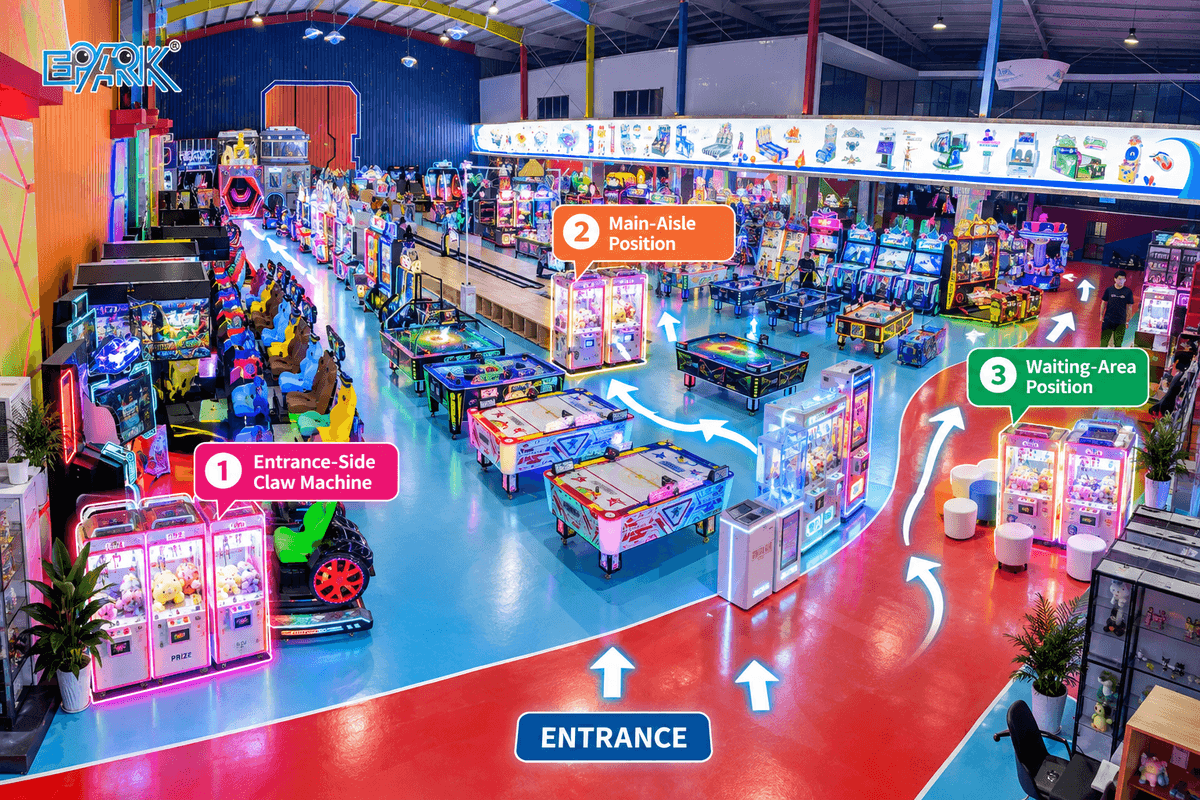
Near the Entrance, but Not in the Doorway
The entrance is often one of the first places customers look when entering an entertainment venue.
A visually attractive claw machine positioned within the entrance sightline can introduce visitors to the arcade's prize games immediately.
However, the highest-traffic point is not always the best installation spot.
Avoid placing cabinets directly in front of entrance doors, security equipment, or essential walking paths. A better option is often a visible position to one side, where visitors can stop comfortably.
Along Main Walking Routes
Main aisles connect the most frequently visited attractions.
Placing machines beside these routes allows customers to discover them while moving between activities.
For example, a claw machine positioned between a racing game area and a ticket redemption zone may attract people traveling in both directions.
The cabinet should face the approaching audience while leaving adequate circulation space.
Near Waiting and Rest Areas
Waiting areas can create natural opportunities for short gaming sessions.
Parents waiting for children, friends watching other activities, and customers taking breaks may be interested in a simple prize game.
However, machines should not interfere with seating, strollers, or queues.
Beside Complementary Arcade Games
Claw machines can also be positioned near other prize-based entertainment.
A grouping of claw machines, capsule toy machines, and ticket redemption games creates a recognizable prize-game area.
Customers interested in one type of game may notice another nearby.
Near the Exit Route, Without Blocking It
A visible machine along the normal customer departure route may encourage one final play before visitors leave.
This position can be useful when customers still have unused game credits or time available.
Keep machines away from exit doors and required emergency exit routes. A final-play opportunity should never create a safety obstruction.
4. Claw Machine Placement Across Different Venue Types
A successful placement strategy should reflect the way customers use each entertainment environment.
The same cabinet may perform differently in a shopping mall, restaurant, or dedicated arcade because visitors have different expectations and available time.
| Venue type | Recommended placement area | Main consideration |
|---|---|---|
| Arcade center | Entrance sightlines and main gaming routes | Visibility and cross-play opportunities |
| Family entertainment center | Between family attractions and nearby waiting areas | Parent supervision and player comfort |
| Shopping mall | Approved entertainment zones near leisure-oriented traffic | Suitable dwell time and landlord rules |
| Cinema or bowling center | Lobby or lounge areas away from queues | Activity before or after the main visit |
| Restaurant | Approved family waiting area | Avoid interference with dining operations |
| Hotel or resort | Supervised recreation or family lounge area | Guest convenience and noise control |
FECs generally contain several types of attractions, making visitor movement especially important.
Claw machines can provide a short activity between longer experiences, such as bowling, racing simulations, or indoor playground sessions.
Operators should prioritize visibility from family circulation areas while leaving adequate room for supervising adults.
Shopping Malls
Shopping mall placement requires careful evaluation of customer behavior.
An open corridor may have substantial foot traffic, but visitors may not have the time or interest to stop.
An approved entertainment zone close to family-oriented retail or leisure activities may offer a better environment.
Operators also need to confirm landlord permissions, electrical access, permitted operating hours, and installation restrictions.
Cinemas and Bowling Centers
Customers in these locations often experience waiting periods.
A claw machine may offer entertainment before a movie or between bowling activities.
The equipment should remain outside ticket lines, concession queues, and primary walking routes.
Restaurants and Hotels
For restaurants and hotels, the machine should complement the main business rather than interrupt it.
Compact models may be appropriate where floor space is limited, while larger cabinets may work in dedicated recreation areas.
Operators should also consider noise levels, supervision, and how frequently customers use the space.
5. How to Design an Effective Claw Machine Zone
When several claw machines are installed together, their arrangement influences visibility, player movement, and the overall appearance of the entertainment area.
A well-organized zone can make multiple machines feel like one coordinated attraction.
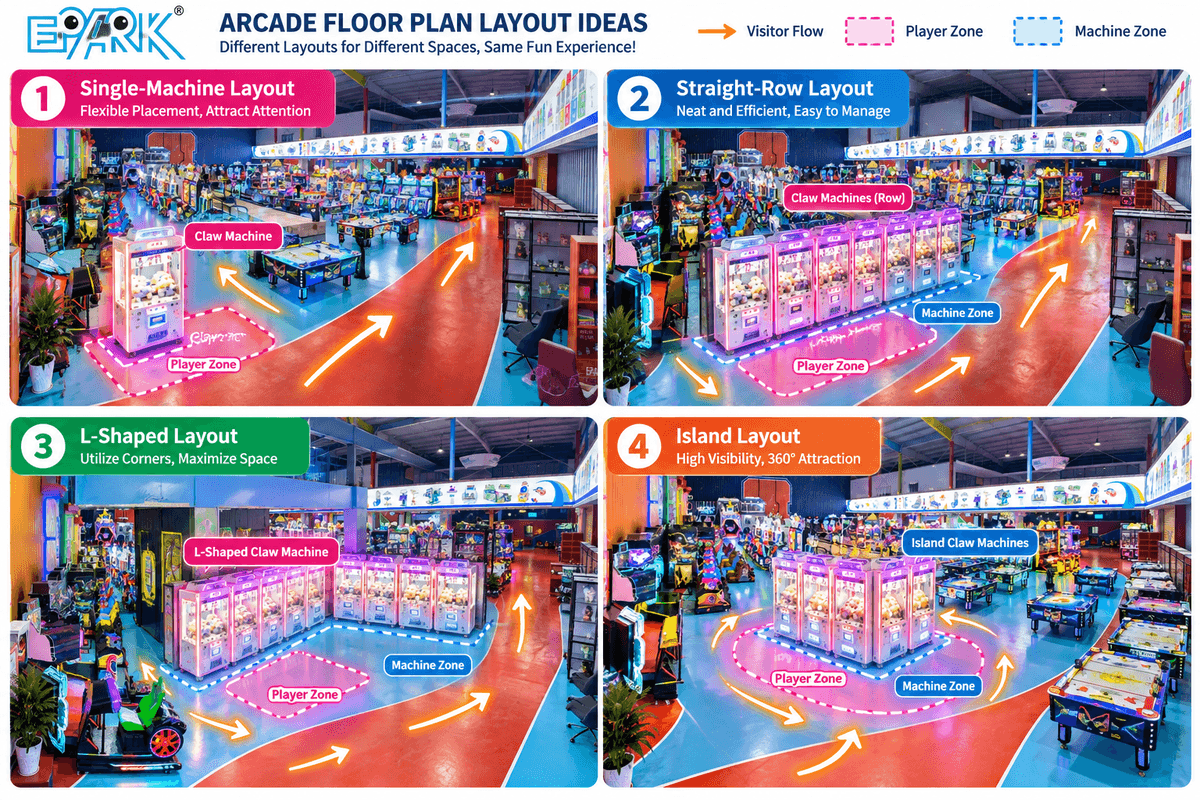
Single-Machine Placement
A single cabinet offers flexibility.
It may be suitable for a small arcade, a restaurant waiting area, or a location where floor space is limited.
The priority is to maintain a clear view of the prize compartment and sufficient room in front of the controls.
Linear or Side-by-Side Layout
A straight row is a practical arrangement for multiple cabinets.
It works particularly well along suitable walls or dedicated entertainment sections.
Machines can share a consistent visual theme while offering different prize categories.
However, operators should avoid extending the row into an essential circulation path.
L-Shaped Layout
An L-shaped arrangement can make use of a corner while giving customers two viewing directions.
This format may be useful where the venue has a clearly defined entertainment section.
The corner should remain spacious enough for players and spectators to move without crowding.
Island Layout
An island layout positions cabinets in a more open area, potentially allowing visibility from several sides.
This can create a focal point inside a larger arcade.
However, island layouts require careful planning for player circulation, power connections, cleaning, and maintenance access.
Choose Variety Without Creating Confusion
A practical layout might combine standard plush-toy claw machines with a different style of gift game.
The objective is not to install the greatest number of cabinets in the smallest area. It is to give each machine enough visibility and usability to attract players.
6. Improve Visibility and Player Comfort
Good positioning does more than place equipment in front of visitors. It also makes the machine appealing and easy to use.
Orient the Cabinet Toward Approaching Customers
The machine's primary display and controls should face a direction where potential players naturally approach.
Avoid placing the main viewing window against a wall or behind another large cabinet.
Transparent prize compartments can help customers recognize the available rewards before reaching the machine.
Use Lighting Carefully
Cabinet lighting should make the prizes easy to see.
Excessive lighting, however, may produce reflections on the glass or create visual discomfort.
Check the cabinet under the venue's actual daytime and evening lighting conditions.
Keep Information Easy to Read
Customers should be able to understand the basic game price, payment method, and instructions without searching for staff assistance.
Clear information reduces uncertainty, especially for first-time players.
Allow Comfortable Viewing and Playing Space
Some players arrive with friends or family members who want to watch.
Provide space for these companions without allowing spectators to obstruct nearby games.
The position should also support practical interaction with the controls for the expected user group.
7. Safety, Accessibility, and Installation Requirements
Increasing play opportunities should never come at the expense of safety or accessibility.
Machine dimensions alone are not enough to determine whether a location is suitable.
Protect Accessible Walking Routes
In the United States, the ADA Accessibility Standards generally require a minimum clear width of 36 inches (915 mm) for accessible walking surfaces, with additional conditions and exceptions for certain configurations.
The U.S. Access Board's accessible route guidance explains these requirements in greater detail.
This measurement should not be treated as a universal recommendation for every arcade aisle. Actual circulation and maneuvering requirements depend on the venue, applicable standards, and local rules.
Operators should also consider clear floor space at applicable accessible controls.
Keep Emergency Exits Clear
Machines must not obstruct emergency exits or required exit routes.
The OSHA requirements for exit routes state that exit routes in covered workplaces must remain free and unobstructed.
Operators must also follow the fire, building, and occupancy requirements applicable to their location.
Plan Power Connections and Maintenance Space
Before installing a machine, verify the cabinet's electrical requirements, available power supply, plug type, and installation conditions.
Avoid exposed cables across customer walking paths.
Sufficient service clearance is also important. Staff may need to open access panels, replenish prizes, inspect payment components, or perform repairs.
For international projects, equipment specifications should be confirmed against the destination country's power standards.
8. How to Measure and Test Placement Performance
Even a well-designed floor plan involves assumptions about customer behavior.
Instead of relying entirely on visual judgment, operators can test locations and compare results.
Step 1: Record a Baseline
Before moving the machine, record its performance over a representative period.
Useful measurements include:
- Total plays and machine operating hours.
- Gross revenue and revenue per operating hour.
- Approximate passing traffic near the machine.
- Number of customers who stop or interact.
- Downtime, prize replenishment, and service incidents.
Where available, machine counters and venue management systems can provide useful operating data.
Step 2: Test One Placement Change
Move the machine to another suitable position while keeping other important factors as consistent as possible.
Avoid changing the game price, prize assortment, and machine position simultaneously.
Otherwise, it becomes difficult to determine which change influenced the result.
Step 3: Run a 14-Day Comparison
A simple initial test can compare two seven-day periods.
|
Test period |
Position |
Passing visitors |
Recorded plays |
Plays per 100 passers |
|---|---|---|---|---|
| Days 1–7 | Original corner position | 1,200 | 48 | 4.0 |
| Days 8–14 | Visible side-of-aisle position | 1,000 | 60 | 6.0 |
Illustrative example only; these are not actual EPARK customer results.
The calculation is:
Plays per 100 passers = (Total plays ÷ Passing visitors) × 100
In this example, the second position generates 50% more plays per 100 passers.
This is a measure of play activity relative to passing traffic, not a unique-person conversion rate, because one visitor may play more than once.
Step 4: Check Other Influences
A short test does not prove that placement alone caused a change.
School holidays, promotions, special events, weather, and differences between weekends may influence customer activity.
If possible, repeat the test, compare similar operating days, or test both positions over multiple weeks.
Step 5: Evaluate the Full Operating Result
More plays are valuable, but they should be considered alongside gross revenue, prize costs, venue fees, downtime, and staff effort.
A more visible position may increase activity while also creating additional service or rental requirements.
The best placement is one that supports sustainable operating performance.
9. Common Claw Machine Placement Mistakes
Some layout problems appear minor during installation but become more noticeable after customers begin using the venue.
Mistake 1: Choosing Traffic Volume Alone
A crowded passage may appear attractive, but visitors might be unwilling or unable to stop.
Better approach: Consider traffic quality, dwell time, and player space together.
Mistake 2: Hiding Machines Behind Larger Attractions
Tall racing cabinets, displays, or structural columns can block sightlines.
Better approach: Check visibility from actual customer walking routes before finalizing the layout.
Mistake 3: Installing Too Many Machines Together
Closely packed cabinets may create crowding and limit access to individual games.
Better approach: Plan standing, viewing, circulation, and maintenance space before selecting the final machine count.
Mistake 4: Ignoring Operating Requirements
A location may look attractive but lack suitable electrical connections or maintenance access.
Better approach: Review installation requirements with the supplier before delivery.
Mistake 5: Never Reassessing the Layout
Visitor behavior can change when new attractions are installed or customer traffic patterns shift.
Better approach: Review performance regularly and test alternative positions when the data suggests a problem.
10. A Supplier's Perspective on Arcade Layout Planning
For commercial entertainment projects, claw machine placement is closely connected to equipment selection and overall venue planning.
From a supplier's perspective, an important issue is the relationship between cabinet dimensions, player behavior, and the available floor area.
A machine that fits physically into a space may still be unsuitable if it restricts circulation, prevents access to another attraction, or leaves insufficient room for players.
Start With the Floor Plan, Not Just the Machine Count
For a compact entertainment venue, adding more cabinets may seem like an easy way to increase earning opportunities.
However, every machine requires operational space beyond its physical footprint.
A practical planning process begins by identifying the entrance, customer pathways, major attractions, seating areas, available power connections, and fixed structural obstacles.
Only then should operators decide how many machines to install and where each model belongs.
How EPARK Supports Commercial Arcade Planning
Guangzhou EPARK Electronic Technology Co., Ltd. is a manufacturer of commercial arcade machines and indoor entertainment equipment, with more than 13 years of industry experience and over 25,000 square meters of factory and showroom space.
In addition to claw machines and gift games, EPARK supplies other entertainment equipment for arcades and FECs.
Its services include equipment selection, venue layout planning, 3D design, OEM/ODM customization, and technical support.
For buyers developing a new arcade or upgrading an existing entertainment area, these services can help coordinate machine dimensions, equipment combinations, appearance, and installation requirements before the machines are produced or shipped.
EPARK also supports customization of cabinet appearance, colors, logos, lighting, and compatible payment configurations, subject to the selected machine model.
Buyers can explore commercial arcade equipment options when planning their machine combination.
Information to Prepare Before Requesting a Layout
A useful layout consultation should begin with accurate project information.
Operators can prepare the following details:
- A floor plan with dimensions, entrances, and fixed obstacles.
- The available area for claw machines and related games.
- Expected customer groups and peak visiting periods.
- Preferred machine styles and approximate quantities.
- Local electrical standards and installation restrictions.
- Existing attractions, seating areas, and customer pathways.
Providing these details makes it easier to compare several feasible arrangements instead of relying on a generic floor plan.
A preliminary 3D layout can help the buyer visualize how the arcade may look, but the final installation should still be checked against actual site conditions and applicable safety requirements.
11. Frequently Asked Questions
Where is the best place to put a claw machine in an arcade?
A visible position near a main customer route is often a good starting point. Entrance-side locations, prize-game areas, and suitable waiting zones are worth testing. The best location must also offer enough space for players and safe circulation.
Should claw machines be placed near the entrance or exit?
Both can work. Entrance-side machines provide early visibility, while machines near the normal departure path may attract customers before they leave. Neither should obstruct doors, emergency routes, or customer circulation.
Is it better to group claw machines together or spread them out?
Grouping machines can create a recognizable prize-game area and simplify supervision. Spreading machines across suitable locations may reach different customer groups. The better choice depends on venue size, traffic patterns, and available service space.
How much space does a commercial claw machine need?
Required space depends on the cabinet dimensions, control position, door opening direction, player standing area, and applicable accessibility rules. Operators should request exact equipment dimensions and prepare a scaled layout before installation.
Can a claw machine perform well in a quiet location?
Yes, if the location attracts suitable customers who spend time nearby. For example, a family waiting area may offer better engagement opportunities than a busier passage where customers rarely stop.
How do you increase claw machine plays without buying more machines?
Start by reviewing visibility, ease of access, prize presentation, payment convenience, and machine availability. Then test changes systematically and measure play activity. Improving placement can be a lower-cost option than expanding equipment quantity.
How often should operators change machine placement?
There is no universal schedule. Operators should review location performance when traffic patterns change, new attractions are installed, or play activity falls. Moving machines should be based on observations and data rather than frequent rearrangement without a clear purpose.
Can a claw machine supplier help design an arcade layout?
Some commercial equipment manufacturers offer site planning, machine selection, and 3D layout services. EPARK provides these services as part of its broader arcade and family entertainment center project support. Buyers should share their site dimensions and operating requirements before requesting a proposed layout.
12. Conclusion: Turn Better Placement Into More Plays
A successful claw machine placement strategy starts with understanding how people move, where they stop, and what encourages them to interact with an arcade game.
The strongest locations combine visibility, suitable customer traffic, comfortable playing space, and practical access for daily operation.
Operators should evaluate several positions rather than assuming the busiest part of a venue will automatically deliver the best results. A clear layout, careful installation, and regular performance testing can help make better use of existing equipment.
For businesses planning a new claw machine area, equipment selection and floor planning should be considered together.
EPARK provides commercial claw machines, customization options, and arcade layout planning support for different entertainment projects.
To discuss a proposed venue, share your floor plan, target audience, and equipment requirements with the EPARK project planning team to explore suitable machine configurations and layout options.
